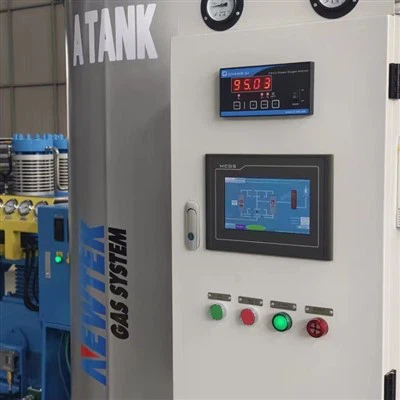
With the expansion of hospital scale and the increase of patients in recent years, oxygen supply by cylinders is no longer suitable for the development needs of medium and large hospitals. Medical oxygen supply technology has also developed from oxygen supply by cylinders in wards to centralized oxygen supply by bus. The molecular sieve oxygen production method uses air as raw material to produce oxygen on site, effectively avoiding the risks of oxygen quality, quantity and time caused by purchasing oxygen from cylinders. Therefore, in recent years, more and more central oxygen supply systems of large and medium-sized hospitals have adopted medical oxygen generator plants, which not only realizes the autonomy of oxygen production and supply in hospitals, but also becomes one of the hardware symbols of hospital modernization.
Main structure of medical oxygen gas plant
1. Air compression system
The function of the air compression system is to inhale and filter air for compression and storage, provide clean air for the oxygen production system and provide partial pressure. The general structure consists of air filter, air compressor and air storage tank.
The inhaled air is generally filtered at multiple stages before being pressurized by the air compressor, and the pressurized air enters the air storage tank. In this part, due to the large amount of air inhaled, the filter part is easily filled with impurities in the air, causing blockage, resulting in failure of the air intake part, and thus making the whole machine inoperative. In the actual application process, the filter part is often not maintained and cleaned in time, resulting in shutdown. In addition, since the air compressor works for a long time, its maintenance is also very important. The lubricating oil should be replaced frequently to prevent the machine head from being damaged due to severe friction.
2. Cold drying system
The key part of the PSA oxygen generator is the molecular sieve, and the molecular sieve has high requirements for the humidity of the air. If the humidity is too high, the molecular sieve will adsorb too much moisture in the air, and its separation and adsorption of oxygen and nitrogen will quickly fail. Therefore, the cold drying system is also an indispensable and important part of the oxygen generator.
The cold drying system cools and condenses the moisture mixed in the compressed air, and then discharges it. The compressed air after cold drying enters the oxygen production part. At present, the cold drying part of the mainstream oxygen generator is cooled by refrigerant. Through the heat exchanger and evaporator, the moisture in the compressed air is condensed and discharged.
The moist compressed air first enters the heat exchanger for preliminary cooling, and then passes through the evaporator to further absorb the heat in the air through the evaporation of the refrigerant. The compressed air is cooled again, and the moisture and oil in it are condensed. The cooled compressed air passes through the water separator to separate the condensed moisture and oil from the air. The cold-dried compressed air flows through the heat exchanger to cool the compressed air input by the air compressor system and outputs it to the oxygen production system.
3. Oxygen production system
The oxygen production system is the core part of the oxygen generator. It is in this part that the air can be converted into oxygen with a purity of more than 90% to provide to the patient. Its main part is the adsorption tower, and it also includes a pressure pump, an oxygen buffer tank, some multi-way rotary distribution valves and other accessories. Most oxygen generators are equipped with 2 adsorption towers for cyclic operation. The compressed air sent by the cold drying system flows through the adsorption tower, and the adsorption tower adsorbs nitrogen, so the output becomes high-purity oxygen. After being pressurized by the pressure pump, oxygen can be directly supplied to the patient through the oxygen buffer tank.
At present, most oxygen generators use zeolite molecular sieves that can preferentially adsorb nitrogen. In addition, the adsorption tower is also equipped with a desiccant that further dehumidifies and removes carbon dioxide. The air after cold drying enters the adsorption tower, and the nitrogen, carbon dioxide and very little in the air are discharged. After decompression, the molecular sieve's adsorption capacity for nitrogen is reduced, and the adsorbed nitrogen is discharged. The molecular sieve after nitrogen discharge can adsorb nitrogen again after pressurization. The two adsorption towers alternately repeat the process of pressurizing nitrogen absorption/decompressing nitrogen discharge, and the required oxygen is continuously produced.
4. Control system
The control system mainly controls the working sequence of each component, and controls the working procedures of components such as air compressors, booster pumps, and cold dryers according to the working pressure thresholds of each part; in addition, it also provides I/O control of the user interface, alarm and error information, etc., which belongs to the general electrical part and is no different from other electrical appliances.
Hot Tags: medical oxygen generator plant, China medical oxygen generator plant manufacturers, suppliers, oxygen refilling plant, oxygen concentrator plant for hospital, PSA Oxygen Plant for Hospital, medical oxygene production plant, oxygen concentrator plant, medical oxygen generator