

Product description
Nitrogen generation plant is an efficient and convenient equipment specially designed for on-site production of high-purity nitrogen. It is widely used in many industrial fields such as electronic manufacturing, chemical industry, food packaging, medicine and metal processing. This device usually adopts advanced pressure swing adsorption (PSA) technology. Its core principle is to extract nitrogen efficiently by separating air to remove oxygen, carbon dioxide and other impurities. Compared with the traditional nitrogen supply method, nitrogen production plant provides a more flexible and economical solution. Users do not need to rely on external nitrogen suppliers and can obtain the required nitrogen at any time according to their own production needs.
Working principle and process flow of nitrogen generation of this product
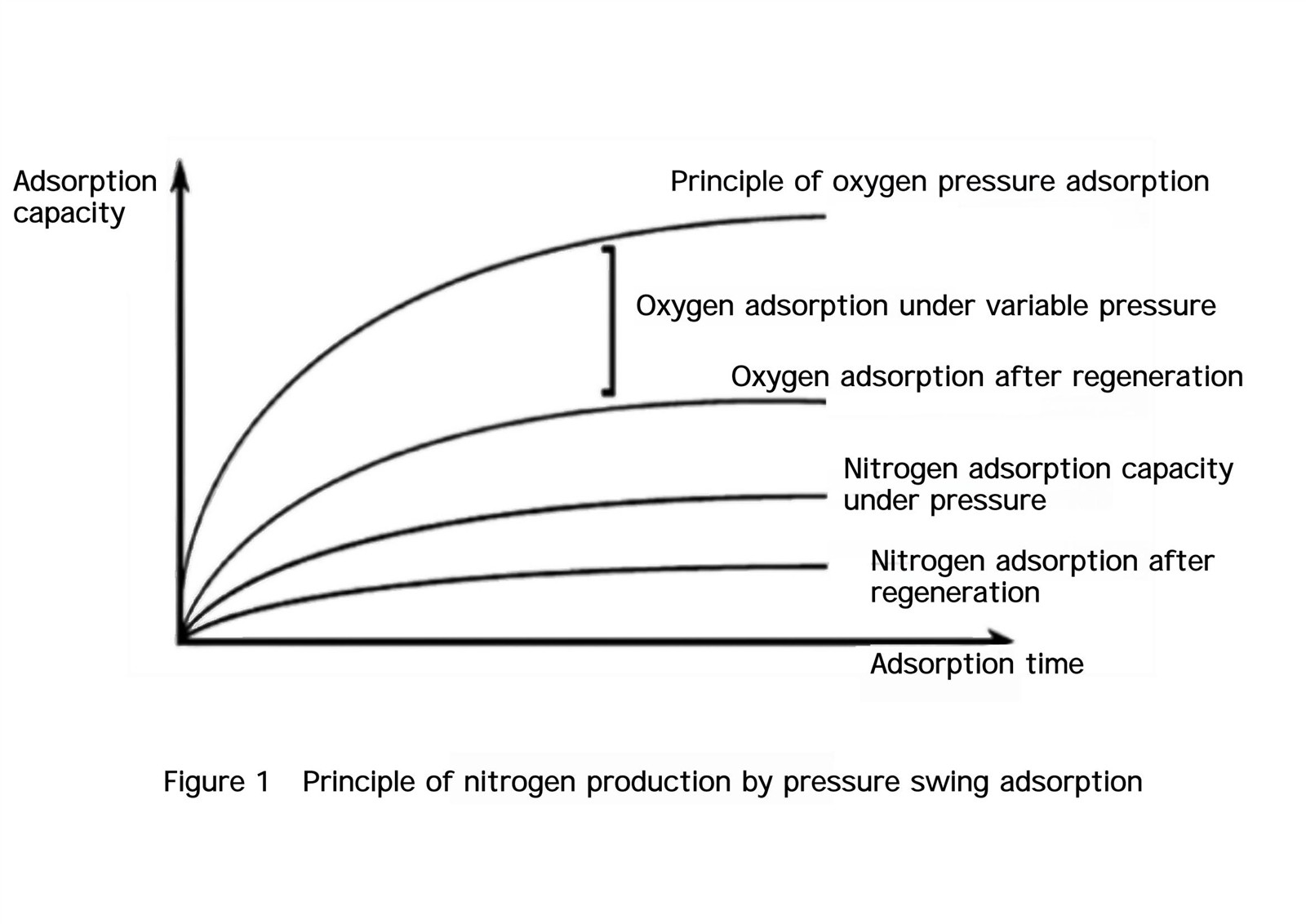
The basic principle of PSA nitrogen generation technology is as follows: using carbon molecular sieve as adsorbent, any adsorbent adsorbs the same gas. The higher the gas pressure, the greater the adsorption capacity of the adsorbent. Conversely, the lower the pressure, the smaller the adsorption capacity3, as shown in Figure 1.
As mentioned above, when the air pressure increases, the carbon molecular sieve will adsorb a large amount of impurity gases such as oxygen and carbon dioxide. When the pressure drops to normal pressure, the amount of impurity gases such as oxygen and carbon dioxide adsorbed by it is very small4, thus analyzing the carbon molecular sieve. When the nitrogen purity requirement is 99.999 5%, conventional nitrogen generators are difficult to meet the requirement, and the nitrogen produced by the nitrogen generator must be further purified. The nitrogen production system adopts a carbon-supported purification method, and its working principle is as follows: 99.9% nitrogen obtained by the PSA nitrogen generator is used as the raw gas. At this time, the main impurities in the nitrogen are water vapor and oxygen. After the raw gas enters the carbon-supported purifier, oxygen undergoes an oxidation-reduction reaction with carbon under the catalytic action of the deoxygenation catalyst to produce carbon dioxide. After cooling and drying, high-purity nitrogen is obtained.
After being compressed by the air compressor and the air pressure reaches 0.8MPa, it enters the SLAD-30NF cold dryer to remove a large amount of moisture in the air, and then passes through a precision filter for further dust and oil removal, and enters the KCG-3/10 air buffer tank for pressure stabilization, which serves as the raw gas for the PSA nitrogen generator. The pretreated air enters the adsorption tower equipped with molecular sieves, and completes the adsorption, pressure equalization, analysis, flushing, and inflation processes in sequence, and then continuously produces nitrogen. The PSA nitrogen production process flow can be seen in Figure 2.

-
![Nitrogen Production Plant]() Nitrogen Production PlantA nitrogen production plant is a machine that extracts nitrogen from the ambient air. By separating nitrogen molecules from oxygen and other components, the nitrogen production plant produces highly-pure nitrogen gas suitable for yourread more
Nitrogen Production PlantA nitrogen production plant is a machine that extracts nitrogen from the ambient air. By separating nitrogen molecules from oxygen and other components, the nitrogen production plant produces highly-pure nitrogen gas suitable for yourread more -
![Small Nitrogen Plant]() Small Nitrogen PlantSmall nitrogen plants are compact nitrogen generators that can produce and supply high-purity nitrogen gas at low flow rates for a variety of work and emergency applications.read more
Small Nitrogen PlantSmall nitrogen plants are compact nitrogen generators that can produce and supply high-purity nitrogen gas at low flow rates for a variety of work and emergency applications.read more -
![Nitrogen Production Plant]() Nitrogen Production PlantIn view of the current situation that the purity of carbon molecular sieve nitrogen generator is not enough to meet the market demand, we independently developed a pressure swing adsorption carbon molecular sieve nitrogen generator with aread more
Nitrogen Production PlantIn view of the current situation that the purity of carbon molecular sieve nitrogen generator is not enough to meet the market demand, we independently developed a pressure swing adsorption carbon molecular sieve nitrogen generator with aread more -
![Molecular Sieve Nitrogen Generator]() Molecular Sieve Nitrogen GeneratorCarbon molecular sieves and zeolite molecular sieves are widely used in the field of nitrogen and oxygen production. The separation effect of molecular sieves on oxygen and nitrogen is mainly based on the different diffusion rates of theread more
Molecular Sieve Nitrogen GeneratorCarbon molecular sieves and zeolite molecular sieves are widely used in the field of nitrogen and oxygen production. The separation effect of molecular sieves on oxygen and nitrogen is mainly based on the different diffusion rates of theread more -
![Small Nitrogen Plant]() Small Nitrogen PlantPSA nitrogen production uses air as raw material and carbon molecular sieve as adsorbent. It uses the principle of pressure swing adsorption to make the carbon molecular sieve full of micropores selectively adsorb gas molecules, andread more
Small Nitrogen PlantPSA nitrogen production uses air as raw material and carbon molecular sieve as adsorbent. It uses the principle of pressure swing adsorption to make the carbon molecular sieve full of micropores selectively adsorb gas molecules, andread more


Product Features and Advantages
High degree of automation
PSA nitrogen production equipment is equipped with an advanced automatic control system, which can realize fully automatic operation. The operator only needs to set the relevant parameters, and the system can automatically start, monitor and adjust the operating status. This highly automated design greatly simplifies the operation process, reduces the need for human intervention, and reduces the workload of operators. The automatic control system has a real-time monitoring function, which can continuously monitor the operating status and production parameters of the equipment. Once an abnormal situation is found, the system can automatically adjust or issue an alarm signal to promptly notify the operator to handle it.
In addition, the automation system also has self-diagnosis and self-maintenance functions, which can regularly self-check the status of the equipment and automatically take preventive measures when potential problems are found to extend the service life of the equipment. The increase in the degree of automation not only improves production efficiency, but also effectively reduces failures and downtime caused by human operating errors, ensuring the continuity and stability of nitrogen production. For enterprises, this means higher production safety and reliability, while also reducing production costs and maintenance costs.
Simple process flow
The process flow of PSA nitrogen production technology is relatively simple, mainly including the following key steps: air compression, cooling, adsorption, separation and regeneration. First, the air is pressurized by the compressor to increase its density and enter a high-pressure state. The pressurized air is sent to the cooler for cooling. During this process, the moisture and some impurities in the air will be separated by condensation, forming a liquid and discharged from the system.
Next, the cooled air enters the adsorption tower, which is filled with adsorbents such as carbon molecular sieves. These adsorbents can selectively adsorb impurity molecules such as oxygen and carbon dioxide in the air, while allowing nitrogen to pass through. Specifically, under high pressure, the adsorbent will adsorb oxygen and other impurities. When the system is depressurized, the adsorbent will release these adsorbed substances, thereby completing the regeneration process of the adsorbent. Through this cyclic operation of adsorption and desorption, oxygen and impurities in the air are effectively removed, and what remains is high-purity nitrogen.
This simple and efficient physical adsorption and desorption process makes PSA nitrogen production technology unnecessary for complex chemical reactions or expensive chemicals, greatly simplifying the entire process. This not only reduces the complexity of the equipment, making it easier to design, manufacture and install, but also improves the maintainability of the system. The simplified design of the equipment means fewer moving parts and failure points, thereby reducing maintenance workload and costs.
Small footprint
The design of the PSA nitrogen generator adopts a compact layout and a small overall structure, which greatly reduces the required floor space. This feature makes it particularly suitable for installation and use in production environments with limited space. Many industrial enterprises face the problem of space constraints, especially in modern production facilities, where it is particularly important to make rational use of every inch of space. The compact design of the PSA nitrogen generator system can effectively adapt to these space constraints, saving valuable plant area for enterprises.
Compared with traditional nitrogen generators, the PSA system is more flexible in design and does not require complex infrastructure or large auxiliary equipment. Traditional nitrogen generator technology often requires more space to install multiple components such as compressors, coolers and separation devices, while the PSA system integrates these functions together, reducing the need for additional space. This integrated design not only saves space, but also reduces the overall construction and installation costs of the equipment, further improving the return on investment.
Application areas of nitrogen generation plant
In the oil and gas industry, the application of nitrogen is crucial, especially in drilling operations and oil well maintenance. As an inert gas, nitrogen can effectively improve the safety of the wellhead and prevent potential safety hazards. One of its main functions is to reduce the pressure in the well, help control the flow of oil and gas, and reduce the risk of blowout. Blowout is a sudden and dangerous phenomenon that may cause a large amount of oil and gas to be ejected rapidly, causing serious safety accidents and environmental pollution. The use of nitrogen can effectively reduce this risk.
During the drilling process, nitrogen can also be used as a driving agent to help push oil and gas to the ground. By injecting nitrogen into the well, a high-pressure environment can be formed to promote the flow of oil and gas, thereby increasing the recovery rate. This technology not only improves the efficiency of resource development, but also reduces the dependence on water and other liquids during the operation process and reduces the environmental impact.
In addition, nitrogen also plays an important role in the maintenance and repair of oil wells. When performing wellhead operations, the use of nitrogen can remove impurities in the well, reduce the risk of corrosion, and extend the service life of equipment. In some cases, nitrogen can also be used for decompression operations to ensure the safety of wellhead equipment and operators.
In laboratories and research institutions, nitrogen is widely used, mainly for sample protection and creating an inert environment. The inert properties of this gas make it an ideal choice for protecting experimental materials and chemical reactions. Nitrogen can effectively prevent samples from reacting with oxygen and moisture in the air, thereby reducing the risk of sample oxidation, decomposition or contamination. For example, in chemical synthesis and analysis, many reactions are extremely sensitive to oxygen and moisture. The use of nitrogen can create a stable inert atmosphere to ensure the smooth progress of the reaction.
In addition, nitrogen also plays an important role in analytical techniques such as gas chromatography and liquid chromatography. In these analytical processes, nitrogen is not only used for sample injection and transportation, but also as a carrier gas to improve separation effects and analytical accuracy. Laboratories usually require high-purity nitrogen to ensure the accuracy and reliability of analytical results. By using nitrogen, researchers can eliminate errors caused by environmental factors and more accurately measure and analyze the properties of compounds.
In biomedical research, nitrogen is also used for cryopreservation of cell and tissue samples. During the freezing process of samples, nitrogen can prevent the formation of ice crystals, protect the cell structure, and ensure that the samples remain active and intact during long-term storage. In addition, nitrogen is also used for the maintenance and protection of various instruments. For example, in high-temperature furnaces, vacuum equipment and reactors, the use of nitrogen can prevent oxidation and corrosion within the equipment and extend the service life of the equipment.
In the food and beverage industry, the application of nitrogen is very extensive and important, mainly used for packaging and preservation to extend the shelf life of products. As an inert gas, nitrogen can effectively replace oxygen in the packaging to prevent oxidation reactions. The presence of oxygen can cause changes in the flavor, color and texture of food, and may even promote the growth of microorganisms, thereby shortening the shelf life of food. In particular, the protective effect of nitrogen is particularly significant in perishable products such as meat, dairy products and dried fruits.
In meat packaging, nitrogen can help prevent oxidation and maintain the red appearance of meat while reducing the risk of bacterial growth. Many meat products are vacuum packed or nitrogen-filled after processing to extend the shelf life and improve the visual appeal when sold. By reducing the oxygen concentration in the package, nitrogen can effectively delay the deterioration of meat and ensure the freshness of the product.
In dairy products, the use of nitrogen can also reduce oxidation reactions and maintain the fresh taste of its milk fat. Products such as milk, cheese and yogurt can not only prevent taste changes by filling nitrogen packaging, but also extend the shelf life. In addition, nitrogen is also used in the packaging of dried fruits and snacks to help maintain their crisp taste and aroma and prevent quality degradation caused by moisture and oxidation.
In addition to packaging, nitrogen is also used in the aeration process of beverages, such as in the production of beer and carbonated beverages. Nitrogen can improve the taste and foam stability of beverages and enhance consumers' drinking experience. By adjusting the gas composition in beverages, manufacturers can create different tastes and flavors to meet the diverse needs of the market.
Maybe you also want to know
Q: What is a nitrogen generator?
Q: How pure is the nitrogen in a nitrogen generator?
Q: How difficult is the installation and maintenance of the device?
Q: What industries and applications are suitable for this device?
Electronic manufacturing: used for welding and protective atmosphere, prevent oxidation, and ensure the quality of electronic components.
Chemical industry: Provide an inert atmosphere in chemical reactions to prevent accidental reactions and explosions.
Food and beverage: Used for packaging, extend shelf life, and maintain the freshness of food.
Pharmaceutical industry: Protect drugs, prevent oxidation and contamination, and ensure the effectiveness of drugs.
Metal processing: Prevent metal oxidation during welding and heat treatment to improve the quality of finished products.
This diverse application makes nitrogen generators an indispensable device in many industries.
Q: What should I do if the nitrogen generator fails?
Q: What factors should be considered when purchasing a nitrogen generator?
Nitrogen demand: First, evaluate the company's nitrogen demand, including flow and purity, to select the appropriate equipment model.
Equipment reliability: Choose a manufacturer with a good reputation and technical support to ensure the long-term stable operation of the equipment.
Investment and return: Evaluate the initial investment and long-term operating costs of the equipment and choose products with high cost performance.
Space requirements: Consider the floor space and installation environment of the equipment to ensure smooth installation within the available space.
After-sales service: Choose a supplier that provides comprehensive after-sales service and technical support to cope with future maintenance and support needs.
We're well-known as one of the leading nitrogen generation plant manufacturers and suppliers in China. If you're going to buy high quality nitrogen generation plant made in China, welcome to get more information from our factory.
nitrogen generation plant, nitrogen generator for power plant, Nitrogen Production Plant-
![Twin Tower PSA Oxygen Generators]() Twin Tower PSA Oxygen GeneratorsNEWTEK is a leading manufacturer of VPSA oxygen equipment. With extensive experience in cost engineering, we designread more
Twin Tower PSA Oxygen GeneratorsNEWTEK is a leading manufacturer of VPSA oxygen equipment. With extensive experience in cost engineering, we designread more -
![Modular PSA Oxygen Generators]() Modular PSA Oxygen GeneratorsFor industrial companies that want to achieve independent and controllable oxygen supply, NEWTEK has launched a newread more
Modular PSA Oxygen GeneratorsFor industrial companies that want to achieve independent and controllable oxygen supply, NEWTEK has launched a newread more -
![Containerized Oxygen Generator]() Containerized Oxygen GeneratorNEWTEK container oxygen production system can be regarded as a mobile oxygen center, providing continuous andread more
Containerized Oxygen GeneratorNEWTEK container oxygen production system can be regarded as a mobile oxygen center, providing continuous andread more -
![Oxygen Generator For Seafood Farming]() Oxygen Generator For Seafood FarmingAs seafood aquaculture moves toward high-density and industrialized farming models, traditional aeration methods oftenread more
Oxygen Generator For Seafood FarmingAs seafood aquaculture moves toward high-density and industrialized farming models, traditional aeration methods oftenread more -
![Oxygen Generator For Tilapia Farm]() Oxygen Generator For Tilapia FarmIn modern tilapia farming, oxygen management is one of the most critical operational factors affecting:. Fish survivalread more
Oxygen Generator For Tilapia FarmIn modern tilapia farming, oxygen management is one of the most critical operational factors affecting:. Fish survivalread more -
![PSA RAS Oxygen Generator]() PSA RAS Oxygen GeneratorIn high-density RAS farming environments, oxygen is not simply a supporting utility. It directly influences fishread more
PSA RAS Oxygen GeneratorIn high-density RAS farming environments, oxygen is not simply a supporting utility. It directly influences fishread more


