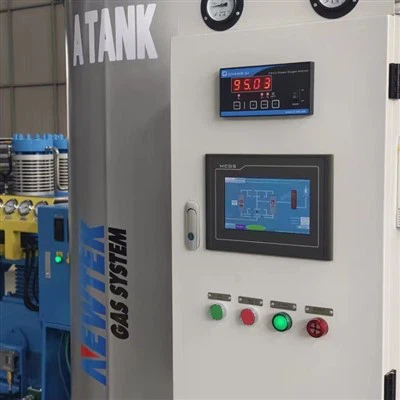
The dual-tower PSA architecture is built around a disciplined separation rhythm.
Each tower operates in a clearly defined role:
One tower focuses entirely on adsorption efficiency
The second tower focuses entirely on regeneration effectiveness
By separating these functions in time and space, the process avoids overlapping states that complicate pressure control and cycle tuning.
This clarity is the foundation of the module's stability.


Why Simplicity Improves Control Accuracy
In PSA systems, every additional process phase increases control sensitivity.
The dual-tower configuration limits:
The number of active pressure transitions
Simultaneous valve operations
Cross-interference between beds
As a result, control algorithms remain stable even under fluctuating air supply or downstream demand, improving real-world performance consistency.
high quality
Advanced Equipment
Professional Team
One-Stop Solution
Oxygen Purity
90–99%
Flow Capacity
5 – 100 Nm³/h (custom-built systems available)
Configuration
Skid-mounted or containerized design for easy installation
Operation
Fully automated PLC-controlled system
Industrial gas demand is rarely constant.
The Dual-Tower PSA Process Module is designed to respond smoothly to:
Partial-load operation
Gradual capacity ramp-up
Short-term flow fluctuations
Rather than relying on aggressive equalization or compressed cycle timing, the module maintains separation integrity across operating ranges.

Adsorbent Protection as a Design Priority
Adsorbent degradation is a hidden cost in many PSA systems.
This module reduces long-term adsorbent stress by:
Avoiding sharp pressure shocks
Maintaining stable regeneration conditions
Limiting unnecessary purge gas flow
Over time, this leads to longer adsorbent life, more stable purity curves, and reduced replacement frequency.

Faster Commissioning, Lower Start-Up Risk
From a project execution perspective, the dual-tower PSA process offers clear advantages.
Commissioning benefits include:
Well-understood tuning logic
Fewer interdependent parameters
Easier performance validation
This shortens the path from mechanical completion to stable gas production, reducing project risk.
Maintenance Transparency and Fault Isolation
When maintenance is required, clarity matters.
The dual-tower structure allows:
Clear identification of which tower is in which state
Easier valve and sequence diagnostics
Logical isolation of performance deviations
This transparency reduces troubleshooting time and minimizes unplanned downtime.
A Core Module That Integrates Cleanly
The Dual-Tower PSA Process Module is designed to integrate smoothly into larger systems.
It works effectively with:
1
Standard industrial air compression systems
2
Integrated oxygen or nitrogen generation units
3
Skid-mounted and containerized plants
Scaling Without Relearning the Process
As capacity requirements grow, many PSA systems require re-optimization.
With the dual-tower module:
Additional capacity is achieved by replication
Control logic remains unchanged
Operating philosophy stays consistent
This allows system expansion without introducing new process risks.

Who Chooses This Module - and Why
This module is typically selected by:
Industrial operators prioritizing uptime
Engineers responsible for long-term system performance
Decision-makers seeking predictable operating cost
They value a PSA process that behaves consistently over years, not just during factory testing.
Hot Tags: dual-tower psa process module, China dual-tower psa process module manufacturers, suppliers, industrial gas generator, oxygen generator for welding, oxygen generat plant, 200 lpm oxygen plant, gas generation equipment, industrial oxygen