Why Oxygen Stability Matters in RAS Systems
In recirculating aquaculture systems, dissolved oxygen (DO) fluctuations can rapidly create biological stress. Even short-term oxygen instability may result in:
Short-term Instability Risks
- Reduced feeding behavior
- Lower feed conversion efficiency (FCR)
- Increased fish stress response
- Higher mortality rates
- Ammonia accumulation
- Biofilter performance decline
- Disease susceptibility increase
Continuous Demand Fluctuations
Unlike conventional pond aeration, RAS systems operate under significantly higher biomass density. Oxygen demand changes continuously throughout:
- Feeding periods
- Nighttime respiration cycles
- Biomass growth stages
- Water temperature fluctuations
- High-density holding periods
Because of this, modern RAS facilities increasingly rely on concentrated oxygen supply instead of relying solely on atmospheric aeration.
PSA Oxygen Generator Advantage: Ensures continuous oxygen availability directly at the farming site without depending on external oxygen logistics.
Working Principle of PSA RAS Oxygen Generator
The PSA oxygen generation process is based on selective adsorption technology.

Compressed air contains approximately:
- 78% nitrogen
- 21% oxygen
- Small amounts of argon, CO₂, and trace gases
Inside the PSA system, compressed air passes through zeolite molecular sieve adsorption towers. The molecular sieve selectively adsorbs nitrogen molecules under pressure while allowing oxygen to pass through.
The process operates in alternating cycles:
- One tower performs nitrogen adsorption
- The second tower undergoes regeneration
- Towers switch automatically
- Oxygen output remains continuous
This cyclic adsorption process enables uninterrupted oxygen generation for 24-hour aquaculture operation.

Main Components of the PSA RAS Oxygen System
01 Air Compressor
Supplies stable compressed air for the PSA process. Industrial screw compressors provide continuous airflow, stable pressure, low vibration, and high operational reliability.
02 Refrigerated Air Dryer
Moisture removal is essential for protecting molecular sieve performance. It removes water vapor, reduces dew point, prevents contamination, and improves purity stability.
03 Precision Filtration System
Removes oil particles, dust, aerosols, and moisture residues. Clean compressed air significantly extends the overall service life of the downstream adsorption system.
04 PSA Oxygen Generator Unit
The core separation section containing twin adsorption towers, zeolite molecular sieves, pneumatic switching valves, and flow controls to continuously separate oxygen via pressure swing cycles.
05 Oxygen Buffer Tank
The oxygen storage tank stabilizes oxygen flow, output pressure, and system fluctuations. It ensures smooth oxygen delivery directly to the aquaculture oxygenation system.
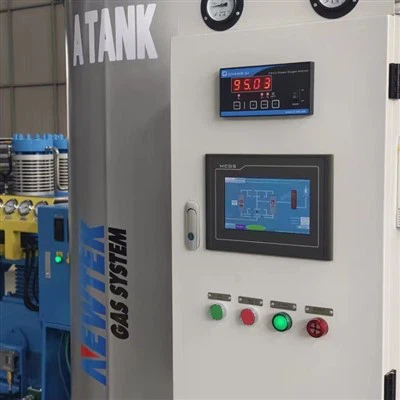
06 PLC Intelligent Control System
Integrates automatic control functions including auto startup/shutdown, purity/pressure monitoring, alarm systems, fault protection, and remote communication interfaces.
07 Oxygen Booster System (Optional)
For applications requiring higher oxygen injection pressure, oxygen boosters may be added for oxygen cone systems, deep tank oxygenation, long-distance oxygen transport, and high-pressure diffusion applications.
Technical Specifications
| Parameter | Specification Range |
|---|---|
| Oxygen Purity | 90% – 95% |
| Oxygen Capacity | 5 – 300 Nm³/h |
| Oxygen Pressure | 0.3 – 1.0 MPa |
| Oxygen Dew Point | ≤ -40°C |
| Air Consumption Ratio | Approx. 4.5 – 5.5:1 |
| Control System | PLC Fully Automatic |
| Operating Mode | 24/7 Continuous |
| Power Supply | 220V / 380V / Customized |
| Oxygen Storage | Buffer Tank Integrated |
| Installation Type | Skid-mounted / Containerized |
Advantages of PSA Oxygen Generator for RAS Aquaculture
Continuous Oxygen Supply
Operates continuously and automatically without cylinder changes. Critical for:
Stable DO Control
Stable DO is more vital than temporary high spikes. The system maintains:
Lower Operating Cost
On-site generation cuts recurring liquid gas or cylinder logistics, eliminating:
Increased Farming Density
Concentrated oxygen supply optimizes commercial tank utilization to:
Better FCR Economics
Fish metabolism heavily relies on DO. Stable conditions noticeably improve:
Reduced Fish Stress
Oxygen fluctuations trigger physiological hazards. Prevention avoids:
Automation Ready
Modern RAS facilities integrate seamlessly. PSA oxygen units sync with:
Typical Application Scenarios
Salmon Farming
Salmon farming systems require highly stable oxygen supply to maintain robust growth environments because of:
Trout Farming
Trout are famously sensitive to dissolved oxygen fluctuations. On-site PSA systems directly improve:
Shrimp RAS Systems
Intensive shrimp cultivation generates extremely high biological oxygen demand across:
Fish Hatcheries
Egg incubation and vulnerable juvenile fish cultivation require pristine, highly stable oxygen levels. The system provides:
Aquaponics Systems
Integrated ecological operations require balanced dual-oxygen supply to successfully maintain:
Comparison Between PSA Oxygen and Traditional Aeration
| Item | PSA Oxygen Generator | Traditional Aeration |
|---|---|---|
| Oxygen Concentration | 90–95% | Atmospheric (~21%) |
| Oxygen Dissolution Efficiency | High | Moderate |
| Oxygen Stability | Excellent | Variable |
| Suitable for High Density Farming | Yes | Limited |
| Operational Automation | High | Medium |
| Long-Term Cost | Lower | Higher |
| Oxygen Supply Continuity | Continuous | Often Limited |
| Space Efficiency | High | Lower |
Optional System Configurations
01 Containerized Oxygen Plant
Ideally suitable for remote aquaculture farms. Containerized systems provide:
02 Remote Monitoring Module
Optional smart IoT cloud monitoring functions seamlessly include:
03 Oxygen Filling System
Allows high-pressure oxygen cylinder filling directly on-site for:
04 Redundant Backup Design
Dual-system redundancy improves operational reliability significantly for large-scale aquaculture facilities.
Optional System Configurations
01 Containerized Oxygen Plant
Ideally suitable for remote aquaculture farms. Containerized systems provide:
02 Remote Monitoring Module
Optional smart IoT cloud monitoring functions seamlessly include:
03 Oxygen Filling System
Allows high-pressure oxygen cylinder filling directly on-site for:
04 Redundant Backup Design
Dual-system redundancy improves operational reliability significantly for large-scale aquaculture facilities.
Installation Requirements
Ventilation Environment
To ensure optimal performance, the oxygen generator should be installed in:
Power Supply Stability
Industrial power stability is extremely important for continuous operation.
Air Compressor Capacity
Proper compressor sizing is critical as it directly affects and determines:
Oxygen Pipeline Design
The engineered oxygen pipeline distribution system should be meticulously designed to minimize:
Maintenance Requirements
01 Daily Inspection
On-site operators should meticulously and regularly monitor:
02 Filter Replacement
Precision filtration elements require strictly scheduled replacement to maintain pristine, clean airflow throughout the system.
03 Valve Inspection
Pneumatic switching valves should be periodically and thoroughly checked for:
Molecular Sieve Protection
System LifespanAir Pretreatment Proper air pretreatment significantly extends molecular sieve service life.
Extended Longevity Under proper operation conditions, the molecular sieve lifespan can easily exceed several years.
Economic Benefits for Aquaculture Operators
Lower Operating Cost
Significantly cuts down long-term running expenses by eliminating recurring liquid oxygen or cylinder logistics.
Reduced Mortality Rate
Prevents sudden dissolved oxygen drops, securing biomass safety and minimizing catastrophic crop losses.
Higher Biomass Output
Enables stable high-density stocking conditions, directly boosting the total harvest volume per cycle.
Improved Feed Efficiency
Optimizes fish metabolism and nutrient absorption, leading to a better and lower Feed Conversion Ratio (FCR).
Production Consistency
Maintains uniform growth rates across all commercial tanks by removing environmental stress fluctuations.
Reduced Labor Dependency
Automated on-site generation minimizes intensive labor requirements for managing gas cylinders.
Increased Operational Scalability
For medium and large-scale RAS projects, oxygen cost optimization becomes increasingly important as production volume grows. PSA systems allow flexible system expansion to meet future farming scaling needs smoothly.
Frequently Asked Questions
What oxygen purity can the PSA RAS oxygen generator provide?
Most industrial PSA oxygen systems provide stable oxygen purity between 90% and 95%, which is ideal for aquaculture needs.
Is PSA oxygen suitable for seawater aquaculture?
Yes, absolutely. PSA oxygen systems are perfectly engineered and highly suitable for both freshwater and marine/seawater aquaculture applications.
Can the system operate continuously?
Yes. Heavy-duty industrial PSA oxygen generators are specifically designed for 24-hour continuous, uninterrupted automatic operation.
Is liquid oxygen still necessary after installing it?
In many modern projects, PSA oxygen becomes the primary on-site oxygen source. However, some commercial farms still keep liquid oxygen as a fail-safe emergency backup storage.
How long does the molecular sieve last?
With proper air pretreatment systems (dryers and filters) and scheduled routine maintenance, the molecular sieve service life can typically reach several years easily.
Can the system connect with DO monitoring equipment?
Yes. Most industrial PSA oxygen generators seamlessly support direct integration with commercial dissolved oxygen (DO) monitoring and automated aquaculture SCADA systems.
Hot Tags: psa ras oxygen generator, China psa ras oxygen generator manufacturers, suppliers, 1000 lpm oxygen plant, 500 lpm oxygen plant, o2 generators, oxygene generator aquaculture, oxygene generator for fish farming, oxygene generator for fish pond