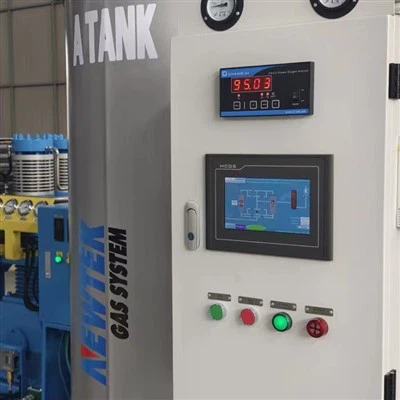
Oxygen Generation Capacity and Technical Specifications
Selecting the correct equipment capacity starts with the farm's oxygen demand, not simply its pond area or total water volume. Fish species, maximum standing biomass, feeding rates, water temperature, oxygen transfer efficiency, and operating schedules all affect the required oxygen output.
The following specifications identify the principal parameters for project evaluation. Final values should be confirmed according to the selected equipment configuration.
| Specification | Configuration considerations |
|---|---|
| Oxygen production capacity | Selected according to calculated oxygen demand and required operating margin |
| Oxygen concentration | Common PSA configurations operate at approximately 90–95%, subject to design and operating conditions |
| Oxygen outlet pressure | Selected according to the downstream oxygen delivery equipment |
| Operating mode | Automatic PLC-based operation, subject to configuration |
| Air treatment | Filtration and drying selected to meet PSA operating requirements |
| Oxygen monitoring | Oxygen concentration analyzer and configured alarms |
| Control interface | PLC control cabinet and HMI operating interface |
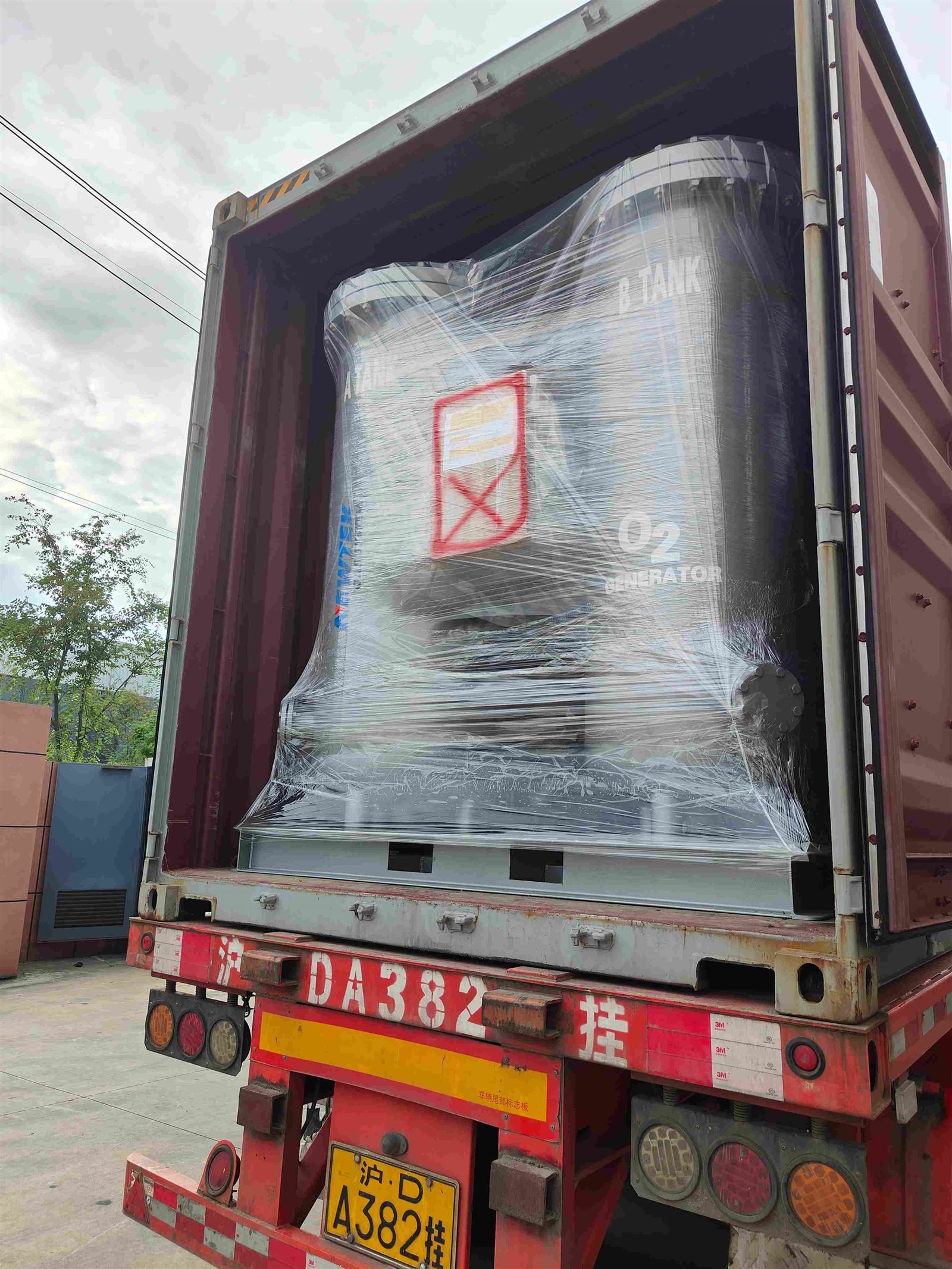
| Installation arrangement | Indoor industrial installation or a suitably configured containerized arrangement |
| Power supply | Specified according to site voltage, frequency, and auxiliary equipment |
| Oxygen delivery | Compatible with a suitably designed oxygen distribution and water transfer system |
| Optional equipment | Oxygen booster, additional storage, remote monitoring, or other specified accessories |
The final technical quotation should state the rated oxygen output at the specified purity and pressure. These parameters should be evaluated together because achievable output can vary with operating conditions and equipment design.
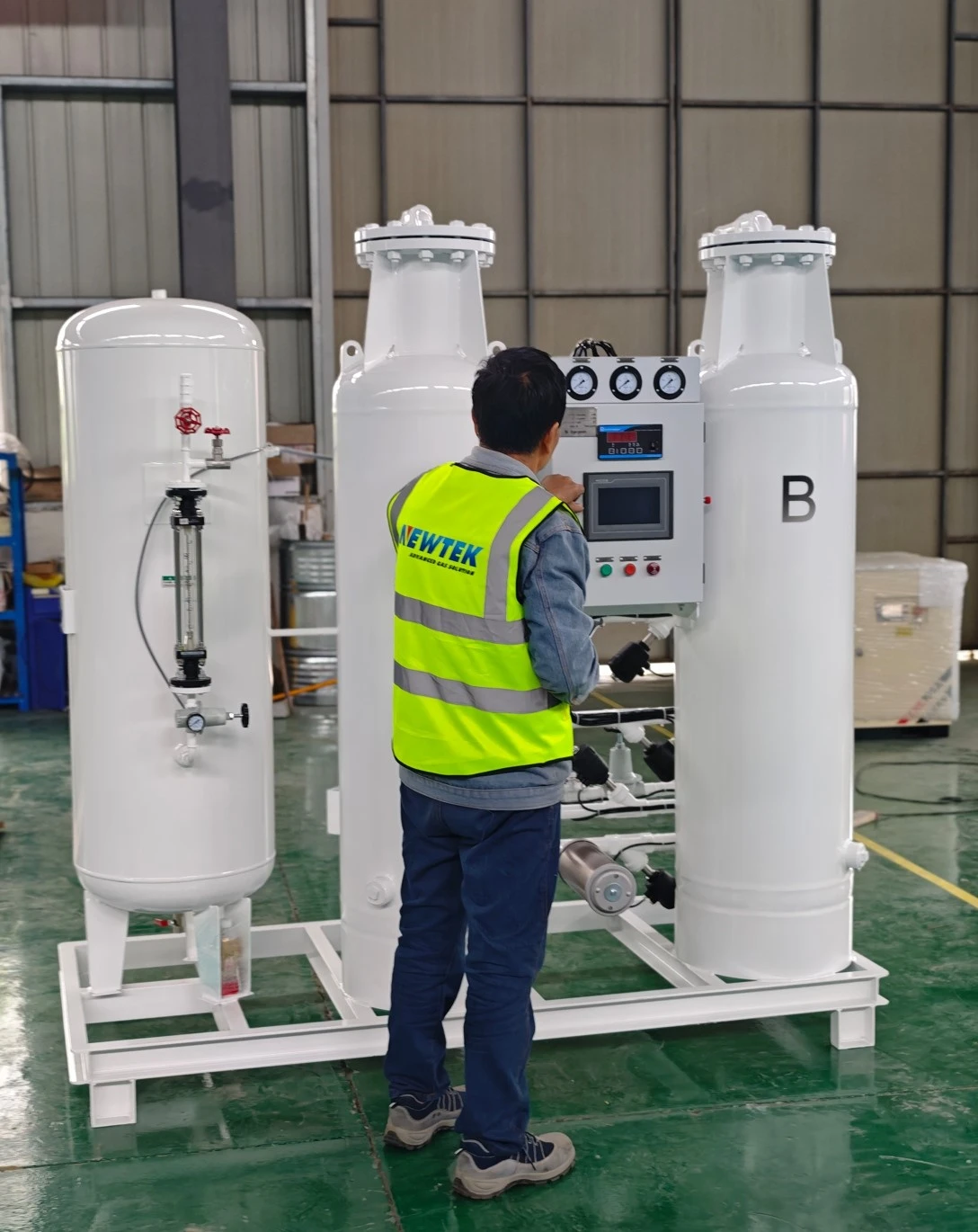
Automatic PSA Oxygen Generation System Configuration
The equipment combines compressed-air preparation, oxygen separation, process control, and oxygen buffering into a coordinated generation system.
Main Equipment and Functions
| Component | Function |
|---|---|
| Air compressor | Provides the compressed air required for oxygen production |
| Air receiver | Buffers compressed air and helps stabilize supply to the treatment section |
| Air filtration system | Removes particles and selected contaminants from the compressed air |
| Air dryer | Reduces moisture to protect the adsorption process |
| PSA adsorption vessels | Separate oxygen from nitrogen through pressure-controlled adsorption and regeneration cycles |
| Molecular sieve material | Selectively adsorbs nitrogen during the oxygen separation process |
| Automatic switching valves | Control the pressure changes and operating sequence of the adsorption vessels |
| Oxygen buffer tank | Helps balance short-term differences between production and demand |
| Oxygen analyzer | Monitors the concentration of the generated gas |
| PLC control cabinet | Coordinates automatic sequencing and configured protection functions |
| HMI interface | Displays operating status, parameters, and alarms |
| Flow and pressure instruments | Support monitoring of gas delivery conditions |
The air compressor, treatment equipment, adsorption vessels, control system, and oxygen buffer should be matched to the selected capacity. Where the project requires a complete oxygen delivery arrangement, additional equipment can be specified according to the downstream process.
How the Oxygen Generation Process Works
The system separates oxygen from compressed air through a cyclic adsorption process.
Process flow:
Ambient Air → Air Compression → Filtration and Drying → PSA Separation → Oxygen Buffer Tank → Oxygen Distribution → Water Oxygenation Equipment
Step 1: Compressed-Air Preparation
The compressor supplies air to the treatment section. Filters and drying equipment reduce moisture and contaminants that could affect molecular sieve performance or increase maintenance requirements.
Step 2: PSA Oxygen Separation
Compressed air enters adsorption vessels containing molecular sieve material. Under pressure, the material preferentially adsorbs nitrogen while oxygen-enriched gas passes through the separation process.
Step 3: Automatic Adsorption and Regeneration
The control system switches the operating conditions between adsorption vessels. One vessel produces oxygen while another undergoes pressure reduction and regeneration. Repeating this cycle maintains continuous production when the equipment is correctly specified and operated.
Step 4: Oxygen Buffering and Delivery
The generated gas enters a buffer tank before being supplied to the downstream equipment. The buffer helps accommodate short-term demand fluctuations, while the distribution system carries oxygen to the selected tanks, ponds, or production zones.
The oxygen generator supplies oxygen-enriched gas; it does not independently guarantee a particular dissolved oxygen level in the water. Water circulation, oxygen transfer efficiency, biological loading, and operating conditions determine the final result.
Automatic Control for Continuous Fish Farming Operations
Commercial aquaculture facilities may operate around the clock. Automatic control helps coordinate routine oxygen production without requiring operators to manually manage each adsorption cycle.
PLC-Based Operating Sequence
The PLC coordinates valve switching and the programmed PSA cycle. The HMI provides an operating interface for monitoring equipment status and selected process parameters.
Oxygen Purity Monitoring
An oxygen analyzer checks gas concentration at the specified monitoring point. Alarm thresholds can be established according to the agreed operating requirements and equipment configuration.
Equipment Status and Fault Alarms
Depending on the selected configuration, the control system can display compressor status, pressure conditions, oxygen concentration, and selected abnormal operating conditions. Protection functions and interlocks should be defined in the technical specification.
Integration With Farm Monitoring Systems
Where required, the oxygen generation controls can be assessed for integration with compatible farm monitoring or supervisory systems. Interface requirements, communication protocols, sensor signals, and control responsibilities must be confirmed before ordering.
Dissolved oxygen sensors measure oxygen levels in water, whereas the generator's oxygen analyzer measures gas concentration. These instruments serve different purposes. Farm-level DO monitoring should be selected and installed according to the actual water system.
Aquaculture Applications and Oxygen Delivery Options
The equipment can be configured for different commercial fish production environments. The correct arrangement depends on the production process and the method used to transfer oxygen into water.
Intensive Fish Farming
High stocking densities and intensive feeding can increase oxygen demand. The generation capacity and delivery arrangement should be assessed against maximum biomass, feed consumption, water temperature, and expected peak demand.
Recirculating Aquaculture Systems (RAS)
RAS facilities circulate water through filtration, biological treatment, degassing, and other treatment stages. The oxygen supply should be coordinated with circulation flow, tank loading, water treatment equipment, and the selected oxygen injection point.
Commercial Fish Hatcheries
Hatcheries and nursery facilities may require oxygen supply across multiple tanks and different production stages. Distribution lines and flow control should accommodate the demand of each operating area.
Large Pond and Raceway Operations
Pond-based and raceway farms may use a central generation plant to serve multiple oxygen delivery points. Pipe length, water flow, oxygen transfer method, and operating zones should be considered during system selection.
Land-Based Marine Aquaculture
Land-based marine fish farms require an oxygen supply arrangement compatible with their salinity, water treatment, stocking density, and circulation design. The system must be selected for the specific production conditions.
Common Oxygen Delivery Equipment
| Delivery method | Application considerations |
|---|---|
| Oxygenation cone | Suitable for compatible water circulation arrangements where gas-to-water transfer can be engineered |
| Side-stream oxygenation | Treats a portion of the circulating water before returning it to the main system |
| Oxygen diffuser | Introduces gas into water; performance depends on diffuser design, depth, contact time, and water movement |
| Central distribution manifold | Routes oxygen from the generation plant to multiple tanks or production areas |
| Oxygen injection system | Supplies oxygen through a compatible injection device selected for the water flow and pressure conditions |
The generator and water-side oxygen transfer equipment should be evaluated as a connected system. A higher gas output alone does not guarantee higher oxygen transfer efficiency.
Oxygen Supply Planning for Medium- and Large-Scale Farms
A commercial fish farm's oxygen requirement varies with its species, biomass, feed rate, water temperature, production stage, and transfer system. Capacity selection should therefore use operational data rather than a general estimate based only on the farm's footprint.
Information Used for Capacity Selection
| Required information | Purpose |
|---|---|
| Fish species | Identifies species-specific oxygen requirements |
| Maximum standing biomass | Establishes the expected peak fish load |
| Daily feed consumption | Helps assess oxygen demand in intensive production |
| Water temperature range | Supports evaluation of operating conditions and oxygen solubility |
| Tank or pond dimensions | Defines the physical production layout |
| Culture system | Identifies the circulation and water treatment arrangement |
| Target dissolved oxygen level | Defines the water-side operating objective |
| Oxygen transfer equipment | Helps estimate the proportion of supplied gas transferred into water |
| Required oxygen flow | Establishes the nominal generation capacity |
| Required purity and outlet pressure | Defines the gas supply specification |
| Daily operating hours | Helps establish the operating schedule |
| Existing backup arrangements | Identifies contingency requirements |
If some information is unavailable, preliminary data can be used for an initial assessment. The final equipment selection should be confirmed once the operating requirements and delivery configuration are sufficiently clear.
Backup Oxygen Supply and Operating Continuity
For high-density aquaculture, an interruption in oxygen supply can quickly become an operational risk. Automatic production is valuable, but it should be supported by a suitable contingency plan.
Depending on the facility's risk assessment, backup arrangements may include:
A secondary oxygen source independent of the normal supply.
Standby generation capacity where justified by production requirements.
Suitable reserve storage for the specified emergency duration.
Power-failure and equipment-fault alarms.
Regular inspection and preventive maintenance.
A documented response procedure for oxygen supply interruptions.
The required reserve depends on the farm's oxygen consumption, response time, available alternative supply, and the consequences of an interruption. A buffer tank should not be treated as a complete emergency backup.
NEWTEK Oxygen Generation Equipment Manufacturing
For overseas aquaculture buyers, selecting a manufacturer involves more than comparing headline equipment prices. The scope of supply, technical specification, factory production capability, documentation, and communication process all affect the purchasing decision.
Factory-Based Manufacturing
NEWTEK supplies industrial PSA oxygen generation equipment for commercial and industrial applications. Our manufacturing approach focuses on equipment configuration, component coordination, assembly requirements, control integration, and the technical specifications agreed for each order.
Application-Based Equipment Configuration
The equipment can be configured according to the required oxygen flow, purity, outlet pressure, operating environment, and downstream connection requirements. This helps the customer define an equipment scope that reflects the actual production process.
Technical Specification and Scope Confirmation
Before an order is finalized, the technical requirements should identify the included equipment, operating parameters, utility requirements, optional accessories, and excluded items. Installation, commissioning, training, and after-sales arrangements should be confirmed separately in the agreed supply scope.
Direct Communication With the Project Team
The purchasing contact may be the farm owner, operations manager, engineering team, purchasing department, or an appointed sourcing company. NEWTEK can communicate with the designated contact to review the required specifications and clarify the equipment configuration.
For a quotation, customers should compare rated oxygen output at the specified purity and pressure, included auxiliary equipment, control functions, utility consumption, and delivery scope rather than comparing equipment prices alone.
Customize the Oxygen Generation System for Your Farm
Different aquaculture facilities have different oxygen demands and site constraints. The final configuration should reflect the actual production load and the way oxygen will be delivered to the water.
Customization may cover:
Rated oxygen production capacity.
Required oxygen concentration and outlet pressure.
Air compressor and air treatment configuration.
Buffer tank capacity.
PLC and HMI control functions.
Oxygen purity monitoring and configured alarms.
Indoor or containerized installation arrangement.
Connection requirements for existing distribution equipment.
Optional oxygen boosting or storage equipment.
Power supply and site operating conditions.
The available configuration depends on the required operating point and equipment design. Any special monitoring, communication interface, or integration requirement should be specified before the quotation is finalized.
FAQ
What oxygen purity is available?
Common PSA oxygen generation configurations provide approximately 90–95% oxygen concentration, depending on the selected design and operating conditions. The required purity and corresponding output should be stated in the technical specification.
Can the system operate continuously?
It can be configured for continuous oxygen production within its specified operating range. Continuous operation requires suitable utility supply, correct installation, routine maintenance, and operation in accordance with the manufacturer's instructions.
Can one unit supply several tanks?
Yes, where the generator capacity and distribution network are designed for the combined demand. The required flow, pressure losses, demand at each tank, and emergency arrangements should be assessed before selection.
Can it be used with a recirculating aquaculture system?
It can be configured to supply oxygen to compatible oxygen transfer equipment within an RAS facility. The connection point and delivery arrangement depend on water circulation, filtration, degassing, and oxygen demand.
Does automatic operation eliminate the need for an operator?
No. Automatic control reduces routine manual intervention, but operators still need to monitor alarms, inspect equipment, perform maintenance, and maintain the farm's oxygen emergency procedures.
What information is needed for a quotation?
Provide the fish species, maximum biomass, daily feed consumption, water temperature range, culture system type, required oxygen flow, target purity, outlet pressure, daily operating hours, installation country, and available power supply. Tank layouts and existing oxygen delivery equipment details are also useful.
Can the system be supplied in a containerized arrangement?
A containerized configuration may be available depending on capacity, site conditions, ventilation, ambient temperature, access requirements, and the selected equipment layout. These details should be reviewed during technical selection.
Request a Technical Quotation From NEWTEK
If your company operates an intensive fish farm, RAS production facility, commercial hatchery, or large-scale aquaculture operation, NEWTEK can review your oxygen demand and discuss an appropriate industrial oxygen generation configuration.
To begin the technical assessment, provide:
Fish species and aquaculture system type.
Maximum standing biomass and daily feed consumption, if available.
Required oxygen flow, purity, and outlet pressure.
Tank or pond layout and oxygen delivery method.
Daily operating hours and site power supply.
Installation country and environmental conditions.
Preferred equipment scope and backup requirements.
Contact NEWTEK to discuss your aquaculture oxygen supply requirements and request a quotation based on your project's technical specifications.
Hot Tags: automatic fish farm oxygen generator, China automatic fish farm oxygen generator manufacturers, suppliers, 500 lpm oxygen plant, aquaculture oxygen generator, o2 generators, oxygen generat plant, oxygenators for aquaculture, small oxygen generator