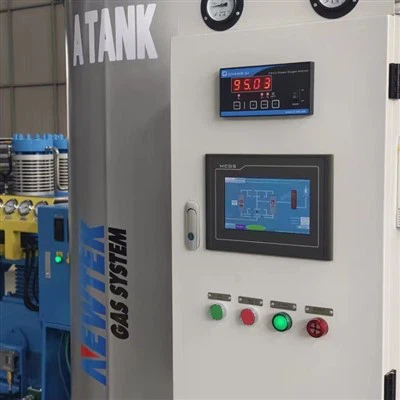
How Pressure Swing Adsorption Produces Oxygen
PSA oxygen generation uses differences in the adsorption behavior of gases under pressure.
Ambient Air → Compression → Filtration & Drying → Pressurized Adsorption → Oxygen-Rich Gas → Buffering → Oxygen Supply
Nitrogen is preferentially retained by the molecular sieve, while oxygen passes through the adsorption bed.
When the adsorption material approaches its operating capacity, the vessel is depressurized and regenerated. Multiple vessels work in alternating cycles so that oxygen production can continue while individual vessels regenerate.
PSA Oxygen Generator Working Cycle
- Air Compression
Ambient air enters the compressor and is raised to the pressure required by the PSA process. - Air Treatment
Compressed air passes through filters and drying equipment to control particles, oil aerosols, and moisture before entering the adsorption system. - Pressurized Adsorption
The treated air enters one adsorption vessel. Nitrogen is preferentially adsorbed by the molecular sieve, allowing oxygen-rich gas to pass through. - Oxygen Collection
The oxygen-rich gas enters the oxygen outlet and buffer system. - Depressurization
When the adsorption cycle ends, the vessel pressure is reduced. The adsorbed nitrogen is released from the molecular sieve. - Regeneration
The vessel returns to a condition suitable for the next adsorption cycle. - Automatic Switching
The control system switches between adsorption vessels according to the programmed PSA sequence. This alternating operation provides continuous oxygen production.
Process Flow Overview
[ PSA Working Cycle Diagram ]
Illustrates continuous multi-vessel alternating adsorption and nitrogen desorption.
Main Components of a PSA Oxygen Generator
| Component | Function |
|---|---|
| Air Compressor | Supplies compressed feed air |
| Air Receiver | Stabilizes compressed-air flow |
| Air Filters | Remove particulate and oil contamination |
| Air Dryer | Controls feed-air moisture |
| PSA Adsorption Vessels | Perform nitrogen adsorption |
| Molecular Sieve | Selectively adsorbs nitrogen |
| Switching Valves | Control adsorption and regeneration cycles |
| Oxygen Buffer Tank | Stabilizes oxygen output |
| Oxygen Analyzer | Monitors oxygen purity |
| PLC Controller | Controls the operating sequence |
| HMI | Displays operating parameters |
| Piping System | Connects process equipment |
| Safety System | Provides equipment protection |
The equipment configuration can be expanded with oxygen compression, storage, or cylinder filling systems.
Oxygen Purity and Production Capacity
PSA oxygen generators can typically produce oxygen with purity of up to approximately 95%, depending on the design and operating conditions. The required oxygen purity should be selected according to the downstream application rather than simply choosing the highest available purity.
Typical Design Parameters
| Parameter | Project Specification |
|---|---|
| Oxygen Capacity | ___ Nm³/h |
| Oxygen Purity | ___ % |
| Oxygen Pressure | ___ bar |
| Operating Hours | ___ h/day |
| Peak Demand | ___ Nm³/h |
| Installation | Indoor / Outdoor / Containerized |
| Ambient Temperature | ___ °C |
| Altitude | ___ m |
| Power Supply | ___ V / Hz |
Why Use PSA Oxygen Generation?
For facilities with regular oxygen demand, on-site production can change how oxygen is supplied to the process.
Compared with Regular Oxygen Delivery
| Consideration | Delivered Oxygen | PSA Oxygen Generation |
|---|---|---|
| Oxygen Source | External supplier | Ambient air |
| Production Location | Supplier facility | Point of use |
| Delivery | Required | Not required for normal production |
| Storage | Often required | Buffer/storage according to design |
| Supply Control | Delivery schedule | On-site production |
| Remote Applications | Logistics required | Can be installed locally |
| Production Capacity | Supplier-dependent | Project-specific |
The economic result depends on oxygen consumption, operating hours, local oxygen prices, transportation costs, power consumption, and equipment utilization.
Industrial Applications
Metal Cutting
PSA oxygen generators can supply oxygen for oxy-fuel cutting applications. Typical users include:
- Steel fabrication workshops
- Shipyards
- Shipbreaking facilities
- Heavy equipment manufacturers
- Structural steel processors
- Industrial demolition contractors
The required oxygen capacity is calculated from the number of cutting stations, cutting method, and operating schedule.
Mining and Mineral Processing
Oxygen can be required in different mining and mineral-processing operations. PSA oxygen generation can be configured for applications involving:
- Gold, Copper, Silver, Lead, Zinc
- Mineral processing
- Metallurgical operations
Remote mining facilities can use skid-mounted or containerized PSA systems when conventional oxygen delivery is difficult.
Metallurgy and Smelting
Oxygen can be used for selected metallurgical and combustion processes. Potential applications include:
- Furnace oxygen enrichment
- Smelting
- Oxidation processes
- Thermal processing
- Non-ferrous metallurgy
The oxygen requirement depends on furnace design, fuel consumption, process chemistry, and the required oxygen enrichment level.
Wastewater Treatment
PSA oxygen generators can supply oxygen to wastewater treatment systems where additional oxygen is required. Applications include:
- Municipal wastewater treatment
- Industrial wastewater treatment
- High-load biological treatment
- Aquaculture wastewater
- Oxygen injection systems
The generator can be connected to oxygen dissolution or injection equipment.
Ozone Generation
Oxygen is used as the feed gas for ozone generation. A PSA oxygen generator can supply oxygen to ozone systems used for:
- Drinking water treatment
- Wastewater treatment
- Industrial water treatment
- Aquaculture
- Advanced oxidation
- Disinfection
The oxygen capacity should be matched to the ozone generator's gas consumption.
Medical Oxygen Supply
PSA oxygen generation can be configured for healthcare facilities requiring an on-site oxygen supply. Potential installations include:
- Hospitals, Clinics & Medical centers
- Rural healthcare facilities
- Temporary medical facilities
- Medical oxygen filling stations
For medical applications, oxygen quality, equipment configuration, installation, and distribution must comply with applicable medical requirements and local regulations.
Automatic PSA Oxygen Generation
The adsorption and regeneration sequence can be controlled automatically through a PLC system.
Automatic Functions
- PSA vessel switching
- Valve sequencing
- Compressor operation
- Oxygen purity monitoring
- Pressure monitoring
- Alarm management
- Equipment protection
- Start-up and shutdown sequences
- Operating status display
The HMI can provide operators with real-time information about the system.
Oxygen Purity Monitoring
An oxygen analyzer can continuously measure the product oxygen concentration. The control system can monitor the analyzer signal and provide alarms when the oxygen purity moves outside the configured operating range.
Typical Monitored Parameters:- Oxygen purity, pressure & flow
- Feed-air pressure & PSA vessel pressure
- Compressor status & System alarms
System Configurations & Modular Options
PSA Oxygen Generator with Oxygen Storage
A buffer or storage system can be incorporated when downstream processes require additional supply stability.
Basic Configuration:
PSA → Oxygen Buffer → Point of Use
With Additional Storage:
PSA → Oxygen Buffer → Oxygen Storage → Point of Use
PSA Oxygen Generator for Cylinder Filling
For oxygen distribution and filling facilities, the PSA system can connect to an oxygen compression and filling system.
Typical Process:
PSA Generator → Oxygen Buffer → Oxygen Compressor → High-Pressure Storage → Filling Manifold
Configured based on cylinder volume, filling pressure, cylinder quantity, and daily filling capacity.
Containerized PSA Oxygen Generator
Integrated into a containerized structure for transportation and deployment flexibility. Ideal for remote mining, temporary projects, and decentralized gas supply.
Includes air compressor, treatment, adsorption vessels, buffer, control cabinet, piping, ventilation, and safety systems.
Compact PSA Oxygen Generator
Arranged as a compact skid or integrated equipment package for facilities with limited installation space.
Designed around available floor area, height, maintenance clearances, piping routes, and ventilation needs.
Engineering & Customization Options
Engineering the Generator Around Your Process
A PSA oxygen generator should be selected according to actual oxygen demand rather than capacity alone:
- Oxygen Flow: Average and peak oxygen consumption.
- Oxygen Purity: Specified based on downstream process needs.
- Oxygen Pressure: Required pressure at the consumption point.
- Operating Schedule: Continuous vs. intermittent operation.
- Site Conditions: Ambient temperature, altitude, humidity, power, installation environment.
- Downstream Equipment: Customization for cutting systems, ozone units, wastewater treatment, gas pipelines, filling manifolds, or metallurgical processes.
What Can Be Customized?
NEWTEK can configure PSA oxygen generators according to project technical requirements:
Technical Information for Quotation
Send the following information to determine the appropriate PSA oxygen generator configuration:
| Project Requirement | Information |
|---|---|
| Application | ___ |
| Oxygen Capacity | ___ Nm³/h |
| Oxygen Purity | ___ % |
| Oxygen Pressure | ___ bar |
| Average Consumption | ___ Nm³/h |
| Peak Consumption | ___ Nm³/h |
| Operating Hours | ___ h/day |
| Installation Location | ___ |
| Altitude | ___ m |
| Ambient Temperature | ___ °C |
| Power Supply | ___ V / Hz |
| Installation Type | Indoor / Outdoor / Containerized |
| Storage Requirement | Yes / No |
| Oxygen Compression | Yes / No |
If you do not know the required oxygen capacity, provide the downstream equipment, current oxygen consumption, number of operating units, or production capacity. These parameters can be used as the basis for system sizing.
FAQ
What is a Pressure Swing Adsorption Oxygen Generator?
It is an oxygen production system that uses PSA technology to separate oxygen from compressed ambient air through selective adsorption of nitrogen.
How does PSA generate oxygen continuously?
Multiple adsorption vessels operate in alternating adsorption and regeneration cycles. This allows one vessel to produce oxygen while another regenerates.
What oxygen purity can PSA technology achieve?
PSA oxygen systems can typically produce oxygen with purity up to approximately 95%, depending on the equipment configuration and operating conditions.
Does the PSA oxygen generator require oxygen as a raw material?
No. The system uses ambient air as the feed gas. The PSA process separates oxygen from nitrogen in the compressed air.
Can the generator supply oxygen directly to production equipment?
Yes. The oxygen outlet can be connected directly to compatible downstream equipment, subject to the required flow, purity, and pressure.
Can PSA oxygen be compressed for cylinder filling?
Yes. An oxygen compressor, high-pressure storage system, and filling manifold can be integrated downstream when cylinder filling is required.
Can the system be used for medical oxygen?
Yes, PSA oxygen generation can be engineered for medical oxygen supply. The complete system must be designed according to the applicable medical oxygen specification, healthcare requirements, and local regulations.
Can the PSA oxygen generator be containerized?
Yes. The complete system can be engineered in a containerized configuration for transportation and remote deployment.
Get a PSA Oxygen Generator for Your Application
Provide NEWTEK with your oxygen flow, required purity, pressure, application, operating hours, installation location, and available power supply.
If the oxygen requirement has not yet been calculated, send us your current oxygen consumption or downstream equipment information.
Hot Tags: pressure swing adsorption psa oxygen generators, China pressure swing adsorption psa oxygen generators manufacturers, suppliers, 200 lpm oxygen plant, fish farming oxygen generator, oxygen filling machine, oxygen generat plant, oxygen generator for fish, oxygen production machine