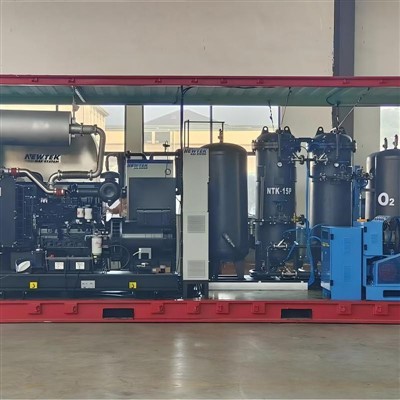
A conventional oxygen supply model depends on an external production facility.
Oxygen must be:
Produced at a centralized gas plant
Filled or liquefied
Transported to the customer
Stored at the project site
Distributed to the process equipment
For remote projects, transportation becomes an important part of the oxygen supply chain.
The onsite PSA model removes several of these intermediate steps.
Ambient air is available directly at the project location, so the plant converts an existing local resource into industrial oxygen.
This changes the customer's oxygen supply structure from purchased and transported gas to locally generated process gas.


Containerized Onsite PSA Oxygen Plant
Why Containerization Matters
The container is not simply an enclosure placed around a conventional oxygen generator. It is used as an integrated equipment room. The container provides a controlled installation space for the major components while simplifying transportation and site deployment.
Why Partner with NEWTEK?
Full-Scale Customization Range:
Flexible engineering tailored from 10 to 1000+ Nm³/h to precisely match your project capacity demand.
Complete Engineering Support:
Complete engineering support from initial design to factory pre-assembly and final site commissioning.
Internal Equipment Arrangement:
- Air compressor & Air receiver
- Air dryer & Multi-stage filtration
- PSA oxygen generator & Oxygen buffer tank
- Oxygen analyzer & Control cabinet
- Pressure regulation equipment & Ventilation system
- Internal piping & Electrical connections
The equipment is arranged according to the process flow so that air treatment, oxygen generation, storage, and distribution operate as one coordinated system.
A Complete Plant Rather Than a Standalone Generator
For industrial oxygen projects, the PSA adsorption towers are only one part of the complete system. The actual plant must also manage the quality and condition of compressed air before it reaches the molecular sieve.
Typical Process Configuration:
Ambient Air → Air Compression → Air Cooling → Moisture Separation → Filtration → Drying → PSA Separation → Oxygen Buffering → Pressure Regulation → Process Pipeline
Each stage affects the reliability of the final oxygen supply. This is why the containerized plant is engineered as a complete process system rather than simply placing a PSA unit inside a container.
PSA Oxygen Production Process
01. Ambient Air Intake
The system draws atmospheric air through an intake system designed according to the installation environment. For dusty industrial locations, additional intake filtration can be provided to reduce particulate loading on the compressor and downstream treatment equipment.
02. Compressed Air Preparation
The air compressor raises atmospheric air to the pressure required for PSA separation. The compressed air then passes through the treatment section to remove contaminants that could affect molecular sieve performance. Typical treatment stages include water separation, oil removal, fine filtration, and air drying. Proper pretreatment is essential because excessive moisture or oil contamination can reduce adsorbent performance and increase maintenance requirements.
03. Nitrogen Adsorption
The treated compressed air enters the PSA adsorption vessels. The zeolite molecular sieve preferentially adsorbs nitrogen while oxygen-rich gas passes through the adsorption bed. The adsorption process operates cyclically.
04. Automatic Tower Switching
The PSA system uses alternating adsorption and regeneration cycles. While one adsorption tower is producing oxygen, the other tower undergoes regeneration. Automatic valve switching maintains continuous production without requiring manual intervention.
05. Oxygen Buffering
The produced oxygen enters a buffer vessel before entering the downstream distribution pipeline. The buffer section helps absorb short-term changes in consumption and stabilize outlet pressure.

Engineered for Different Site Conditions
Containerized oxygen plants are frequently installed where conventional industrial buildings are unavailable. The installation environment may include:
- Remote mining areas
- Coastal industrial facilities
- Desert regions
- Agricultural production zones
- Temporary project sites
- Outdoor processing facilities
Therefore, the container configuration can be adapted according to the local environment. Possible engineering options include:
- Thermal insulation
- Air conditioning
- Forced ventilation
- Heating systems
- Dust protection
- Anti-corrosion treatment
- High-altitude configuration
The objective is to ensure that the internal equipment operates within its specified environmental conditions.
Installation Without Building a Dedicated Equipment Room
One of the main project advantages is that the container itself functions as the equipment housing. The customer does not necessarily need to construct a dedicated oxygen-generation building. The basic site requirements generally include:
- Level foundation
- Electrical supply
- Cooling/ventilation conditions
- Oxygen outlet pipeline
- Adequate maintenance access
External utility connections are completed after the container is positioned at the site. This is particularly useful when oxygen infrastructure must be established quickly or when construction resources are limited.
Designed for Remote Project Deployment
For remote projects, equipment logistics can be more complicated than the equipment itself. The containerized format provides a standardized transportation unit. It simplifies:
- Factory shipment
- Site unloading
- Equipment positioning
- Internal equipment protection
- Project logistics
Once delivered, the customer receives a complete oxygen production system rather than a collection of unrelated components.
Centralized Oxygen Production for Multiple Consumers
A containerized PSA plant does not have to supply a single machine. One plant can feed a central oxygen pipeline serving several consumption points. Depending on the project, oxygen may be distributed to:
- Processing equipment
- Production workshops
- Treatment systems
- Metallurgical units
- Aquaculture systems
- Laboratory facilities
A centralized supply arrangement makes oxygen management easier than maintaining multiple individual gas sources.
Typical Industrial Applications
Mining and Mineral Processing
The plant can provide oxygen for oxygen-dependent mineral processing and metallurgical operations. Its containerized construction is particularly useful at remote mine sites where conventional utility buildings may not yet exist.
Metal Cutting and Fabrication
Oxygen can be supplied to:
- Laser cutting machines
- Flame cutting equipment
- Plasma cutting systems
A central plant can serve several cutting machines through a workshop oxygen pipeline.
Wastewater Treatment
Oxygen can be introduced into biological treatment systems where additional oxygen availability is required for microbial activity. The onsite production model eliminates the need to transport large quantities of compressed oxygen to the treatment facility.
Aquaculture
The system can supply oxygen to:
- Intensive fish farms
- Shrimp farms
- Hatcheries
- RAS facilities
The plant can be connected to oxygen cones, diffusers, oxygenators, or other oxygen injection equipment.
Metallurgical Applications
Oxygen can be used for:
- Furnace oxygen enrichment
- Combustion support
- Oxidation-related processes
- Metal refining operations
The required oxygen purity, pressure, and flow should be determined according to the specific metallurgical process.
Technical Specifications
| Parameter | Typical Configuration |
|---|---|
| Oxygen Generation Technology | PSA |
| Oxygen Purity | 90–95% |
| Oxygen Capacity | 10–500 Nm³/h |
| Oxygen Outlet Pressure | 0.3–1.0 MPa |
| Operation Mode | Automatic / Continuous |
| Installation Type | Containerized |
| Control System | PLC + HMI |
| Oxygen Monitoring | Online Oxygen Analyzer |
| Air Treatment | Filtration + Drying |
| Power Supply | Customized According to Project |
| Container Size | Customized According to Equipment Configuration |
| Environmental Protection | Optional Thermal / Ventilation / Corrosion Package |
Final specifications should be determined according to oxygen consumption, required outlet pressure, ambient conditions, altitude, and project operating schedule.
How to Size the Plant for a Project
Selecting the correct oxygen plant should begin with the process rather than the equipment model. The engineering assessment should include:
Oxygen Consumption
Determine the normal oxygen demand in Nm³/h.
Peak Demand
Identify temporary periods when oxygen consumption increases significantly.
Operating Schedule
Determine whether the plant operates: 8 hours/day, 16 hours/day, or 24 hours/day.
Required Oxygen Pressure
The outlet pressure must match the requirements of the oxygen distribution network and end-use equipment.
Installation Environment
The following factors may affect equipment configuration: Ambient temperature, Altitude, Dust concentration, Humidity, Corrosive atmosphere.
Power Availability
The compressor represents an important portion of the plant's electrical load, so available power capacity should be evaluated during project design.
Container Configuration Options
The container can be configured according to the project environment.
Standard Industrial Configuration
Suitable for normal industrial sites with moderate ambient conditions.
Hot Climate Configuration
For regions with high ambient temperatures, the container can be equipped with enhanced ventilation and cooling systems.
Cold Climate Configuration
Heating and thermal insulation can be incorporated for low-temperature environments.
Dusty Environment Configuration
Additional filtration and equipment protection can be used for mining and other high-dust locations.
Coastal Configuration
Anti-corrosion treatment and appropriate material selection can improve equipment durability in high-humidity or salt-laden environments.
Operation and Monitoring
The plant is designed for automatic operation. The PLC system can coordinate:
- Compressor operation
- PSA tower switching
- Valve sequences
- Oxygen purity monitoring
- Pressure monitoring
- Alarm management
Operators can view key operating information from the HMI panel. Important parameters include: Oxygen purity, Oxygen pressure, Operating status, Alarm conditions, Equipment running time.
This allows operators to identify abnormal conditions before they develop into production interruptions.
Maintenance Considerations
The containerized layout is designed around practical maintenance access. Routine inspection typically covers:
- Air filters
- Dryer performance
- Compressor condition
- Pneumatic valves
- Oxygen analyzer
- Electrical connections
- Pipeline connections
The container protects sensitive components from direct outdoor exposure while providing technicians with a dedicated maintenance environment. For long-term operation, maintenance schedules should be established according to operating hours, environmental conditions, and component manufacturer's recommendations.
What Buyers Should Evaluate Before Ordering
A containerized oxygen plant should not be selected only according to oxygen purity and capacity. Procurement teams should also evaluate:
| Evaluation Point | Why It Matters |
|---|---|
| Oxygen Capacity | Determines whether production demand can be met |
| Outlet Pressure | Must match process requirements |
| Ambient Temperature | Affects compressor and container cooling |
| Site Altitude | Influences air compressor performance |
| Dust Level | Determines filtration requirements |
| Power Supply | Determines compressor compatibility |
| Container Layout | Affects maintenance accessibility |
| Oxygen Distribution | Determines pipeline pressure loss |
| Control System | Affects daily operation |
| Spare Parts | Influences long-term maintenance |
This information should be confirmed before equipment configuration and quotation.
Why Choose an Onsite Containerized PSA Plant?
For Remote Projects
Establish oxygen production where conventional oxygen delivery is difficult or expensive.
For New Facilities
Avoid building a separate oxygen equipment room during the initial project stage.
For Distributed Industrial Sites
Place oxygen production close to the actual point of consumption.
For EPC Projects
Receive a factory-integrated package with defined mechanical, electrical, and control interfaces.
For Long-Term Operators
Gain direct control over oxygen production instead of depending entirely on external gas deliveries.
FAQ
Q: What is the difference between an onsite PSA oxygen plant and a containerized PSA oxygen plant?
An onsite PSA oxygen plant describes where the oxygen is produced-directly at the user's facility. A containerized PSA oxygen plant describes how the equipment is packaged and deployed-inside a dedicated container. Therefore, this product combines both concepts: on-site oxygen production with containerized equipment deployment.
Q: Does the container contain the entire oxygen production system?
The container can integrate the major equipment required for oxygen production, including air treatment, PSA generation, control, and associated auxiliary systems. The exact configuration depends on capacity and project requirements.
Q: Can the plant supply several oxygen-consuming machines?
Yes. A properly designed oxygen distribution system can supply multiple consumption points from one centralized production unit.
Q: Is the equipment suitable for 24-hour operation?
The PSA process is suitable for continuous industrial operation when the equipment is correctly sized, installed, operated, and maintained.
Q: Can the container be installed outdoors?
Yes. The containerized configuration is specifically intended to simplify outdoor and remote installation. Environmental protection measures should be selected according to local temperature, humidity, dust, altitude, and corrosion conditions.
Q: What information is required for quotation?
For an accurate technical proposal, buyers should provide:
- Required oxygen capacity
- Required oxygen purity
- Required outlet pressure
- Daily operating hours
- Number of oxygen-consuming devices
- Installation location
- Ambient temperature
- Site altitude
- Available power supply
- Preferred container configuration
Hot Tags: onsite containerized psa oxygen plant, China onsite containerized psa oxygen plant manufacturers, suppliers, Container oxygen generator, Containerized Oxygen Plant, Containerized Oxygen Production Plant, Mobile Oxygen Plant, oxgen generator, oxygen supply