Product Description
This flexibility not only improves the scalability of the system, but also simplifies the installation and maintenance of the equipment. Modular oxygen generators are widely used in metal processing, chemical reactions, wastewater treatment and other fields, which can effectively reduce the cost of transporting and storing oxygen while improving overall production efficiency and safety.
Basic working principle
Air contains 21% oxygen, 78% nitrogen, and 1% other gases. PSA medical oxygen production is the most advanced and simple oxygen production method in modern medicine. It uses the characteristics of molecular sieves that absorb oxygen when pressurized and release oxygen when depressurized. It uses the principle of pressure-adsorption to make two groups of molecular sieves work alternately. The electronically controlled active discriminator allows air to enter different molecular sieves to separate nitrogen and oxygen in the air, and produce high-energy purity medical oxygen without interruption. It is suitable for medical purposes such as oxygen therapy centers, high-pressure oxygen bags, and central oxygen supply.

Product Features
(1) Modular design: multiple modules and flexible combination
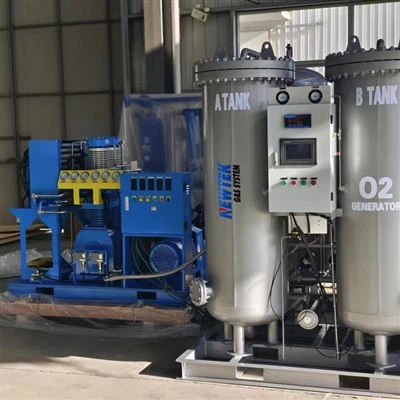
The PSA modular oxygen generator adopts a modular design, which allows the equipment to be flexibly combined according to different oxygen demand requirements. Users can add or reduce oxygen production modules according to the needs of actual applications to achieve the required oxygen output. For example, for a large hospital or industrial site, multiple oxygen production modules can be added to meet the large flow of oxygen demand; while for small and medium-sized clinics or laboratories, only a small number of modules are required. This flexible design not only improves the adaptability and scalability of the equipment, but also enables users to upgrade and adjust the system at any time according to future changes in demand.
In addition, the device can also be configured with a SMART compressed purified air source module. This module integrates advanced air compression and purification technology and can provide a pure and stable compressed air source. Through multi-stage filtration and drying treatment, moisture, oil and impurities in the air are effectively removed to ensure that the air quality entering the oxygen production module is excellent, further improving oxygen production efficiency and gas production quality.
(2) Independent integration: the system is divided into oxygen production module and gas source module
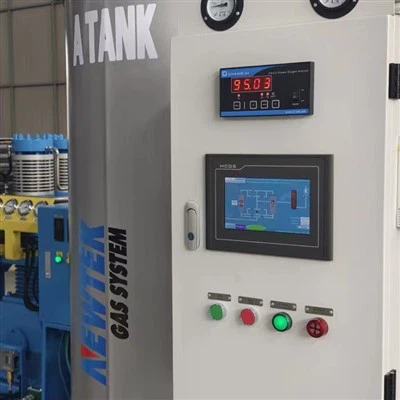
The design of the PSA modular oxygen generator emphasizes independent integration. The system is divided into oxygen production module and gas source module. The air source module has built-in high-quality air compressors, air handling systems, air storage tanks and other key components. This structural design makes the equipment more compact and occupies a small area, making it suitable for use in environments with limited space. The independent integrated design also simplifies the installation and maintenance process, and users can flexibly configure and adjust the position and quantity of each module according to their needs.
(3) Performance guarantee: multiple operation monitoring and protection
In order to ensure the long-term stable operation of the equipment, the PSA modular oxygen generation device is equipped with multiple operation monitoring and protection systems. By real-time monitoring of various operating parameters, the equipment can promptly detect and handle potential faults and problems to ensure the safety and reliability of the system. As the core component of the oxygen generation device, the performance of the molecular sieve directly affects the purity and output of oxygen. In order to effectively ensure the performance of the molecular sieve, the equipment can be equipped with an optional combined air drying system to prevent moisture and impurities in the air from damaging the molecular sieve and extend the service life of the molecular sieve to more than 100,000 hours.
(4) Intelligent and convenient: one-button start, fully automatic operation
The PSA modular oxygen generation device has intelligent operation functions, and one-button start can achieve fully automatic operation. The user does not need to perform complicated operations. Just press the start button and the device will automatically complete the entire process of air compression, purification, adsorption and desorption, and provide oxygen instantly. This intelligent design not only improves the convenience of equipment operation, but also reduces the need for professional operators, greatly reducing labor costs.
(5) Expansion and upgrade: multiple system upgrade options
The equipment design takes into account future expansion and upgrade needs and provides multiple system upgrade options. Users can choose upgrade modules with different specifications and functions based on actual usage and future oxygen demand. For example, additional oxygen production modules can be added to increase oxygen production, or the air treatment system can be upgraded to further improve the air purification effect. This flexible scalability enables the PSA oxygen generator to adapt to a variety of complex and changing application environments.
(6) Quiet operation: special noise reduction design
In order to reduce noise interference during equipment operation, the PSA modular oxygen generator adopts a sturdy and specially designed chassis with noise reduction design. By optimizing the design of the air compressor and air flow path, the operating noise is greatly reduced, providing a quieter working environment. This is particularly important for places that require a quiet environment, such as hospitals and laboratories.
(7) Simple operation: no need for specialized operators
Thanks to the highly automated and intelligent design of the equipment, the operation of the Modular PSA Oxygen Generators is extremely simple. Users do not need to have professional operating knowledge and skills, they only need to follow the instructions to perform basic operations and monitoring. This not only reduces the difficulty of operation, but also reduces the need for specialized operators, further reducing labor costs.
Some application fields of this product
(1) Chemical industry
1) Oxidation reaction
Improved reaction rates: In the chemical industry, oxidation reactions are the basis of many key chemical manufacturing processes, such as sulfuric acid production and ammonia synthesis. These reactions often require high-purity oxygen to increase reaction rates and increase yields. Using modular oxygen generators, reaction conditions can be optimized by adjusting the oxygen supply to the needs of specific reactions. For example, in sulfuric acid production, by providing a high concentration of oxygen, the rate at which sulfur dioxide is converted into sulfur trioxide in the sulfur combustion reaction can be significantly increased, thereby improving the production efficiency of sulfuric acid. Similarly, in the ammonia synthesis process, providing stable and high-purity oxygen can promote the reaction of nitrogen and hydrogen, improving the rate and yield of ammonia synthesis.
Optimize reaction conditions: Many chemical reactions have very strict requirements on oxygen concentration. Too high or too low oxygen concentration will affect the reaction effect. The modular oxygen generator can provide precise oxygen supply by flexibly adjusting the purity and flow rate of oxygen to ensure that the reaction proceeds under optimal conditions. This flexibility allows the equipment to be adjusted according to the needs of different reactions, thereby achieving the best reaction results in different chemical production processes and improving product quality and production efficiency.
2) Catalyst activation
Maintain catalyst activity: Catalytic reactions are widely used in the chemical industry, many of which require stable and high-purity oxygen to maintain catalyst activity. For example, in catalytic oxidation processes, the effectiveness of the catalyst depends on the purity and stability of oxygen. The modular oxygen generator can provide continuous and high-purity oxygen to ensure that the catalyst maintains its optimal performance throughout the reaction process, thereby improving the efficiency of the catalytic reaction and the quality of the product.
Flexible production needs: A key advantage of modular design is its flexibility, allowing it to be expanded or adjusted based on actual production needs. The demand for oxygen may change at different stages of the catalytic process, for example, the demand for oxygen may be different during the start-up phase and the stabilization phase. The modular oxygen generator allows users to dynamically adjust the oxygen supply according to actual demand, thereby better adapting to changes in the production process and ensuring efficient catalytic processes. This flexibility not only improves the adaptability of the production process, but also optimizes overall production efficiency.
Reduce catalyst consumption: Since high-purity oxygen can maintain catalyst activity and reduce catalyst failure, the application of modular oxygen generators can also reduce catalyst consumption and replacement frequency. This not only saves the cost of the catalyst, but also reduces downtime during the production process, thus improving the economic efficiency and stability of the production line.
(2) Wastewater treatment
1) Aerobic treatment
Improve organic matter degradation efficiency: In the aerobic stage of wastewater treatment, sufficient oxygen is crucial to promote the microorganisms in activated sludge to decompose organic matter. Activated sludge requires a continuous supply of oxygen during treatment to maintain its biodegradability. If the oxygen supply is insufficient, the degradation efficiency of microorganisms will be significantly reduced, resulting in the inability to effectively remove organic matter in wastewater, thus affecting water quality. Through its flexible design, the modular oxygen generator can adjust the flow and purity of oxygen in real time according to the specific needs of wastewater treatment, ensuring that the oxygen supply during the organic matter degradation process is always at an optimal level. This ability to adjust allows the treatment process to operate efficiently, significantly improving the overall efficiency and effectiveness of wastewater treatment.
Adapt to different scales of treatment needs: Wastewater treatment facilities vary in size and capacity, and treatment needs will change accordingly. The design of the modular oxygen generator allows users to flexibly adjust the oxygen generation module according to the actual scale and load requirements of wastewater treatment. This flexibility allows the equipment to be adapted to a variety of application scenarios, from small sewage treatment stations to large industrial wastewater treatment plants. Through modular expansion, users can easily increase or decrease oxygen generation capacity according to changes in processing capacity, thus avoiding excessive investment and waste of resources. The scalability of the equipment not only improves the adaptability of wastewater treatment facilities, but also provides long-term economic benefits.
2) Gas mixing
Optimize the mixing of oxygen and other gases: In the wastewater treatment process, in addition to oxygen, the participation of other gases may also have an important impact on the treatment effect. For example, some processes require oxygen to be mixed with nitrogen or carbon dioxide to maintain specific environmental conditions. The design of the modular oxygen generator makes the gas mixing process more flexible and precise. The equipment can adjust the flow rate and proportion of gas according to the needs of the treatment process to achieve the best gas mixing effect. This optimization capability helps ensure the stability of the gas environment during wastewater treatment, thereby improving treatment effectiveness and efficiency.
Improve treatment system flexibility: Gas requirements in wastewater treatment can vary over time and as treatment conditions change. Modular oxygen generators allow users to adjust gas supply and mixing ratios based on actual operating conditions. For example, when treating certain types of wastewater, different gas combinations may be needed to optimize treatment. The modular nature of the equipment makes this adjustment easier and more efficient. By flexibly adjusting the gas ratio and supply, users can optimize the wastewater treatment process, improve water quality, and respond to different treatment challenges. This flexibility not only improves the adaptability of the processing system, but also ensures the efficiency and stability of the processing process.
(3) Glass manufacturing
1) Melting process
Improved combustion efficiency: In glass manufacturing, the melting process is a critical step that involves heating raw materials to high temperatures to form molten glass. The introduction of oxygen is crucial to improving the combustion efficiency of the melting furnace. High-purity oxygen can improve the combustion of fuel, making combustion more complete and efficient. This not only increases the calorific value of combustion, but also reduces exhaust emissions and heat loss. By optimizing combustion efficiency, the equipment is able to reach the required high temperatures in a shorter time, thus speeding up the melting process. This improvement not only improves production efficiency, but also reduces energy consumption and helps reduce production costs.
Accelerate the melting speed: During the glass melting process, the melting speed directly affects the continuity of production and the quality of the glass. Adequate oxygen supply can significantly increase the temperature of the melting furnace and shorten the melting time of the raw materials. The flexible design of the modular oxygen generator allows the oxygen supply to be dynamically adjusted based on the needs of the melting furnace, so that the oxygen supply can be increased during peak production periods to cope with higher production demand, or reduced during off-peak periods to reduce operating costs. Optimizing the melting speed not only improves production efficiency, but also ensures glass uniformity and quality so that the final product meets strict industrial standards and specifications.
Optimize glass quality: Precise oxygen control not only affects the efficiency of the melting process, but is also directly related to the final quality of the glass. A stable supply of oxygen helps maintain a uniform temperature distribution during the melting process, reducing bubbles and impurities in the glass melt, thereby improving the transparency and strength of the glass. The modular oxygen generator can be adjusted according to the actual needs during the production process, so that the temperature and atmosphere during the melting process are maintained at an optimal state, thereby producing high-quality glass products. This optimization of production conditions not only meets high quality requirements, but also improves the overall reliability and stability of the glass manufacturing process.
FAQ
Q: What is the oxygen generation capacity of this device?
Q: Is the installation and commissioning process of the equipment complicated?
Q: Does this equipment have remote monitoring capabilities?
Q: Is the equipment maintenance and servicing workload heavy?
Q: How is the energy consumption of the equipment?
Q: How durable is the equipment?
Hot Tags: psa modular oxygen generator, China psa modular oxygen generator manufacturers, suppliers, Modular Oxygen generators, modular oxygen plant, modular medical oxygen generating, PSA Modular Oxygen Generator, Modular PSA Oxygen Generators, modular PSA oxygen generator