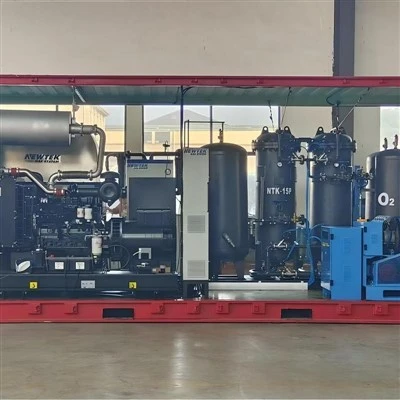
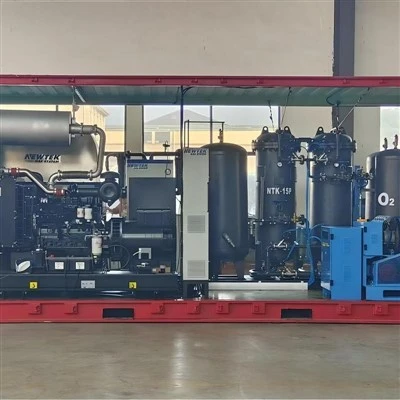
The process principle of vacuum pressure swing adsorption (VPSA) oxygen production process is basically the same as PSA. The main difference is that after the adsorption reaches equilibrium (adsorption saturation), the way in which the nitrogen adsorbed in the oxygen-producing zeolite molecular sieve is desorbed is different.
The pressure swing adsorption oxygen production process is essentially a PSA process. The VPSA process, which is currently the most widely used in industrial production, is a type of PSA process. For the most widely used zeolite molecular sieve oxygen production process, the raw material used to produce oxygen using the pressure swing adsorption process is air, which can be simplified as a binary mixed system composed of oxygen and nitrogen. The adsorption forces of nitrogen and oxygen on the zeolite molecular sieve are different. The force of nitrogen on the zeolite molecular sieve is greater than that of oxygen, which makes nitrogen easier to be adsorbed on the zeolite molecular sieve than oxygen.
Under isothermal conditions, when the pressurized air passes through the oxygen-producing zeolite molecular sieve packing layer in the adsorber (or tower), the equilibrium adsorption amount of nitrogen is much higher than that of oxygen. Under medium and low pressures, the oxygen-producing zeolite molecular sieve preferentially adsorbs nitrogen, thereby separating oxygen and nitrogen. When the pressure of the adsorber (or tower) decreases, the equilibrium adsorption amount of nitrogen decreases more than the equilibrium adsorption amount of oxygen. By utilizing this characteristic of the adsorption between nitrogen, oxygen and oxygen-producing zeolite molecular sieve, the adsorbed nitrogen is desorbed from the oxygen-producing zeolite molecular sieve by reducing the pressure or evacuating the vacuum, thereby restoring the adsorption performance of the oxygen-producing zeolite molecular sieve for nitrogen. In this way, the continuous production of oxygen can be achieved by using 2 or more adsorbers (or towers) for pressurized adsorption and decompressed desorption cyclic operation.
The VPSA process adds a vacuum pumping device compared to the PSA process. When the oxygen-producing zeolite molecular sieve adsorbs nitrogen to saturation, the pressure of the adsorber (or tower) is first reduced by venting, and then the vacuum pumping device is turned on to further reduce the pressure in the adsorber until it is below the standard atmospheric pressure. By maintaining a lower desorption pressure, the nitrogen adsorbed in the oxygen-producing zeolite molecular sieve is desorbed more fully, thereby enhancing the adsorption amount of nitrogen by the oxygen-producing zeolite molecular sieve after regeneration, thereby improving the purity of the product oxygen. By adding vacuum equipment, the VPSA process can produce oxygen with higher purity than the PSA device of the same scale, and the oxygen production capacity of the device is also greater, so the VPSA process has become a widely used pressure swing adsorption oxygen production process.
The vacuum pressure swing adsorption (VPSA) oxygen production process is developed on the basis of the PSA oxygen production process.
The main process characteristics of the VPSA oxygen production process are pressure adsorption and vacuum desorption. The main difference between it and the PSA process is that a vacuum blower (or vacuum pump) is added to the exhaust gas discharge pipeline of the adsorption bed. In the process operation "step purge", the vacuum pump is started to vacuum the regeneration bed and purge the product gas at the same time. The two operations of vacuuming increase the desorption rate and degree of nitrogen in the molecular sieve by vacuuming.
Hot Tags: vpsa oxygen generator, China vpsa oxygen generator manufacturers, suppliers, vpsa plant, vpsa oxygen plant, VPSA Oxygen Generator