Why Choose Us?
Rich Experience
NEWTEK is the LARGEST supplier and Manufacturer of PSA oxygen and nitrogen gas generators in China. We have been in continuously R&D for the on-site gas generators since 1987.
Reliable Product Quality
Our long experience in advanced O2 and N2 generators designing and customization ensures the high energy saving,high quality and lowest investment cost for the client in market worldwide.
Wide Range of Applications
NEWTEK provides custom oxygen and nitrogen generator solutions to a wide range of industries. Whether it is wastewater treatment, mining, fish farming, healthcare, tire inflation or laser cutting, we can design and customize cost-effective solutions.
Reliable Product Quality
Our solutions range from oxygen/nitrogen generation units, modular oxygen units to containerized units with built-in air conditioning, all of which can include our innovative NTK series generators - basically whatever your requirements are, we can imagine, design and build your solution in our custom manufacturing environment.
Modular oxygen generator is an efficient and flexible device specially designed for on-site generation of high-purity oxygen in industrial environments. Through pressure swing adsorption technology (PSA), the device separates oxygen from the air to provide a continuous and stable gas supply. Its modular design allows the generation capacity to be increased or decreased as needed to meet the production needs of different scales. This flexibility not only improves the scalability of the system, but also simplifies the installation and maintenance of the equipment. Modular oxygen generators are widely used in metal processing, chemical reactions, wastewater treatment and other fields, which can effectively reduce the cost of transporting and storing oxygen while improving overall production efficiency and safety.

These devices generate high-purity oxygen by compressing air and separating nitrogen in a special adsorption tower. The equipment is mainly used in hospitals, industries, laboratories and other places that require a stable supply of oxygen.

The air is compressed by a full-performance air compressor and enters a multi-stage filter to remove most of the particulate dust impurities. Then, the hot air is cooled by a cold dryer to remove moisture from the air.

PSA oxygen generator is developed based on the principle that the adsorbent has different adsorption capacity for different gas components when it is under different pressure conditions at room temperature, and completes air separation through pressure swing adsorbent.

Industrial Oxygen Generator Machine
For large and medium-sized PSA oxygen devices with vacuum desorption, the adsorption pressure of the ZMS tower is generally less than 0.2 MPa, and the adsorption pressure of the CMS tower is generally 0.2~0.6MPa; the adsorption pressure of atmospheric desorption is generally 0.2~0.45 MPa.

With the development of economy and society, people's requirements for domestic water, industrial water and water environment are increasing day by day, which puts forward higher requirements for various water treatment process technologies in water supply and drainage.

The main features of the basic pressure swing adsorption (PSA) oxygen production process are pressure adsorption and pressure reduction flushing regeneration.

PSA Modular Oxygen Generation Plant
First and foremost, it allows on-site production of oxygen without the need to constantly purchase and transport oxygen tanks.

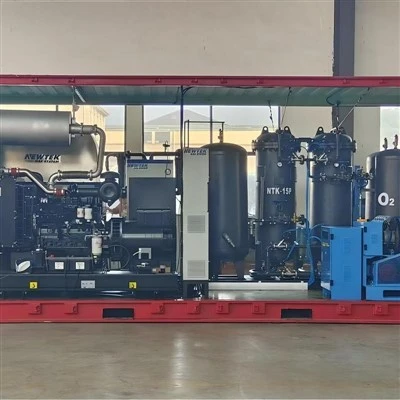
NEWTEK containerized oxygen plant, includes 530 LPM medical oxygen generator (29 Nm3/hr continuous flow), 18 Nm3/hr 10 cylinder filling station, spare manifold, gas cylinders, pressure regulator, flow meter and humidifier.

The system integrates all core components such as air compressor, cold dryer, oxygen storage tank, etc., all placed in a container. Compact design, space saving, multi-functional, durable.
Advantages of PSA Modular Oxygen Generator
Modular Design
The oxygen generator system mainly consists of oxygen generation modules, booster modules, and control systems. Each module has specific functions that operate independently and can be combined and expanded according to actual oxygen demand. This makes it easy to store and transport, and the entire module can also be maintained and upgraded in the future without interrupting the overall oxygen production or supply.
Built-in Oxygen Storage Tank
Integrated oxygen storage tanks are another key advantage of the pressure swing adsorption oxygen generator. They are designed to store the oxygen produced to ensure continuous supply during the operation or brief shutdown of the O2 generator. The compact storage tanks facilitate plug-and-play installation without requiring extensive site preparation.
Intelligent Control System
Intelligent control systems can achieve automated operation of oxygen generator machines without the need for dedicated staff, reducing labor costs. It can also monitor the status of the equipment in real-time, ensuring the stability and safety of oxygen production.
Combined Structure
The combined structure of modular PSA oxygen generators allows users to add or remove modules according to their actual needs, achieving flexible expansion and upgrading. Multiple oxygen production modules can be used in parallel to increase the total oxygen production of the system and meet larger-scale oxygen demand. Therefore, when the oxygen demand in hospitals increases, only corresponding modules need to be added, without the need to replace the entire equipment.
Chemical industry
Improved reaction rates: In the chemical industry, oxidation reactions are the basis of many key chemical manufacturing processes, such as sulfuric acid production and ammonia synthesis. These reactions often require high-purity oxygen to increase reaction rates and increase yields. Using modular oxygen generators, reaction conditions can be optimized by adjusting the oxygen supply to the needs of specific reactions. For example, in sulfuric acid production, by providing a high concentration of oxygen, the rate at which sulfur dioxide is converted into sulfur trioxide in the sulfur combustion reaction can be significantly increased, thereby improving the production efficiency of sulfuric acid. Similarly, in the ammonia synthesis process, providing stable and high-purity oxygen can promote the reaction of nitrogen and hydrogen, improving the rate and yield of ammonia synthesis.
Maintain catalyst activity: Catalytic reactions are widely used in the chemical industry, many of which require stable and high-purity oxygen to maintain catalyst activity. For example, in catalytic oxidation processes, the effectiveness of the catalyst depends on the purity and stability of oxygen. The modular oxygen generator can provide continuous and high-purity oxygen to ensure that the catalyst maintains its optimal performance throughout the reaction process, thereby improving the efficiency of the catalytic reaction and the quality of the product.
Wastewater treatment
Improve organic matter degradation efficiency: In the aerobic stage of wastewater treatment, sufficient oxygen is crucial to promote the microorganisms in activated sludge to decompose organic matter. Activated sludge requires a continuous supply of oxygen during treatment to maintain its biodegradability. If the oxygen supply is insufficient, the degradation efficiency of microorganisms will be significantly reduced, resulting in the inability to effectively remove organic matter in wastewater, thus affecting water quality. Through its flexible design, the modular oxygen generator can adjust the flow and purity of oxygen in real time according to the specific needs of wastewater treatment, ensuring that the oxygen supply during the organic matter degradation process is always at an optimal level. This ability to adjust allows the treatment process to operate efficiently, significantly improving the overall efficiency and effectiveness of wastewater treatment.
Optimize the mixing of oxygen and other gases: In the wastewater treatment process, in addition to oxygen, the participation of other gases may also have an important impact on the treatment effect. For example, some processes require oxygen to be mixed with nitrogen or carbon dioxide to maintain specific environmental conditions. The design of the modular oxygen generator makes the gas mixing process more flexible and precise. The equipment can adjust the flow rate and proportion of gas according to the needs of the treatment process to achieve the best gas mixing effect. This optimization capability helps ensure the stability of the gas environment during wastewater treatment, thereby improving treatment effectiveness and efficiency.
Glass manufacturing
Improved combustion efficiency: In glass manufacturing, the melting process is a critical step that involves heating raw materials to high temperatures to form molten glass. The introduction of oxygen is crucial to improving the combustion efficiency of the melting furnace. High-purity oxygen can improve the combustion of fuel, making combustion more complete and efficient. This not only increases the calorific value of combustion, but also reduces exhaust emissions and heat loss. By optimizing combustion efficiency, the equipment is able to reach the required high temperatures in a shorter time, thus speeding up the melting process. This improvement not only improves production efficiency, but also reduces energy consumption and helps reduce production costs.
Accelerate the melting speed: During the glass melting process, the melting speed directly affects the continuity of production and the quality of the glass. Adequate oxygen supply can significantly increase the temperature of the melting furnace and shorten the melting time of the raw materials. The flexible design of the modular oxygen generator allows the oxygen supply to be dynamically adjusted based on the needs of the melting furnace, so that the oxygen supply can be increased during peak production periods to cope with higher production demand, or reduced during off-peak periods to reduce operating costs. Optimizing the melting speed not only improves production efficiency, but also ensures glass uniformity and quality so that the final product meets strict industrial standards and specifications.
PSA Modular Oxygen Generators Operating Principle
The PSA Oxygen Generator works the same as our Nitrogen PSA Generators with one exception. The adsorption media inside the vessel for an Oxygen PSA is a material called a Zeolite, for a Nitrogen PSA the material is called CMS (Carbon Molecular Sieve). In both cases compressed air is fed into one of the absorption towers. In the case of an Oxygen generator the Nitrogen in the Air is absorbed onto the Zeolite surface and the Oxygen passes out of the vessel at the desired purity. Once the Zeolite absorption material become saturated with Nitrogen the compressed air is switched to the other vessel which now does the absorption while the other vessel is regenerated.
The Zeolite material have a very unique property that when the pressure is released back to atmospheric pressure during the regeneration process the Zeolite releases the Nitrogen that was stored on its surface. The process consists of switching the compressed air from one vessel to the other by means of a series of valves in a very precise sequence to take advantage of this unique property.
This process provides a constant flow of Oxygen for a multitude of applications.

How Zeolite Works in PSA Modular Oxygen Generators?
● Selective adsorption: Zeolite's porous structure allows it to absorb gases based on their molecular size and polarity. In a typical PSA generator, zeolite absorbs nitrogen from the air, allowing oxygen to pass through as the main product. This selectivity is crucial for producing high-purity oxygen.
● High absorption capacity: Zeolite can hold a large amount of nitrogen, which is important for the efficiency of PSA generators. The ability to absorb large amounts of nitrogen during each cycle ensures that the oxygen produced is of high purity.
Another key feature of zeolite in PSA generators is its ability to be reused. When the pressure is reduced, zeolite releases the absorbed nitrogen, making it usable for multiple cycles of absorption and release. This reuse capability is important for the long-term operation of PSA systems, as it allows continuous operation without needing to replace the material often.
Zeolite is also known for its durability and stability under the operating conditions of PSA generators. It can withstand repeated pressure changes while keeping its structure and absorption properties over time. The durability ensures the long-term reliability and efficiency of the generator, by which maintenance cost and downtime is reduced.
Features Of PSA Modular Oxygen Generator
Modular design: multiple modules and flexible combination
The PSA modular oxygen generator adopts a modular design, which allows the equipment to be flexibly combined according to different oxygen demand requirements. Users can add or reduce oxygen production modules according to the needs of actual applications to achieve the required oxygen output. For example, for a large hospital or industrial site, multiple oxygen production modules can be added to meet the large flow of oxygen demand; while for small and medium-sized clinics or laboratories, only a small number of modules are required. This flexible design not only improves the adaptability and scalability of the equipment, but also enables users to upgrade and adjust the system at any time according to future changes in demand.
Independent integration: the system is divided into oxygen production module and gas source module
The design of the PSA modular oxygen generator emphasizes independent integration. The system is divided into oxygen production module and gas source module. The air source module has built-in high-quality air compressors, air handling systems, air storage tanks and other key components. This structural design makes the equipment more compact and occupies a small area, making it suitable for use in environments with limited space. The independent integrated design also simplifies the installation and maintenance process, and users can flexibly configure and adjust the position and quantity of each module according to their needs.
Performance guarantee: multiple operation monitoring and protection
In order to ensure the long-term stable operation of the equipment, the PSA modular oxygen generation device is equipped with multiple operation monitoring and protection systems. By real-time monitoring of various operating parameters, the equipment can promptly detect and handle potential faults and problems to ensure the safety and reliability of the system. As the core component of the oxygen generation device, the performance of the molecular sieve directly affects the purity and output of oxygen. In order to effectively ensure the performance of the molecular sieve, the equipment can be equipped with an optional combined air drying system to prevent moisture and impurities in the air from damaging the molecular sieve and extend the service life of the molecular sieve to more than 100,000 hours.
Intelligent and convenient: one-button start, fully automatic operation
The PSA modular oxygen generation device has intelligent operation functions, and one-button start can achieve fully automatic operation. The user does not need to perform complicated operations. Just press the start button and the device will automatically complete the entire process of air compression, purification, adsorption and desorption, and provide oxygen instantly. This intelligent design not only improves the convenience of equipment operation, but also reduces the need for professional operators, greatly reducing labor costs.
Expansion and upgrade: multiple system upgrade options
The equipment design takes into account future expansion and upgrade needs and provides multiple system upgrade options. Users can choose upgrade modules with different specifications and functions based on actual usage and future oxygen demand. For example, additional oxygen production modules can be added to increase oxygen production, or the air treatment system can be upgraded to further improve the air purification effect. This flexible scalability enables the PSA oxygen generator to adapt to a variety of complex and changing application environments.
Quiet operation: special noise reduction design
In order to reduce noise interference during equipment operation, the PSA modular oxygen generator adopts a sturdy and specially designed chassis with noise reduction design. By optimizing the design of the air compressor and air flow path, the operating noise is greatly reduced, providing a quieter working environment. This is particularly important for places that require a quiet environment, such as hospitals and laboratories.
Simple operation: no need for specialized operators
Thanks to the highly automated and intelligent design of the equipment, the operation of the Modular PSA Oxygen Generators is extremely simple. Users do not need to have professional operating knowledge and skills, they only need to follow the instructions to perform basic operations and monitoring. This not only reduces the difficulty of operation, but also reduces the need for specialized operators, further reducing labor costs.
It is necessary to maintain for daily use and pay enough attention to equipment maintenance. Good operating habits and regular maintenance can prolong the normal service life of equipment, reduce energy consumption, reduce maintenance costs, effectively avoid sudden failures, and greatly reduce the negative impact of failures on production.
1. Normal supply of power, water, air and temperature conditions required by the machineshould be ensured. Normal opening and closing are also important, especially the stability of the power supply voltage. If necessary, a voltage stabilizer can be installed to reduce the damage to the controller and electromagnetic caused by power supply problems.
2. Pay attention to the air volume, temperature and pressure at the inlet of the cold dryer at any time, and keep the evaporation pressure of the cold dryer between 0.4 and 0.5 MPa, and do not exceed the rated value.
3. Check the automatic drain valve of the filter and the automatic drain of the cold dryer every day to avoid clogging,drainage and sewage discharge.
4. Regularly check whether the heat sink of the cold dryer is clean every week, so as not to affect the effectiveness and life of the dryer due to poor heat dissipation.
5. Perform operation and daily maintenance according to the requirements of the User Manual, and check the sensitivity of the solenoid valve/pneumatic valve, the pressure range of the pressure regulating valve, the accuracy of the gas analyzer, the compression of the adsorption tower, and the exhaust state of the muffler from time to time.
Our Factory
NEWTEK is the LARGEST supplier and Manufacturer of PSA oxygen and nitrogen gas generators in China. We have been in continuously R&D for the on-site gas generators since 1987. Our long experience in advanced O2 and N2 generators designing and customization ensures the high energy saving,high quality and lowest investment cost for the client in market worldwide. Engaged in the design, production and sales of PSA oxygen generator, VPSA oxygen generator and other equipment.

Ultimate FAQ Guide to PSA Modular Oxygen Generator
Hot Tags: psa modular oxygen generator, China psa modular oxygen generator manufacturers, suppliers, Modular PSA Oxygen Generators, modular oxygen plant, PSA Modular Oxygen Generation Plant, PSA Modular Oxygen Generator, modular PSA oxygen generator, modular medical oxygen generating