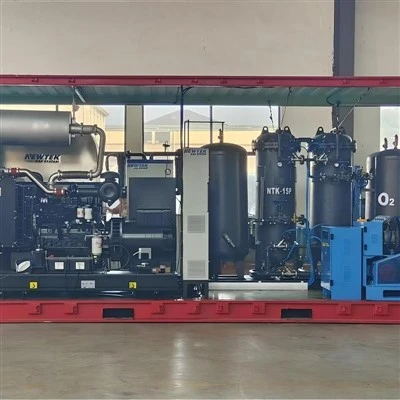
Stability Under Continuous Load
In continuous industrial operation, the primary question is not whether an oxygen system can reach a certain purity or capacity in laboratory conditions. The real question is whether the system can maintain stable output, predictable performance, and controllable operating cost over long, uninterrupted production cycles.
Industries such as mining, metallurgy, wastewater treatment, glass manufacturing, chemical processing, pulp and paper, and energy-related facilities do not operate in short batches. They require oxygen supply that is:
Continuous rather than intermittent
Predictable rather than fluctuating
Easy to maintain under real industrial conditions
Economically sustainable over long operating hours
Within this context, Pressure Swing Adsorption (PSA) and Vacuum Pressure Swing Adsorption (VPSA) have become the two dominant technologies for on-site oxygen generation. Both are mature technologies, but they behave very differently when placed under continuous industrial load.
Choosing between PSA and VPSA is not a branding decision or a budget-only decision. It is a system engineering choice that affects energy cost, maintenance strategy, footprint, redundancy design, and long-term operational risk.
This article focuses on how PSA and VPSA perform when used for continuous industrial operation and how engineers, project managers, and plant owners should evaluate them.
PSA vs VPSA
Before comparing performance under continuous operation, it is important to clarify how the two technologies work at a process level.
PSA Oxygen Systems
PSA systems generate oxygen by separating nitrogen from compressed air using zeolite molecular sieve. The process operates at elevated pressure, typically between 0.6 and 1.0 MPa.
Core process features:
Air is compressed and dried
Compressed air passes through adsorption beds
Nitrogen is adsorbed, oxygen passes through
Beds switch between adsorption and regeneration using pressure release
Key characteristics:
Relies mainly on pressure variation
No vacuum pump required
Uses air compressors as the main energy consumer
Generally simpler mechanical layout
VPSA Oxygen Systems
VPSA uses the same adsorption principle but combines moderate positive pressure during adsorption with vacuum during regeneration.
Core process features:
Air is supplied at low pressure, often via blower instead of high-pressure compressor
Adsorption occurs at near-atmospheric or slightly elevated pressure
Regeneration is done using a vacuum pump
Larger adsorption beds, slower cycle time
Key characteristics:
Lower adsorption pressure, deeper regeneration
Requires vacuum pumps
Larger equipment size
Lower specific energy consumption at large scale
The process difference becomes critical when evaluating continuous operation.
What Actually Matters
In real industrial plants, continuous operation means:
24 hours per day, 7 days per week
Thousands of operating hours per year
Exposure to dust, heat, humidity, vibration, and power fluctuations
Maintenance performed under production pressure
Under these conditions, system selection must consider:
Energy consumption over long hours
Component wear and replacement cycles
Stability of oxygen purity and flow
Tolerance to process disturbances
Ease of redundancy design
Short-term performance data is almost meaningless if long-term operating behavior is not understood.
Energy Efficiency in Long-Term Operation
PSA Energy Profile
PSA systems depend heavily on compressed air. Compressing air to 0.6–1.0 MPa is energy intensive.
In continuous operation:
Air compressors run almost constantly
Electricity cost becomes the dominant operating expense
Efficiency depends strongly on compressor type, load factor, and inlet conditions
Typical energy characteristics:
Good efficiency at small to medium capacities
Efficiency drops when scaled too large
Sensitive to air quality and ambient temperature
For continuous operation at modest oxygen demand, PSA can be economically reasonable. However, when demand grows, the compressor energy becomes a major burden.
VPSA Energy Profile
VPSA uses lower pressure air supply, often with blowers instead of high-pressure compressors.
In continuous operation:
Blower power is much lower than compressor power
Vacuum pump adds energy consumption, but total is still lower at large scale
Energy per cubic meter of oxygen decreases as capacity increases
Typical energy characteristics:
Higher initial investment
Lower long-term power cost for large and continuous demand
More stable energy efficiency under varying load
For large-scale, continuous oxygen demand, VPSA generally offers lower specific power consumption.
Stability of Output Under Continuous Load
PSA Stability
PSA systems use fast switching cycles. Over time:
Valve wear becomes a critical factor
Cycle timing drift can affect purity
Adsorbent performance degrades gradually
In continuous operation:
Output stability depends heavily on valve reliability and control accuracy
Frequent switching increases mechanical stress
Sudden load changes may cause short-term purity fluctuation
PSA can maintain stable output, but it requires:
High-quality valves
Well-designed control logic
Regular performance monitoring
VPSA Stability
VPSA operates with slower cycles and larger adsorption beds.
In continuous operation:
Fewer switching cycles per hour
Less mechanical stress on valves
Deeper regeneration gives more stable adsorption capacity
As a result:
Purity stability is generally higher
Flow fluctuation is lower
System is more tolerant to load variation
For processes where oxygen stability directly affects product quality or safety, VPSA provides a stronger margin.
Maintenance in a 24/7 Environment
PSA Maintenance Characteristics
Key wear components:
Solenoid or pneumatic valves
Air compressor
Air treatment system (filters, dryers)
In continuous operation:
Valve replacement is relatively frequent
Compressor maintenance is critical
Air quality strongly affects adsorbent life
Maintenance profile:
More frequent small interventions
Lower cost per intervention
Easier access to spare parts
PSA is suitable where maintenance teams are experienced and spare parts logistics are reliable.
VPSA Maintenance Characteristics
Key wear components:
Vacuum pump
Blower
Large switching valves
In continuous operation:
Fewer switching actions reduce valve wear
Vacuum pump requires regular inspection
Larger components mean higher replacement cost
Maintenance profile:
Less frequent interventions
More specialized service
Higher cost per major component
VPSA is suitable where long-term stability is prioritized over frequent small maintenance actions.
System Scale and Footprint
PSA at Different Scales
PSA is compact and modular.
Suitable for small to medium capacities
Easy to containerize or skid-mount
Flexible for distributed installations
However:
Scaling up means adding more modules
Complexity increases with multiple units
VPSA at Different Scales
VPSA is naturally large-scale.
Requires larger adsorption vessels
Needs space for vacuum system
Better suited for centralized oxygen supply
For continuous industrial plants with stable large demand, VPSA integrates more naturally into the plant layout.
Redundancy and Risk Management
In continuous operation, failure is not an option. Redundancy strategy matters.
PSA Redundancy
Advantages:
Easy to design N+1 with multiple modules
Failure of one unit does not stop the whole system
Modular expansion is simple
Disadvantages:
More units means more valves, more control points
System complexity increases
VPSA Redundancy
Advantages:
Fewer major units
Higher inherent stability
Disadvantages:
Single large unit failure has big impact
Redundancy requires large capital investment
PSA fits distributed redundancy. VPSA fits centralized high-stability systems with backup planning.
Cost Over the Full Life Cycle
Initial Investment
PSA: Lower initial cost
VPSA: Higher initial cost due to size and vacuum system
Operating Cost
PSA: Higher power consumption, moderate maintenance
VPSA: Lower power consumption, heavier but less frequent maintenance
Long-Term Cost
For continuous operation:
Small to medium scale: PSA often cheaper over life cycle
Large and stable demand: VPSA usually cheaper over long term
The correct choice depends on demand profile, energy price, and maintenance capability.
Application-Based Selection Logic
When PSA Is More Suitable
Small to medium oxygen demand
Limited space
Need for modular and flexible layout
Projects with lower capital budget
Sites with strong maintenance teams
Typical industries:
Small wastewater plants
Medium metal processing lines
Food and beverage processing
Local medical or industrial supply
When VPSA Is More Suitable
Large and stable oxygen demand
Centralized industrial facilities
High electricity cost environment
Processes sensitive to purity fluctuation
Typical industries:
Large mines and smelters
Steel plants
Large chemical complexes
Major wastewater treatment facilities
Integration with Modern Industrial Systems
Modern plants require more than just oxygen output.
Continuous operation systems must integrate with:
DCS or PLC systems
Remote monitoring platforms
Energy management systems
Predictive maintenance tools
PSA integration:
Easier digital control
Modular data structure
Good for distributed monitoring
VPSA integration:
Strong centralized control logic
Better suited for plant-wide optimization
Ideal for energy optimization systems
Decision Framework for Engineers
To choose between PSA and VPSA for continuous operation, engineers should answer:
What is the stable average oxygen demand?
How many hours per year will the system operate?
What is the local electricity cost?
How sensitive is the process to purity fluctuation?
What maintenance resources are available?
Is modular expansion required?
How critical is footprint and installation speed?
If the system must run continuously at large scale with strict stability and low energy cost, VPSA is usually the strategic choice. If flexibility, modularity, and lower upfront cost are more important, PSA becomes the practical solution.
System Thinking, Not Equipment Thinking
The biggest mistake in oxygen system selection is treating it as a single piece of equipment rather than a long-term operating system.
For continuous industrial operation:
Oxygen generation is part of production infrastructure
Downtime has real financial and safety cost
Energy efficiency affects competitiveness
Maintenance strategy affects reliability
PSA and VPSA are not competitors in theory. They are tools for different system strategies.
Choosing correctly means:
Matching technology to operation pattern
Designing redundancy and maintenance into the system
Planning for expansion and future demand
Considering full life-cycle cost, not purchase price