Dissolved oxygen (DO) is one of the key operating parameters in aquaculture. Fish, shrimp, and other cultured aquatic species depend on sufficient oxygen in the water to maintain respiration, feeding activity, growth, and normal metabolism. When dissolved oxygen falls below the level required by a particular species and growth stage, animals may reduce feed intake, become stressed, grow more slowly, or experience increased mortality. For farms operating at high stocking densities, maintaining stable DO levels is therefore a daily production requirement rather than an optional improvement.
Traditional aeration systems transfer oxygen from the surrounding air into water. They can be suitable for many ponds and low-density farming operations, but their oxygen transfer capacity may become insufficient as biomass, feeding rates, water temperature, or biological oxygen demand increases. In these conditions, adding more aerators does not always provide the required improvement, particularly when oxygen transfer efficiency is limited.
Pressure Swing Adsorption (PSA) oxygen generation provides another approach. It produces an oxygen-enriched gas on-site from ambient air and supplies it to a suitable oxygen delivery system. When properly designed and operated, this arrangement can help aquaculture farms increase oxygen transfer capacity, respond to changing oxygen demand, and reduce dependence on delivered oxygen cylinders.
However, an important distinction must be made: producing oxygen-enriched gas does not automatically guarantee a specific dissolved oxygen concentration in the culture water. The final DO level depends on oxygen supply, transfer efficiency, water circulation, temperature, salinity, stocking density, and oxygen consumption by the cultured animals and the surrounding biological system.
Understanding how these factors work together helps farm operators determine whether PSA oxygen generation is suitable for their production requirements.
Why Maintaining Dissolved Oxygen Is Difficult in Intensive Aquaculture
In aquaculture, oxygen demand changes throughout the production cycle. A system that performs adequately at a lower stocking density may struggle after biomass increases, especially during periods of high feeding activity or elevated water temperature.
Several factors can cause dissolved oxygen levels to decline.
Increasing stocking density
As more fish or shrimp occupy a tank, pond, raceway, or recirculating aquaculture system (RAS), total respiration demand increases. The farm must provide enough oxygen to support the entire biomass, not simply maintain an acceptable reading at one measurement point.
High-density production therefore requires an oxygen supply system that can accommodate both average demand and periods of elevated consumption.
Rising water temperature
Warm water generally holds less dissolved oxygen than cooler water at the same atmospheric pressure and salinity. At the same time, the metabolic oxygen demand of many cultured species increases as temperature rises within their suitable operating range.
This combination can narrow the margin between oxygen availability and oxygen consumption. A farm may consequently experience DO problems during hot weather even when its equipment has not changed.
Feeding and biological activity
After feeding, the oxygen demand of cultured animals and the surrounding biological system can increase. Uneaten feed, fecal matter, and other organic material also contribute to microbial oxygen consumption during decomposition.
In biofloc systems and RAS facilities, microbial processes can create a substantial and continuous oxygen requirement. Oxygen supply calculations should therefore consider both animal respiration and other processes that consume oxygen.
Uneven oxygen distribution
An acceptable DO reading at the water inlet does not necessarily mean that oxygen is sufficient throughout the culture area. Poor circulation, tank geometry, dead zones, and uneven distribution can produce local areas with lower oxygen concentrations.
For this reason, farm operators should assess DO at representative locations, including areas where oxygen demand is high or water movement is limited.
Limited performance of conventional aeration
Mechanical aerators and air blowers transfer oxygen from air into water. Their actual performance depends on equipment design, water depth, operating conditions, and the difference between the oxygen concentration in the water and its equilibrium concentration.
When oxygen demand becomes high, conventional aeration may require additional equipment and electricity while still failing to deliver the desired oxygen transfer rate. PSA oxygen can supplement the existing system or support a different oxygen delivery configuration where higher oxygen transfer capacity is required.
How PSA Oxygen Generation Works
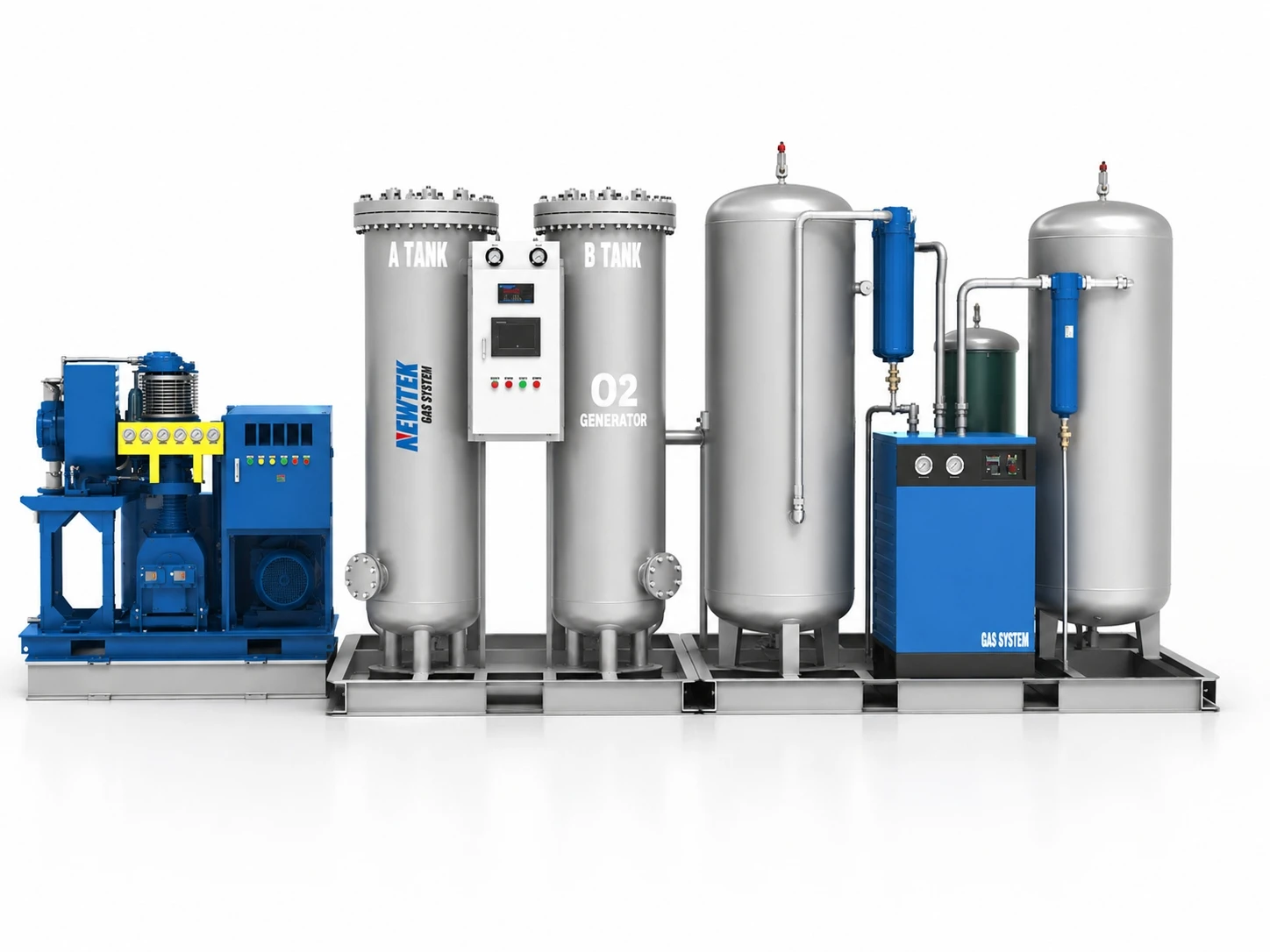
A PSA oxygen plant produces oxygen-enriched gas through pressure swing adsorption. Ambient air is first compressed and conditioned, then passed through adsorption vessels containing a suitable molecular sieve material.
Under pressure, the sieve preferentially adsorbs nitrogen and allows oxygen-enriched gas to pass through. The system periodically changes the operating pressure to release the adsorbed nitrogen and regenerate the sieve. By alternating between adsorption vessels, the equipment can provide a continuous supply of oxygen-enriched gas.
A typical system includes:
Air compressor: Supplies compressed ambient air.
Air treatment equipment: Removes contaminants and moisture as required by the system design.
Adsorption vessels: Separate nitrogen from the air stream using molecular sieve material.
Control system: Coordinates pressure cycles, valve operation, alarms, and operating parameters.
Oxygen buffer tank: Helps stabilize supply pressure and accommodate short-term fluctuations where included in the design.
Oxygen delivery equipment: Transfers the generated gas to the aquaculture system through a suitable diffuser, injector, contactor, or other oxygenation device.
The oxygen concentration at the generator outlet depends on the selected equipment configuration and operating conditions. PSA systems should be specified according to the required oxygen flow, outlet pressure, purity, duty cycle, and site conditions.
For aquaculture, the objective is not simply to generate a particular oxygen purity. The complete installation must deliver enough oxygen into the water, at the required locations and under the farm's actual operating conditions.
How PSA Oxygen Raises Dissolved Oxygen Levels
PSA oxygen improves dissolved oxygen when the oxygen-enriched gas is transferred efficiently into the culture water. The process involves several linked stages.
Stage 1: Increasing the oxygen concentration available for transfer
Air contains approximately 21% oxygen by volume. PSA equipment produces a gas stream with a higher oxygen concentration, commonly around 90%–95% for many industrial configurations, depending on the required flow and equipment design.
At a comparable operating pressure, using oxygen-enriched gas increases the oxygen partial pressure available for transfer into water. This can create a stronger driving force for oxygen dissolution than ordinary air, although the actual benefit depends on the oxygenation equipment and operating conditions.
This does not mean that every PSA installation will achieve the same DO improvement. Gas composition is only one part of the process; the transfer method determines how much of the supplied oxygen enters the water.
Stage 2: Transferring oxygen into the water
Oxygen-enriched gas can be supplied through suitable diffusers, fine-bubble systems, oxygen cones, venturi injectors, or other devices designed for the required gas flow and operating pressure.
The choice depends on the culture system. A pond may require a different arrangement from a deep tank, raceway, hatchery, or RAS loop.
Oxygen transfer generally improves when the system provides sufficient contact between gas and water. Bubble size, contact time, water depth, pressure, turbulence, and gas distribution all influence the amount of oxygen transferred.
Fine bubbles can provide a large gas–liquid contact area, but they are not automatically the best choice for every application. Some systems may benefit more from a dedicated oxygen dissolution device that operates under pressure or provides longer contact time.
Stage 3: Maintaining oxygen delivery as demand changes
In intensive aquaculture, oxygen demand can fluctuate throughout the day and production cycle. A properly selected PSA system can supply oxygen continuously while the delivery system distributes it according to operational demand.
Where the equipment and controls permit, oxygen flow can be adjusted to match changing requirements. DO probes can also be used to monitor water conditions and support automated control of oxygen delivery, provided the control system is designed and commissioned for that purpose.
The objective is to maintain the required DO range without excessive oxygen consumption or unnecessary equipment operation.
Stage 4: Distributing oxygen throughout the culture system
Oxygen must reach the areas where the cultured animals are located. Adequate water circulation helps distribute oxygen and prevent localized depletion.
In tanks and raceways, operators should consider inlet and outlet positions, circulation patterns, biomass distribution, and the possibility of dead zones. In RAS facilities, oxygenation may be integrated at selected points in the water treatment and recirculation loop.
A well-designed system therefore combines oxygen generation, oxygen transfer, water movement, and DO monitoring. Improving only one of these elements may not solve the farm's underlying problem.
PSA Oxygen Compared with Conventional Aeration
PSA oxygen and conventional aeration serve related but different purposes. Conventional aeration introduces air into water, whereas PSA equipment supplies oxygen-enriched gas that can be used with a suitable oxygen transfer device.
| Comparison factor | Conventional aeration | PSA oxygen with suitable delivery equipment |
|---|---|---|
| Gas supplied | Ambient air | Oxygen-enriched gas |
| Oxygen concentration in supplied gas | Approximately 21% | Commonly around 90%–95% for many industrial configurations |
| Oxygen transfer potential | Depends on aerator design and operating conditions | Can provide higher transfer potential when the delivery device is appropriately selected |
| Typical role | General aeration, mixing, and gas exchange | Supplementary or dedicated oxygen supply for higher oxygen demand |
| Equipment requirements | Aerators, blowers, or air distribution systems | PSA plant, air treatment, oxygen piping, and suitable transfer equipment |
| Power consumption | Depends on aerator type and operating depth | Depends on compressor, PSA system, oxygen transfer equipment, and operating strategy |
| Water circulation | Often provides useful mixing | May require separate circulation equipment |
| Best application | Systems with suitable air-transfer capacity | Systems needing greater oxygen delivery capacity or more controlled oxygen supply |
PSA oxygen is not necessarily a replacement for every aerator. In many farms, maintaining circulation and removing accumulated gases remain important functions of the existing equipment.
A combined approach may be appropriate: conventional aeration supports mixing and general gas exchange, while PSA oxygen supplies additional oxygen where the farm's demand exceeds the practical capacity of air-based systems.
The decision should be based on measured performance and total operating cost rather than oxygen concentration alone.
Which Aquaculture Systems Can Benefit from PSA Oxygen?
The suitability of PSA oxygen depends on production intensity, water management, existing equipment, and the farm's required oxygen supply.
Intensive fish farming
High-density fish farms can experience substantial oxygen demand as fish biomass increases. PSA oxygen may support tanks, raceways, and other intensive systems where conventional aeration cannot maintain the target DO under peak operating conditions.
A suitable installation must account for fish species, biomass, feeding schedules, water temperature, tank geometry, and the consequences of oxygen supply interruption.
Shrimp farming
Shrimp ponds and intensive shrimp production systems require sufficient dissolved oxygen to support respiration and the biological processes occurring in the pond.
PSA oxygen may be useful where stocking density is high, pond conditions fluctuate significantly, or delivered oxygen is difficult to obtain consistently. The system must be designed for the farm's water volume, circulation pattern, oxygen demand, and preferred delivery method.
In coastal or island locations, on-site oxygen production may also reduce the logistical burden of transporting oxygen cylinders. Whether it produces a financial advantage depends on local electricity costs, equipment utilization, maintenance requirements, and the cost of delivered oxygen.
Hatcheries and nursery systems
Larvae and juvenile aquatic animals can be sensitive to environmental changes. Hatcheries often operate with smaller water volumes but require stable, closely monitored conditions.
PSA oxygen can provide an on-site supply for a properly engineered oxygenation system. Because water volumes may be relatively small, the design should pay particular attention to flow control, measurement accuracy, and avoiding excessive oxygen exposure.
Recirculating aquaculture systems
RAS facilities reuse and treat water through filtration, biofiltration, and other processes. Their oxygen demand includes both animal respiration and the oxygen required by biological treatment processes.
PSA oxygen can be integrated at selected points in the water loop, depending on the system layout. The design should consider the oxygen demand of the culture tanks, biofilter, water treatment stages, and any additional processes that consume oxygen.
The oxygenation arrangement must also account for carbon dioxide management. Supplying more oxygen does not automatically remove carbon dioxide, and elevated carbon dioxide can remain a limiting water-quality factor.
Biofloc systems
Biofloc production depends on microbial activity to manage nutrients and organic matter. These biological processes consume oxygen in addition to the demand created by cultured animals.
A farm considering PSA oxygen should estimate the combined demand of animals and microbial activity, then verify that mixing and circulation distribute oxygen throughout the culture system. Oxygen supply and mixing must be evaluated together because a high gas supply cannot compensate for poorly circulated water.
What Determines the Actual DO Improvement?
A PSA oxygen plant should be sized according to oxygen demand and transfer performance rather than selected only by its rated gas output.
Several variables determine the resulting DO concentration.
Oxygen demand. Total demand includes fish or shrimp respiration, microbial activity, organic matter decomposition, and other processes. Demand may change substantially with biomass, feeding, and operating conditions.
Water temperature and salinity. These influence oxygen solubility and the equilibrium concentration that water can hold. Temperature and salinity should be included in the design basis.
Operating depth and pressure. Oxygen transfer can be affected by the pressure and depth at which gas contacts the water, along with the type of transfer device used.
Transfer efficiency. Not all oxygen supplied to a system dissolves in the water. Some may leave in the exhaust gas or escape from the water surface. The transfer device and its operating conditions determine how much supplied oxygen is actually used.
Water circulation. The distribution of oxygen depends on flow patterns and mixing. A high DO reading at one location can hide lower concentrations elsewhere.
Biological loading. Biomass and biological activity influence how quickly dissolved oxygen is consumed after it enters the water.
Control and measurement. DO sensors should be placed at representative locations, maintained according to the manufacturer's instructions, and checked for measurement errors. Control settings should reflect the species and production system rather than a universal target.
These factors should be evaluated together. For example, if a farm has sufficient oxygen production but poor oxygen transfer, upgrading the generator alone may deliver limited improvement. If transfer capacity is adequate but water circulation is weak, the priority may be redesigning the distribution system.
How to Select the Right PSA Oxygen System for a Farm
Before requesting a quotation, operators should collect information that allows the supplier to evaluate the complete oxygen supply requirement.
Establish the required DO range
Identify the species, growth stage, water temperature range, salinity, stocking density, and the DO range required by the farm's operating plan. Species-specific guidance and local aquaculture requirements should be used rather than relying on one universal DO target.
Record the lowest observed DO, the time it occurs, and the locations where readings are taken. Measurements taken during periods of high demand are particularly useful.
Estimate total oxygen demand
The calculation should consider total biomass, expected growth, feed input, water treatment processes, and peak operating conditions. A design based only on current average biomass may become inadequate as production increases.
Where the farm already operates an oxygenation system, measured oxygen consumption and existing equipment performance can help establish the additional capacity required.
Define oxygen flow, purity, and pressure
The PSA supplier needs to know the required oxygen flow rate, target outlet purity, delivery pressure, and expected daily operating hours. These values should be determined from the application and oxygen transfer design.
Rated flow should be checked at the specified outlet conditions. Buyers should confirm whether the quoted capacity refers to gas output at a particular purity and pressure, and whether the plant is designed for continuous operation.
Select the oxygen transfer method
The farm should assess whether the oxygen will be introduced through diffusers, injectors, oxygen cones, or another device. The choice depends on water depth, circulation, desired transfer efficiency, maintenance access, and the existing pipework.
The generator and transfer equipment should be sized as a single system. A PSA plant with adequate output can still underperform if the delivery equipment cannot transfer that oxygen into the water efficiently.
Evaluate installation conditions
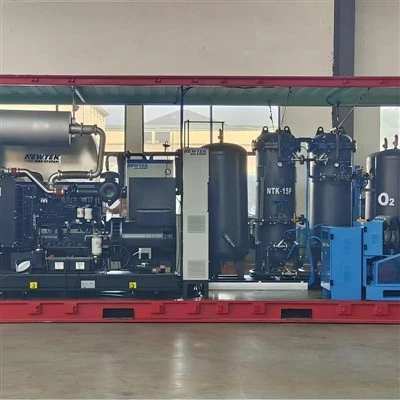
Consider the available installation space, ambient temperature, humidity, dust, power supply, ventilation, and access for maintenance. A containerized configuration may be appropriate where the farm needs a dedicated equipment enclosure or has limited permanent building space.
Containerized equipment still requires suitable foundations, electrical connections, ventilation, piping, drainage where applicable, and a planned maintenance area. The enclosure should be specified for the actual environmental conditions at the farm.
Plan for interruptions
A PSA plant is mechanical and electrical equipment and should not be treated as an infallible oxygen source. Farms with high stocking densities should consider backup oxygen supply, emergency distribution arrangements, alarms, and contingency procedures.
The backup system should be capable of responding to the farm's risk level and the time required to restore normal oxygen production. Automatic changeover, remote alarms, and emergency power arrangements may be appropriate depending on the project.
Monitoring DO After Installation
Commissioning should confirm not only that the PSA plant produces the specified gas but also that the complete installation meets the farm's operational requirements.
A practical verification process includes:
Confirming oxygen output, purity, pressure, and stable operation at the specified conditions.
Checking gas distribution, leaks, flow control, and the performance of the oxygen transfer device.
Measuring DO at multiple representative points, including locations with potentially high oxygen demand.
Recording DO during different operating periods, such as feeding, peak biomass loading, and warmer conditions.
Checking that automatic controls respond correctly to the selected setpoints and alarms.
Comparing oxygen consumption, power use, and DO performance against the original design assumptions.
The farm should maintain records of DO trends, equipment alarms, maintenance, biomass, feeding, and unusual operating conditions. These records help distinguish an oxygen production problem from a transfer, circulation, or biological loading problem.
If DO remains below the required range after commissioning, operators should investigate the entire system. Potential causes include insufficient oxygen flow, low transfer efficiency, poor distribution, unexpected biological demand, sensor errors, or inadequate water circulation.
How On-Site PSA Oxygen Can Affect Operating Costs
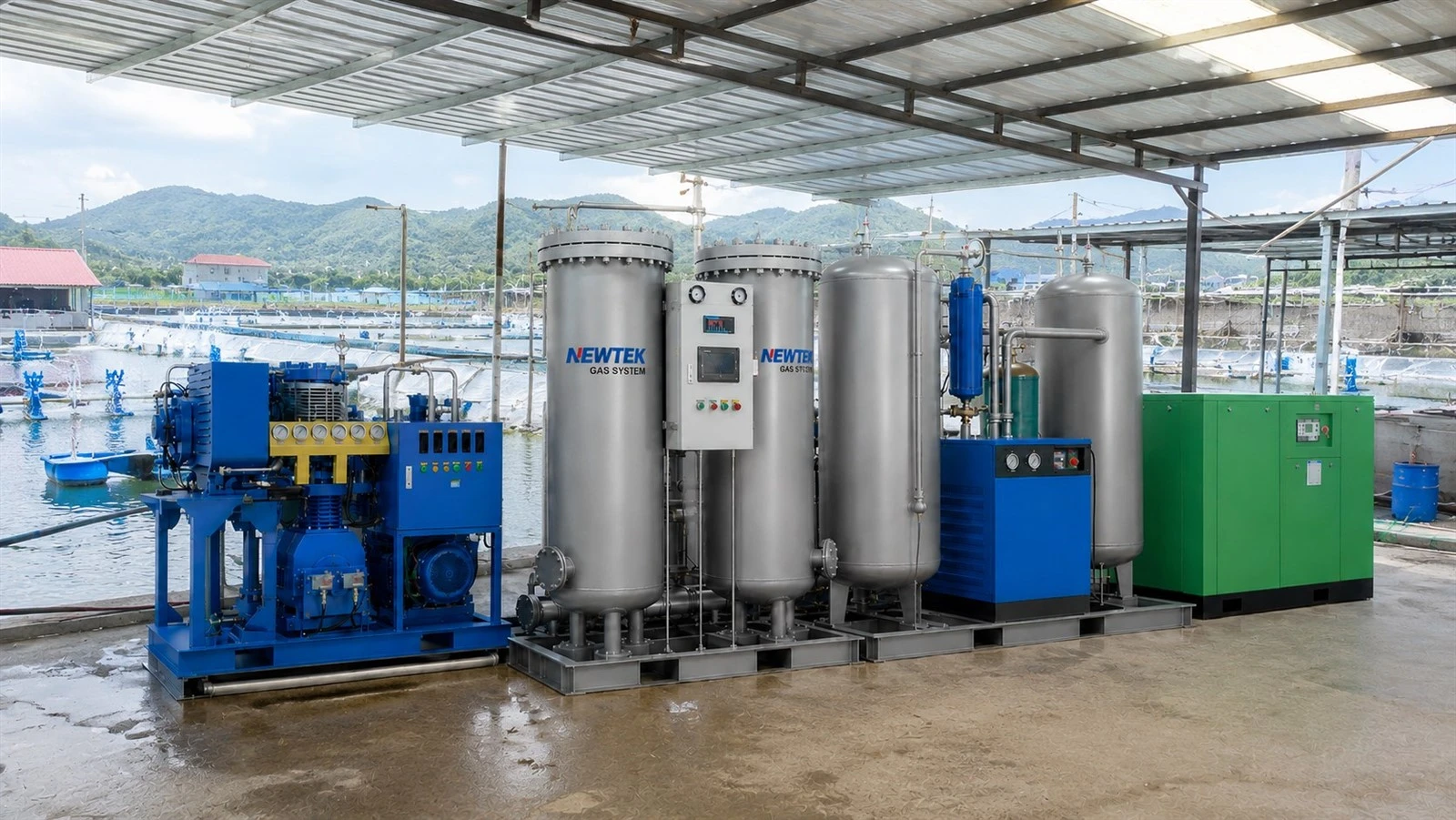
The financial value of PSA oxygen depends on the farm's existing supply method and operating profile. For facilities that rely on delivered oxygen cylinders, on-site generation may reduce delivery frequency, storage requirements, and transport-related costs. The benefit can be particularly relevant for remote farms, islands, and sites with unreliable oxygen delivery.
For farms using conventional aeration, the comparison is different. The relevant question is whether a PSA-based arrangement can meet the required oxygen demand at an acceptable total cost while maintaining water quality and production performance.
A complete cost assessment should include:
Initial investment in the PSA plant and oxygen transfer equipment.
Electricity consumption of the compressor, adsorption system, and auxiliary equipment.
Routine maintenance and replacement of consumable components.
Oxygen distribution piping, control systems, and installation work.
Backup supply and emergency arrangements.
Expected operating hours and seasonal variation in demand.
The cost of delivered oxygen, where applicable.
The production and operational consequences of inadequate oxygen supply.
The lowest equipment purchase price does not necessarily produce the lowest cost over the system's service life. Buyers should compare oxygen delivery capacity, power consumption, maintenance needs, and the expected operating conditions on a consistent basis.
It is also important not to assume that a higher oxygen purity automatically means lower operating costs. Purity, flow, pressure, and energy use interact, and the optimal specification is the one that meets the farm's requirements without unnecessary capacity or operating expense.
Information to Prepare Before Requesting a Quotation
A detailed inquiry helps the supplier recommend a suitable configuration and reduces the risk of sizing the system incorrectly.
| Information required | Why it matters |
|---|---|
| Aquaculture type and species | Establishes the biological operating requirements |
| Culture system | Determines how oxygen can be introduced and distributed |
| Water volume and depth | Helps assess transfer equipment and circulation |
| Current and target stocking density | Supports oxygen-demand estimation |
| Current DO readings | Identifies the severity and timing of oxygen shortages |
| Water temperature and salinity | Influences oxygen solubility and operating conditions |
| Required oxygen flow | Establishes the plant capacity requirement |
| Required purity and delivery pressure | Defines the PSA operating specification |
| Existing aerators and oxygenation equipment | Shows what can be retained or upgraded |
| Power supply and installation environment | Helps determine equipment configuration |
| Operating schedule and backup requirements | Supports continuous operation and contingency planning |
Where detailed oxygen-demand calculations are not yet available, buyers can provide the current production scale, culture system, observed DO levels, and existing equipment information as a starting point. The final plant capacity should be confirmed through engineering evaluation rather than selected from water volume alone.
Conclusion
PSA oxygen generation can help aquaculture farms improve dissolved oxygen availability by supplying oxygen-enriched gas for a properly designed oxygen transfer system. It can be particularly valuable in intensive fish farming, shrimp production, hatcheries, RAS facilities, and other operations where oxygen demand is high or conventional aeration has limited capacity.
Its performance depends on more than generator output. Oxygen purity and flow must match the required demand, the transfer device must dissolve oxygen efficiently, water circulation must distribute it properly, and DO monitoring must verify the results under actual production conditions.
For farm operators evaluating an on-site oxygen supply, the most effective starting point is to document the current DO problem, estimate peak oxygen demand, review existing aeration and circulation equipment, and define the required operating conditions. This information allows the PSA oxygen plant and its delivery system to be specified as one coordinated installation.
A well-matched system can provide a more controllable source of oxygen for aquaculture operations. The final benefit should be judged by measured DO performance, stable production conditions, operating cost, and the farm's ability to maintain oxygen supply when demand changes.