

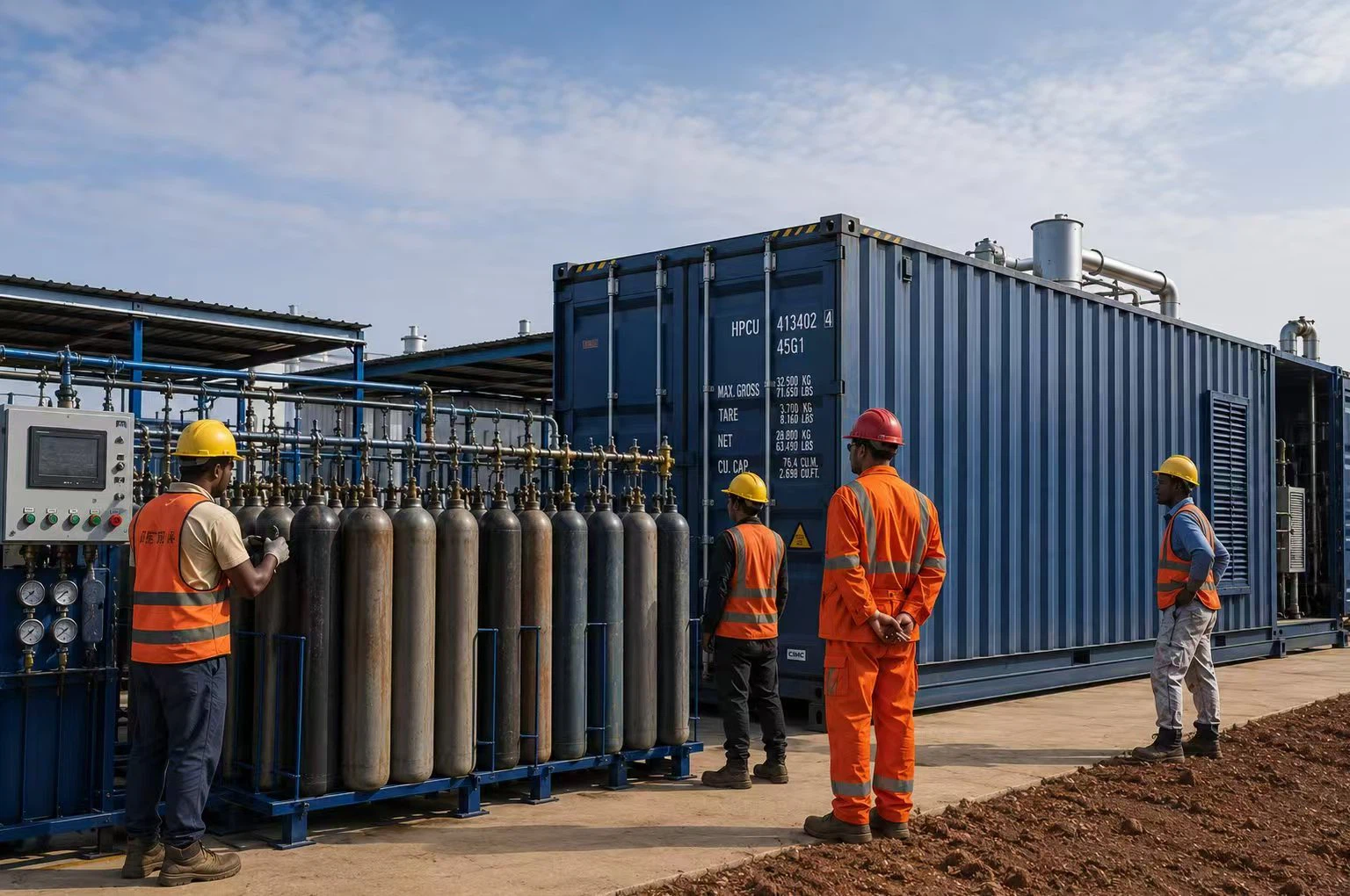
On-Site Gas Compression and Automated Distribution Grid Systems
Industrial oxygen cylinder filling operations require a continuous oxygen source with stable purity, controlled pressure, and predictable flow. Traditional cylinder filling stations often depend on liquid oxygen deliveries, which require cryogenic storage tanks, insulated transfer pipelines, and scheduled transportation.
For regional centers, mining sectors, and fabrication workshops, PSA oxygen generation systems produce oxygen directly from ambient air and feed full-automatic high-pressure cylinder filling manifolds without relying on external oxygen supply networks.
1. Engineering Challenges in Traditional Cylinder Filling Operations
Dependence on Bulk Liquid Oxygen Supply Chains
Many conventional filling stations experience logistically high operational costs due to cryogenic liquid oxygen delivery chains. Liquid oxygen must be trucked, stored at -183°C, and passed through ambient vaporizers before compression can begin, leaving stations vulnerable to transport bottlenecks.
Pressure Matching Barriers
A critical engineering challenge lies in reconciling the immense pressure gap between generation and terminal storage stages:
| System Stage | Standard Operating Pressures |
|---|---|
| Typical PSA Oxygen Generator Outlet | 4 – 10 bar |
| Industrial Oxygen Cylinder Terminal Pressure | 150 bar / 200 bar / 300 bar |
Older filling systems suffer from steep manual labor requirements-forcing field operators to manually position heavy tanks, turn manifolds, and monitor pressure dials per batch. Transitioning to automated filling loops powered by solenoid valves and PLC controllers requires highly stable oxygen input conditions to maintain safe, steady cycle parameters.
2. How Dual-Tower PSA Oxygen Generators Work
A dual-tower PSA system establishes continuous oxygen separation by alternating atmospheric gas streams under pressure between twin pressure vessels filled with zeolite molecular sieves.
The Alternating Gas Cycle:
Ambient intake air gets compressed to 7–10 bar, passing through dryers and filters to strip moisture, dust, and aerosols. As air flows up through Tower A, the zeolite molecular sieve structure selectively adsorbs nitrogen molecules, allowing a 90% to 95% pure oxygen stream to flow into the buffer line. Concurrently, Tower B depressurizes down to atmospheric levels, venting its saturated nitrogen back to the ambient environment. Every 45 to 120 seconds, the PLC flips the pneumatic network valves, seamlessly reversing tower states to enable non-stop gas production.
3. Integrating PSA Oxygen Systems with Full-Automatic Cylinder Filling Lines
To feed a fully automated cylinder filling line safely and consistently, the system bridges generation components with a dedicated boosting stage:
- Oxygen Buffer Storage Tank: Absorbs pressure waves caused by tower switching cycles, stabilizes downstream pure gas flow volumes, and smooths out minor purity variations.
- Oil-Free Reciprocating or Diaphragm Booster: Safely ramps low-pressure gas up to 150–300 bar filling constraints. Complete oil-free architecture utilizing PTFE rings and stainless steel components ensures zero hydrocarbon contamination risks.
- Automatic Cylinder Filling Manifold: Distributes high-pressure gas streams across multiple cylinders simultaneously. Integrated PLC sensors continuously track pressure points, closing terminal solenoid valves automatically when targets are met to prevent dangerous overfilling.
4. Why Containerized Oxygen Plants Improve Cylinder Filling Projects
Integrating high-pressure boosters and complex gas separation systems into standard ISO steel containers cuts down field construction requirements while shielding core mechanical parts from external dust and weather factors.
Factory-Assembled Integration
Compressors, filters, PSA columns, and control boards arrive pre-piped and pre-tested, reducing complex layout tasks down to basic line hookups.
Portable Enclosure Architecture
The rugged structural shell features heavy-duty exhaust fans, ventilation louvers, and weatherproofing insulation, acting as a drop-in equipment room.
Scalable Modular Expansion
NEWTEK system infrastructures support modular growth frameworks. Operations can easily add parallel skids to step from 60 Nm³/h to 120 Nm³/h as cylinder demand rises.
5. FAQ
What oxygen purity is typically used for cylinder filling lines?
Most industrial on-site PSA configurations supply constant gas purities between 90% and 95% oxygen concentration, depending on target pressure loads and flow parameters.
Can a dual-tower system easily manage 24-hour non-stop operations?
Yes. Because the adsorption columns alternate cycles continuously via an automated PLC program, the plant yields an uninterrupted pure gas stream with minimal maintenance overhead.
Why exactly is an intermediate oxygen booster compressor necessary?
PSA gas generation takes place at lower base levels (4–10 bar). Since commercial distribution cylinders operate at 150 to 300 bar, a highly specialized compressor stage must raise pressure to filling thresholds.
How are molecular sieve and compressor loops routinely serviced?
System operators trace line dew points and differential pressures to replace internal cartridge filters before moisture fouls the zeolite. High-pressure boosters undergo standard ring and seal checks every 2,000–8,000 hours.
Establish Gas Self-Sufficiency via High-Pressure On-Site Generation
Operating an optimized filling system requires far more than basic delivery piping. True automated line safety depends on steady pressure management, strict impurity filtration, and precise digital loop triggers. Deploying containerized, multi-stage PSA generation stations gives industrial suppliers complete logistics independence, eliminating tank transportation vulnerabilities while cutting terminal distribution overhead.
Design a Custom Packaging Station
NEWTEK develops modular, high-pressure containerized PSA stations customized for mining networks, fabrication bays, and regional gas centers.
Consult with Layout Engineers ➔Filling Infrastructure
Oil-Free Oxygen Boosters
Reciprocating loops for secure 150-300 bar compression.
Container Filling Plants
Drop-in turn-key ISO enclosures built for field service.
Automated Filling Manifolds
PLC-connected valves stopping overpressurization risks.


