Solving Long-Distance Supply Chains via Portable On-Site Gas Generation
Oxygen supply interruptions can directly affect production continuity, medical treatment capacity, aquaculture survival rates, and emergency response readiness. In remote zones, oxygen shortages are often caused by transportation constraints rather than oxygen production limitations. When cylinders or liquid tanks travel through mountain corridors or islands, logistics become a volatile operational vulnerability.
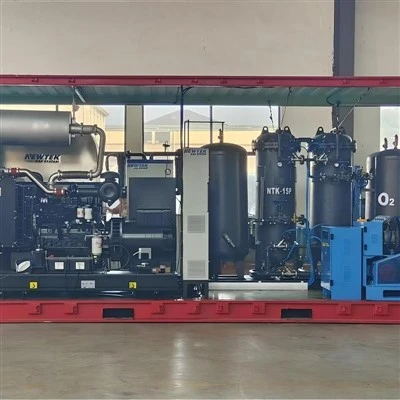
To reduce dependence on recurring deliveries, operators are turning to transportable ISO container structures. NEWTEK Containerized Gas Solutions address this bottleneck by integrating the entire air compression, purification, PSA generation, and buffer storage array into a drop-in modular frame, converting ambient air into pure gas right at the point of use.
1. Why Oxygen Shortages Occur in Remote Zones
Long Transportation Distances Increase Supply Risk
Conventional models rely on complex multi-stage routes (production plants, filling facilities, regional depots, semi-truck networks, ferry transfers, and local distribution vans). Any single failure due to weather or port congestion can trigger catastrophic on-site stock decreases before replacement shipments arrive.
Fluctuating Dynamics Across Core Applications
In remote areas, consumption loads are inherently volatile, increasing the operational risk during logistics disruptions:
| Facility Sector | Critical Oxygen Demand Swings |
|---|---|
| Island Aquaculture | Spikes during summer temperature peaks above 28°C, heavy feeding schedules, and high-density stocking. |
| Isolated Hospitals | Driven unexpectedly by emergency admissions, intensive care expansions, and respiratory care waves. |
| Remote Mining Sites | Fluctuates dynamically with gold cyanidation circuits, oxy-fuel cutting, and emergency underground breathing manifolds. |
To survive these swings, facilities are forced to dedicate extensive floor space, heavy tracking labor, and continuous pressure safety maintenance to massive, rotating cylinder storage banks, adding unwanted manual complexity to daily operations.
2. What Is a Containerized Gas Solution?
A containerized plant integrates a rugged, full-scale industrial oxygen house inside a standardized 20-foot or 40-foot shipping container. Pre-engineered and fully pre-piped at the factory, it functions simultaneously as the transport skid and the permanent weather enclosure.
| Integrated Module | Engineering Subsystem Function |
|---|---|
| Air Compressor Section | Draws ambient air, compressing it cleanly to 7–10 bar to feed the generation line. |
| Purification Package | Combines cyclones, refrigerated dryers, and carbon filters to strip water droplets, oils, and particulates. |
| PSA Adsorption Blocks | Houses twin zeolite sieve vessels and pneumatic valve manifolds to alternate gas extraction cycles. |
| Storage & Smart Controls | Pairs a 4–10 bar buffer vessel with central PLC screens and built-in analyzers to verify constant gas purity. |
3. How PSA Technology Generates Oxygen On-Site
Ambient atmospheric air (78% nitrogen, 21% oxygen) is processed into concentrated gas without requiring cryogenic liquefaction at extreme temperatures (-183°C). Under steady pressure inside the active adsorption vessel, the specialized zeolite molecular sieve beds dynamically trap crossing nitrogen molecules, allowing a **90%, 93%, or 95% pure oxygen stream** to move straight into the distribution buffer.
Once the active sieve bed hits structural saturation, the automated PLC valves shift input paths, depressurizing the column to vent trapped nitrogen safely out the exhaust port. This twin-tower alternating rhythm enables continuous, uninterrupted on-site oxygen generation without pauses or delivery dependencies.
4. Why Containerized Deployment Solves Remote Oxygen Supply Problems
- Reduced Construction Constraints: Remote sites suffer from poor labor and material access. As a factory-built drop-in solution, it bypasses masonry building work, requiring only basic foundation pads, local power lines, and pipe headers.
- Simplified Standard Logistics: Built strictly to standard ISO container scales, systems travel smoothly via normal flatbeds, rail systems, or cargo ports, using existing dock cranes to drop systems straight into position.
- Heavy Environmental Shielding: Enclosures act as defensive barriers against environmental elements, incorporating industrial epoxy paint coatings, internal stainless steel lines, dust-separating louvers, and insulated panels to withstand coastal salt air, desert storms, or tropical monsoons.
5. Typical Applications of NEWTEK Containerized Gas Solutions
Remote & Island Hospitals
Feeds intensive care units, pipeline networks, and backup manifolds directly, ending the operational risks of boat and shipping delays.
Aquaculture & Hatcheries
Supplies oxygen cones, diffuser grids, and transport tanks efficiently, preserving survival rates during hot summer water spikes.
Mining & Leaching Lines
Brings high-volume gas streams close to cyanide leaching circuits and workshops, avoiding cylinder transport up mountain loops.
Wastewater Basins
Drives continuous dissolved gas transfers into activated sludge aeration basins, maximizing biological oxidation targets.
Routine Maintenance Parameters: System operators perform simple baseline checks, such as inspecting cartridge filters, tracking zeolite sieve pressure changes, swapping seals, and running swift digital calibrations on gas analyzer circuits.
6. FAQ
How quickly can a containerized oxygen plant be deployed?
Once local structural concrete pads are poured and power connections are secured, field commissioning takes only a few days since all inner mechanical parts arrive completely integrated.
What oxygen purity levels can these systems achieve?
Most industrial PSA generators supply a reliable purity range between 90% and 95% gas concentration, varying strictly with target flow demands and configuration scaling.
Can a containerized system fill high-pressure cylinders on-site?
Yes. By incorporating an oil-free high-pressure booster compressor and filling manifold skid, the system can compress pure gas into standard storage cylinders for regional distribution.
Establish Supply Chain Independence via Portable ISO Stations
Shortages in isolated sectors are fundamentally a failure of delivery logistics and geography, rather than generation limits. Transitioning to integrated on-site PSA container solutions allows facilities to process ambient air into high-purity gas streams non-stop. This approach eliminates the risks of long-distance transport, stabilizes daily water and medical lines, and significantly lowers terminal operating costs.
Request On-Site Capacity Sizing
NEWTEK supplies engineered, transportable containerized gas plants optimized to match stocking biomass weights, clinic arrays, and leaching parameters.
Get a Technical Quote ➔Enclosure Platforms
20ft ISO Gas Plants
Compact mobile enclosures built for rugged transport paths.
40ft Commercial Stations
High-volume generation skids linked to integrated booster loops.
Cylinder Manifold Systems
High-pressure filling networks with PLC automatic safety caps.