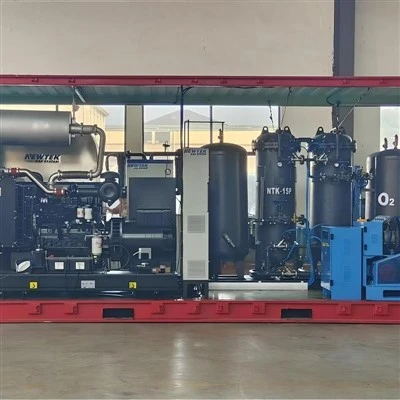
This announcement signals more than just a product release-it shows NEWTEK's intent to reshape how small-scale oxygen generation is deployed worldwide.
Why Mini Modular Oxygen Generators, and Why Now?
For decades, large hospitals and heavy industries relied on centralized oxygen supply: either bulk liquid oxygen deliveries or full-scale air separation units. While reliable, these solutions are costly, infrastructure-heavy, and logistically complex.
In recent years, however, smaller and more flexible demand points have been growing rapidly:
Community hospitals and clinics that need a stable but modest oxygen supply.
Aquaculture farms seeking to improve dissolved oxygen levels in ponds without overhauling their energy bills.
Manufacturing workshops that require oxygen for cutting, welding, or combustion support.
Remote research stations or emergency relief sites where oxygen must be available immediately, without waiting for cylinder deliveries.
Traditional systems struggle to serve these use cases efficiently. That's where Mini Modular Oxygen Generators come in. They're compact, plug-and-play, and easy to scale. By stacking or linking modules, users can increase capacity as demand grows.
According to NEWTEK's R&D director, "The industry doesn't just need large plants anymore-it needs smarter, smaller, and more adaptable solutions. Our Mini Module platform was built to meet this exact need."
What Makes the NEWTEK Mini Module Stand Out
The new product line isn't just a downsized version of an industrial oxygen generator. It has been carefully engineered for flexibility, reliability, and long-term cost savings. Here's what sets it apart:
1. Compact Modular Design
Lightweight aluminum alloy frame with corrosion resistance.
All key subsystems-air compressor, filtration unit, PSA beds, control system, and storage tank-fit into a neat modular package.
Easy transport and quick installation.
2. Proven PSA Technology, Optimized
Built on Pressure Swing Adsorption (PSA) with next-generation molecular sieves.
Delivers oxygen purity of 93% ±3% (with options for higher purity upon request).
Smart cycle optimization ensures stable performance even in varying environmental conditions.
3. Smart Controls and IoT Integration
PLC-based control system that automates every cycle and provides alarms.
Optional cloud connectivity, allowing remote monitoring and diagnostics.
Mobile access so operators can check purity, pressure, and flow in real time.
4. Energy Efficiency & Low Maintenance
Designed for low power consumption per Nm³ of oxygen produced.
Standardized, easy-to-replace filters and valves.
Longer service intervals, meaning fewer shutdowns.
5. Flexible Expansion
Start small with a single module.
Scale up by adding more units in parallel-no need to replace your initial investment.
Integrates with storage cylinders or piping networks.
Highlights from the NEWTEK Buyer's Guide
The Mini Modular Oxygen Generator Buyer's Guide isn't just a spec sheet. It's a practical roadmap for decision-makers-especially those who may be comparing several brands or deciding between traditional cylinders, liquid supply, or on-site generation.
Here are some of the guide's most useful insights:
Define Your Oxygen Needs First
Flow Rate – Know your continuous demand and your peak demand.
Purity Requirements – Medical applications may need 93%+ purity, while some industrial uses are fine with lower.
Pressure – Decide if you're feeding pipelines, filling cylinders, or supplying equipment directly.
Operating Environment – Temperature, humidity, altitude, and available space all matter.
Look Beyond Price Tags
The guide emphasizes Total Cost of Ownership (TCO) over sticker price:
Power consumption (kWh per Nm³).
Maintenance cycles and spare parts availability.
Operator training and after-sales service.
Expansion flexibility-will the system grow with you, or will it be obsolete in two years?
Check Certifications & Safety Standards
Especially for hospitals, certification matters. Look for:
ISO quality management compliance.
CE or equivalent international standards.
Medical oxygen standards in line with pharmacopoeia requirements.
Service Matters as Much as Technology
Does the supplier provide remote monitoring?
How quickly can spare parts be delivered?
Is training available for local technicians?
NEWTEK uses the guide to show potential buyers not only what to ask, but also how its Mini Module answers those questions.
Market Strategy
NEWTEK isn't hiding its ambitions-the Mini Module series is aimed squarely at three main sectors:
Healthcare – Clinics, community hospitals, and rural medical centers that can't rely on cylinder logistics.
Industrial Applications – Small-to-medium manufacturers needing oxygen for cutting, welding, or combustion.
Aquaculture & Agriculture – Fish farms, greenhouse cultivation, and other oxygen-intensive processes.
To support international buyers, NEWTEK is also expanding its service network overseas, with regional partners in Southeast Asia, Africa, and Latin America. In some markets, the company even plans to introduce leasing and pay-per-use models to lower upfront investment barriers.
Early Customer Stories
A Rural Hospital in Western China
Faced with inconsistent liquid oxygen deliveries, the hospital installed a Mini-2 Series module producing 2 Nm³/h at 93% purity. After a year of operation:
The hospital reported zero supply interruptions.
Annual oxygen costs dropped by 30%.
Staff could monitor oxygen purity in real time via a mobile dashboard.
A Fish Farm in Southern Asia
The farm struggled with seasonal fish deaths due to low dissolved oxygen. After integrating a Mini Module system with an oxygen diffuser:
Mortality rates dropped sharply during summer heat waves.
Productivity increased, with healthier stock and higher yields.
Operators described the system as "low noise, low maintenance, and high peace of mind."
The Future of Mini Oxygen Generation
NEWTEK sees the Mini Module not as an endpoint but as the start of a broader evolution. Future directions include:
Higher Purity Options – For advanced medical or laboratory use.
Hybrid Systems – Combining oxygen with nitrogen or argon modules in a unified platform.
AI-Driven Maintenance – Predictive analytics to reduce downtime.
Global Certifications – Expanding compliance to FDA and EU MDR for wider healthcare adoption.
Final Word
With the launch of its Mini Modular Oxygen Generator Series and the accompanying Buyer's Guide, NEWTEK is making a clear statement: the future of oxygen supply isn't just about scale, it's about adaptability.
For businesses, clinics, or farms that need reliable oxygen without the burden of traditional supply chains, the NEWTEK Mini Module offers a compelling answer. And with its guide, NEWTEK isn't just selling equipment-it's helping buyers make smarter, future-proof decisions.
As one industry analyst put it after the launch:
"Mini modular generators may well become the smartphone of the oxygen industry-compact, customizable, and indispensable."