

Introduction
In modern aquaculture farming, oxygen management is one of the most critical factors affecting survival rate, feed conversion ratio (FCR), growth speed, and disease control. As stocking densities increase in intensive farming systems such as shrimp ponds, RAS (Recirculating Aquaculture Systems), and industrial fish farms, the demand for stable and cost-efficient oxygen supply has become a central operational concern.
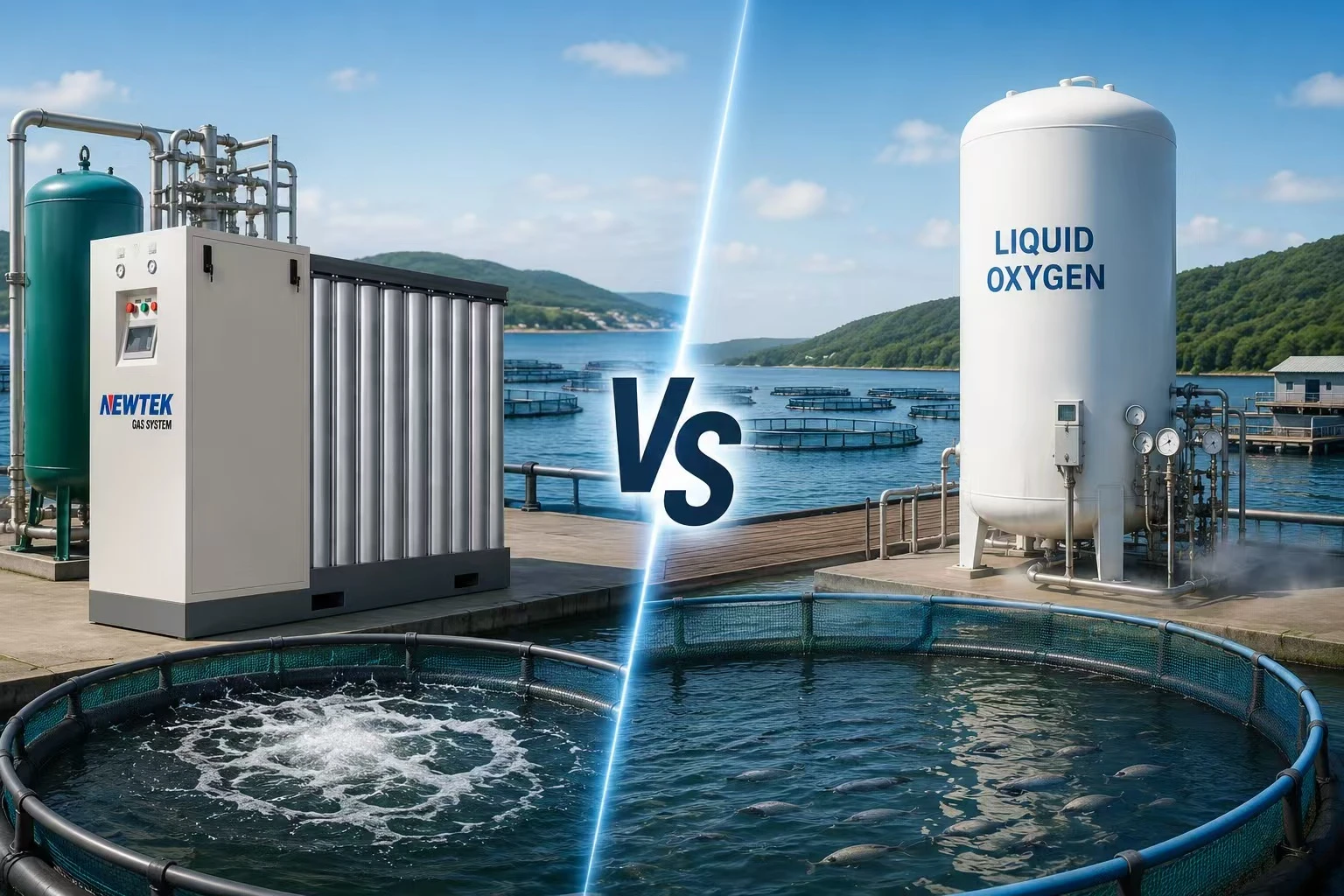
Two primary oxygen supply methods dominate the industry: Pressure Swing Adsorption (PSA) oxygen generators and liquid oxygen (LOX) supply systems. Both technologies serve the same purpose-delivering high-purity oxygen-but their operational principles, cost structures, safety profiles, and long-term efficiency differ significantly.
This article provides a detailed engineering-level comparison to help aquaculture farm operators, project developers, and procurement teams make informed decisions.
1. Understanding PSA Oxygen Generation Systems
A PSA oxygen generator produces oxygen on-site by separating oxygen molecules from ambient air using molecular sieve beds filled with zeolite materials. The system works in a cyclic adsorption-desorption process under pressure.
Working principle:
- Ambient air is compressed using an air compressor.
- The compressed air enters adsorption towers filled with zeolite molecular sieves.
- Nitrogen is selectively adsorbed by zeolite under pressure.
- Oxygen passes through as the product gas.
- When pressure is released, nitrogen is desorbed and expelled.
- The system alternates between dual towers for continuous oxygen production.
Key output characteristics:
- Oxygen purity: typically 90%–95%
- Continuous on-demand production
- Flow rate adjustable depending on farm scale
- Requires only electricity and ambient air
In aquaculture environments, PSA systems are often integrated with diffusers, oxygen cones, or nano-bubble systems to improve dissolved oxygen (DO) efficiency in water.
2. Understanding Liquid Oxygen Supply Systems
Liquid oxygen is industrial oxygen that has been cryogenically cooled to -183°C and stored in insulated tanks. It is vaporized into gas form before being delivered to aquaculture aeration systems.
Supply chain process:
- Oxygen is produced in large industrial air separation plants.
- It is liquefied and transported via cryogenic tankers.
- Stored on-site in insulated LOX tanks.
- Vaporized using ambient or electric vaporizers.
Key output characteristics:
- Oxygen purity: up to 99.5%
- High instantaneous supply capacity
- Dependent on logistics and refilling schedules
- Requires strict safety protocols for cryogenic handling
LOX systems are commonly used in large-scale or remote farms where PSA installation is not feasible or where extremely high oxygen purity is required.
3. Cost Structure Comparison
PSA Oxygen Generator Cost:
· Initial investment: medium (equipment + installation)
· Operating cost: electricity + periodic maintenance
· No transportation or refill cost
· Cost per kg oxygen decreases with long-term operation
Liquid Oxygen Cost:
· Initial investment: low to medium (tank setup)
· Operating cost: continuous oxygen purchase
· Includes transportation, storage, and supplier margin
· Price fluctuates with energy and logistics costs
Conclusion: For long-term continuous aquaculture production, PSA systems generally offer lower total cost of ownership. LOX may appear cheaper initially but becomes expensive with sustained consumption.
| On-Site PSA Oxygen Generation | Delivered Cryogenic Liquid Oxygen (LOX) |
|---|---|
| 🟢 Strategic Advantages · On-site production reduces supply dependency · Stable long-term operation if maintained properly · No risk of supply interruption due to logistics · Eliminates transportation emissions & supplier margin |
🟢 Strategic Advantages · High oxygen purity (up to 99.5%) and immediate availability · Suitable for emergency oxygen demand spikes · Lower initial equipment setup complexity |
| 🔴 System Limitations · Requires stable electricity supply · Sensitive to air quality (dust, humidity) · Molecular sieve replacement needed every 3–5 years |
🔴 System Limitations · Highly dependent on external suppliers & refilling schedules · Risk of delivery delays or supply chain disruption from weather · Cryogenic storage safety risks (pressure buildup, frost hazards) |
4. Operational Reliability and Risk Factors
PSA Systems:
Advantages: On-site production reduces supply dependency; Stable long-term operation if maintained properly; No risk of supply interruption due to logistics.
Limitations: Requires stable electricity supply; Sensitive to air quality (dust, humidity); Molecular sieve replacement needed every 3–5 years.
Liquid Oxygen Systems:
Advantages: High oxygen purity and immediate availability; Suitable for emergency oxygen demand spikes.
Limitations: Dependent on external suppliers; Risk of delivery delays or supply chain disruption; Cryogenic storage safety risks (pressure buildup, frost hazards).
5. Energy Efficiency and Environmental Impact
PSA systems consume electricity but eliminate transportation emissions associated with liquid oxygen logistics. Modern PSA units are designed with energy-saving compressors and smart control systems that adjust output based on dissolved oxygen sensors in water.
Liquid oxygen systems rely heavily on centralized industrial production, which is energy-intensive due to liquefaction and transportation stages. From a sustainability perspective, PSA oxygen generation is generally more environmentally friendly for decentralized aquaculture farms.
6. Suitability for Different Aquaculture Models
PSA Oxygen Generator is ideal for:
· Medium to large inland aquaculture farms
· Recirculating Aquaculture Systems (RAS)
· Shrimp intensive farming systems
· Farms with stable electricity supply
· Operators seeking long-term cost reduction
Liquid Oxygen is ideal for:
· Emergency oxygen backup systems
· Very large industrial-scale farms near supply chains
· Temporary or seasonal farming operations
· Locations without infrastructure for PSA installation
7. Maintenance and Operational Complexity
PSA systems require: routine compressor maintenance, filter replacement (air intake system), monitoring of zeolite beds, and electrical system inspection.
LOX systems require: tank pressure monitoring, safety valve inspections, periodic refilling coordination, and cryogenic handling training for operators. Although PSA systems require more technical maintenance, they reduce dependency on external logistics.
8. Long-Term Economic Analysis
Over a 5–10 year operational cycle, PSA oxygen generators generally provide superior economic performance due to:
· Elimination of recurring oxygen purchase costs
· Stable electricity-based operating expense
· Reduced vulnerability to market price fluctuations
· Higher control over oxygen supply timing
Liquid oxygen systems may incur significantly higher cumulative costs due to continuous procurement and transportation fees.
9. Final Comparison Summary
PSA Oxygen Generator: Best for long-term cost efficiency | On-site oxygen independence | Moderate initial investment | Requires technical maintenance
Liquid Oxygen Supply: Best for high purity and emergency supply | Low initial setup complexity | High long-term operational cost | Dependent on external logistics
Conclusion
For most modern aquaculture farms transitioning toward intensive and precision farming systems, PSA oxygen generation technology offers a more sustainable, cost-effective, and operationally independent solution. Liquid oxygen supply still plays an important role in backup systems and large centralized operations, but its long-term economic disadvantages make it less suitable as the primary oxygen source. Ultimately, the decision should be based on farm scale, infrastructure availability, budget structure, and risk tolerance. In most cases, PSA oxygen systems represent the future direction of oxygen management in aquaculture.
Request Infrastructure Sizing
NEWTEK supplies custom, transportable PSA oxygen platforms optimized to balance your stocking load profiles and biomass weights. Submit your metrics:
- Target species & stocking density
- Daily biomass & total water volume
- Dissolved Oxygen (DO) parameters
- Local power infrastructure profiles
Aquaculture Modules
Dual-Tower PSA Platforms
Continuous 90%–95% pure oxygen stream.
Containerized ISO Gas Plants
Drop-in weatherproof stations for remote farms.
High-Pressure Booster Lines
Oil-free filling manifolds for emergency backups.


