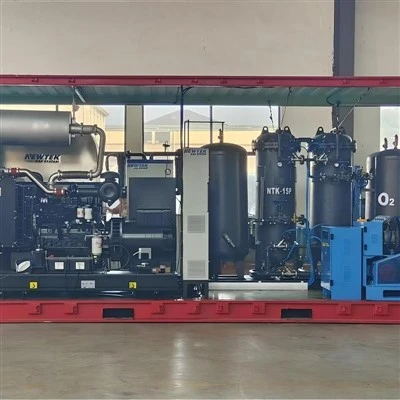
Oxygen plays an important role in modern glass manufacturing. It is widely used to support furnace combustion, improve melting efficiency and help maintain stable production quality.
When planning an oxygen supply system, glass manufacturers generally consider two options: purchasing bulk liquid oxygen (LOX) or installing an on-site PSA oxygen generation system.
Each solution has its own advantages depending on plant size, oxygen consumption and operating requirements. This article compares the two approaches to help manufacturers select the most suitable oxygen supply strategy.
Understanding the Two Oxygen Supply Methods
Bulk Liquid Oxygen (LOX)
Produced at commercial air separation plants, transported via cryogenic tanker trucks, and stored in large specialized storage tanks. Oxygen must be vaporized into a gaseous state before entering the furnace pipeline. This model relies entirely on precise external supplier delivery schedules.
On-Site PSA Oxygen Systems
An independent hardware asset that separates oxygen directly from standard compressed ambient air using Pressure Swing Adsorption (PSA) technology. It generates continuous gas feeds on site, eliminating long-term reliance on commercial logistics networks.
Technical & Operational Comparison
Since glass furnaces operate continuously under extreme thermal configurations, supply disruptions risk catastrophic brick damage. Below is an operational comparison between on-site generation and external bulk purchasing:
| Evaluation Factor | On-Site PSA Oxygen Generation | Bulk Liquid Oxygen (LOX) |
|---|---|---|
| Long-Term Cost | Highly Predictable: Tied directly to local electricity rates and simple routine filter maintenance. | Variable: Subject to recurring gas purchasing fees, transport fuel margins, and liquid tank rental surcharges. |
| Supply Stability | Absolute independence. Continuous on-site generation from ambient air removes external logistics chain risks. | Dependent on commercial supply contracts, logistics infrastructure conditions, and tanker truck availability. |
| Space Footprint | Highly compact. Available in skid-mounted packages or container modules adapted to tight outdoor space layouts. | Demands broad cryogenic yard clearances, heavy concrete foundations, vaporizers, and large truck turning zones. |
| Maintenance | Straightforward routine tasks focused on standard compressor filter element adjustments and valve monitoring. | Requires ongoing safety inspection for ultra-low cryogenic structures, vacuum loss tracking, and delivery auditing. |
| Safety Control | Generates gas directly at working low pressures. No high-volume hazards or liquid boil-off losses. | Involves complex ultra-cold liquid handling hazards, pressure relief venting, and boil-off product waste. |
Which Solution Is Better for Glass Manufacturing?
There is no single answer for every production plant. Bulk liquid oxygen systems may remain functional for mega-scale float-glass facilities with massive, multi-ton hourly consumption where cryogenic infrastructure is already established.
However, **small and medium-sized glass manufacturers** are increasingly transitioning to on-site PSA systems. On-site plants provide precise flow flexibility, eliminate reliance on third-party pricing spikes, and simplify facility engineering steps.
NEWTEK PSA Oxygen Engineering for Glass Plants
NEWTEK supplies heavy-duty industrial PSA oxygen generation configurations specifically optimized for harsh glass furnace plant conditions. Every project layout is calculated by our engineers according to your real-world parameters:
Custom Design Engineering Inputs
Our engineered installations actively support diverse manufacturing workflows worldwide, including **Float Glass Production lines, Container Glass manufacturing, Glass Fiber operations, Decorative glassware, and specialized industrial optics fields**.
Conclusion
Selecting an oxygen supply system is an important decision for every glass manufacturing facility. While bulk liquid oxygen continues to serve many large industrial plants, on-site PSA oxygen generation has become an increasingly attractive alternative for manufacturers seeking greater supply independence, flexible installation and predictable long-term operating costs. By evaluating oxygen demand, production requirements and future expansion plans, glass manufacturers can choose the solution that best supports efficient and reliable operation. NEWTEK provides customized PSA installations matching your exact furnace combustion goals and site layouts.
Request Furnace ROI Audit
Optimize combustion and fuel savings. Submit your core furnace data for custom engineering blueprints:
- Daily Glass Melting Volume
- Target Oxygen Flow ($Nm^3/h$)
- Required Delivery Pressure
- Current Gas Purchasing Costs
Furnace Supply Lines
Heavy Industrial PSA Plants
Continuous high-flow oxy-fuel setups.
Skid-Mounted Systems
Pre-assembled compact room modules.
Containerized Oxygen Units
Turnkey independent outdoor machinery.