- How Does PSA Oxygen Generation Technology Work?
- How Does VPSA Oxygen Generation Technology Work?
- What Are the Main Differences Between PSA and VPSA Oxygen Generators?
- Oxygen Requirements in Large-Scale Steel Manufacturing
- Why Are VPSA Systems Often Considered for Large Steel Plants?
- Energy Consumption Comparison Between PSA and VPSA Systems
- What Should Steel Manufacturers Consider Before Selecting an Oxygen Generator?
- NEWTEK Oxygen Generator Manufacturing and Industrial Applications
- Conclusion
Steel manufacturing requires oxygen as a process gas for combustion improvement, molten metal treatment, and oxidation reactions. The oxygen supply system must match the operating conditions of the steel plant, including furnace type, oxygen consumption rate, required purity, supply pressure, and production schedule.
For small and medium oxygen demand, PSA (Pressure Swing Adsorption) oxygen generators can produce oxygen directly from compressed air through molecular sieve adsorption. For larger steel plants requiring continuous oxygen supply at hundreds or thousands of Nm³/h, VPSA (Vacuum Pressure Swing Adsorption) systems are often considered because the separation process uses vacuum regeneration and a blower-based air supply structure. The selection between PSA and VPSA depends on oxygen demand, energy consumption, installation conditions, and integration with steelmaking equipment.
In steel production, oxygen is not simply a purchased gas. It is part of the production process. The oxygen system must connect with furnaces, burners, lances, combustion systems, or enrichment equipment while maintaining stable flow and pressure during continuous operation.
How Does PSA Oxygen Generation Technology Work?
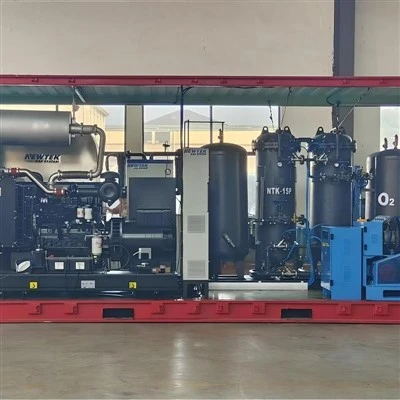
PSA oxygen generators separate oxygen from compressed air through a repeated adsorption and regeneration process. The core component of the system is the adsorption tower filled with zeolite molecular sieve, which has different adsorption characteristics for nitrogen and oxygen molecules.
A typical PSA oxygen generation system consists of several main components:
| Component | Function |
|---|---|
| Air Compressor | Provides compressed air for the separation process |
| Air Treatment System | Removes oil, moisture, and impurities from compressed air |
| Adsorption Towers | Houses molecular sieve materials for nitrogen separation |
| Molecular Sieve | Selectively adsorbs nitrogen molecules |
| Oxygen Storage Tank | Stabilizes oxygen flow and pressure |
| PLC Control System | Controls valve switching and system operation |
The PSA process starts when ambient air enters the air compressor. After compression, the air passes through filtration and drying equipment to remove contaminants. This pretreatment process is important because oil and moisture can reduce molecular sieve adsorption performance and shorten material service life.
The purified compressed air then enters one adsorption tower. Under increased pressure, nitrogen molecules are captured by the molecular sieve, while oxygen molecules pass through the adsorption bed. The resulting oxygen-rich gas is collected and sent to the oxygen storage tank.
After a certain operating period, the molecular sieve becomes saturated with nitrogen. The system then switches airflow to another adsorption tower, while the saturated tower enters the regeneration stage. By reducing pressure, the adsorbed nitrogen is released, allowing the molecular sieve to recover its adsorption capacity.
Through automatic switching between adsorption and regeneration cycles, PSA systems can continuously produce oxygen.
PSA oxygen generators commonly provide oxygen purity levels around 90–95%. The final purity depends on molecular sieve quality, operating pressure, airflow conditions, and system configuration.
How Does VPSA Oxygen Generation Technology Work?
VPSA oxygen generators use the same basic molecular sieve separation principle but apply vacuum-assisted regeneration technology. The main difference is the way air is supplied and how the adsorption material is regenerated.
Instead of using high-pressure compressed air as the main driving force, VPSA systems generally use blowers to provide low-pressure air and vacuum pumps to remove nitrogen during regeneration.
The VPSA operating process includes:
Ambient air enters the system through a blower.
Air passes through adsorption beds containing molecular sieve.
Nitrogen molecules are adsorbed while oxygen passes through.
Oxygen-rich gas is collected as product oxygen.
Vacuum pumps remove nitrogen from the molecular sieve during regeneration.
Adsorption and regeneration cycles continue automatically.
Because VPSA systems operate under lower pressure conditions, they reduce dependence on high-pressure air compression equipment. This operating method makes VPSA suitable for applications requiring large oxygen production capacity and continuous operation.
In large steel manufacturing facilities, VPSA systems are often designed with multiple adsorption units, large-capacity blowers, vacuum equipment, and centralized control systems. These configurations allow the system to provide stable oxygen output for high-consumption processes.
What Are the Main Differences Between PSA and VPSA Oxygen Generators?
Although PSA and VPSA oxygen generators are based on similar adsorption technology, their system designs create differences in application range and operating characteristics.
| Comparison Item | PSA Oxygen Generator | VPSA Oxygen Generator |
|---|---|---|
| Air Source | Compressed air | Low-pressure air from blower |
| Regeneration Method | Pressure reduction | Vacuum regeneration |
| Main Equipment | Compressor, dryer, filters | Blower, vacuum pump |
| Operating Pressure | Higher pressure | Lower pressure |
| System Capacity | Small to medium capacity | Medium to very large capacity |
| Installation Space | More compact | Requires larger area |
| Energy Performance | Suitable for moderate output | Suitable for large continuous production |
| Typical Application | General industrial oxygen use | Large steel and heavy industries |
The main difference is not oxygen separation capability but system scale and operating conditions. PSA systems are commonly selected when oxygen demand is moderate and installation flexibility is important. VPSA systems are more suitable when oxygen consumption reaches a large industrial scale and energy consumption becomes a major consideration.
Oxygen Requirements in Large-Scale Steel Manufacturing
Steel production involves several processes where oxygen plays a critical role.
Basic Oxygen Furnace Steelmaking
In BOF steelmaking, oxygen is injected into molten iron to oxidize carbon and remove unwanted elements. The oxygen flow rate, purity, and stability influence the refining process.
Because BOF operations require a continuous oxygen supply during production cycles, oxygen generation systems must maintain stable output conditions.
Blast Furnace Oxygen Enrichment
Blast furnace operations may use oxygen enrichment to increase oxygen concentration in the air supply. This can affect combustion conditions and furnace performance.
Large steel plants typically require significant oxygen volumes for enrichment processes, making high-capacity oxygen generation systems important.
Electric Arc Furnace Operations
Electric arc furnaces use electrical energy to melt steel scrap. Oxygen can be used for combustion support, carbon oxidation, and process optimization.
The oxygen demand depends on furnace size, production rate, and operating methods.
Metal Cutting and Thermal Processing
Oxygen is also used in steel fabrication, cutting, and thermal treatment applications. Compared with primary steelmaking processes, these applications usually require smaller oxygen volumes but still need stable supply quality.
Why Are VPSA Systems Often Considered for Large Steel Plants?
For large steel plants, oxygen consumption is one of the most important factors when selecting generation technology.
VPSA systems are often considered for large-scale applications because their design is focused on high-volume oxygen production. The use of blowers and vacuum regeneration allows the system to operate efficiently under conditions where oxygen demand remains high for extended periods.
Large steel facilities usually have:
- Continuous production schedules
- High oxygen consumption
- Strict requirements for supply stability
- Long equipment operating hours
- Demand for reduced operating costs
Under these conditions, oxygen generation equipment needs to balance production capacity and energy consumption.
However, the final selection between PSA and VPSA should be based on actual plant conditions rather than production scale alone. Factors such as electricity cost, installation space, oxygen demand pattern, and maintenance capability should also be considered.
Energy Consumption Comparison Between PSA and VPSA Systems
Energy consumption is an important consideration in industrial oxygen generation because steel manufacturing already requires significant energy input.
PSA systems rely on air compressors to increase air pressure. Compressor power consumption increases as oxygen production capacity rises. For smaller and medium oxygen requirements, this structure can provide a practical solution.
VPSA systems use blowers and vacuum pumps instead of high-pressure compressors. In large oxygen production applications, this lower-pressure operating method can reduce energy consumption per unit of oxygen produced.
Several factors influence actual energy performance:
| Factor | Effect |
|---|---|
| Oxygen Output | Higher production requires larger air handling capacity |
| Oxygen Purity | Higher purity requirements may affect system operation |
| Molecular Sieve Condition | Aging materials may reduce separation efficiency |
| Air Pretreatment Quality | Moisture and oil contamination affect adsorption performance |
| Operating Hours | Continuous operation increases the impact of energy efficiency |
Therefore, steel manufacturers should evaluate oxygen generation systems based on long-term operating conditions instead of only comparing initial equipment specifications.
What Should Steel Manufacturers Consider Before Selecting an Oxygen Generator?
Selecting an oxygen generator requires analysis of both technical and operational requirements.
Oxygen Flow Requirement
The required oxygen flow rate is the first factor to evaluate. Manufacturers need to consider normal production demand, peak consumption, and possible future expansion.
Oxygen Purity and Pressure
Different steel processes require different oxygen conditions. The equipment should be configured according to furnace requirements, pipeline design, and process parameters.
Installation Environment
PSA and VPSA systems require different layouts. PSA systems require space for compressors and air treatment equipment, while VPSA systems require larger areas for blowers, vacuum pumps, and adsorption units.
Maintenance Requirements
Oxygen generation systems require regular inspection of filters, valves, molecular sieve materials, and control components. Proper maintenance helps maintain stable oxygen production.
Automation and Monitoring
Modern industrial oxygen generators usually include PLC control systems, pressure monitoring, purity detection, alarm functions, and remote communication options. These functions help operators monitor equipment status during continuous production.
NEWTEK Oxygen Generator Manufacturing and Industrial Applications
NEWTEK focuses on industrial PSA oxygen generation systems, PSA nitrogen generation systems, and related air compression and purification equipment. The company provides on-site gas generation solutions designed for industrial users requiring continuous gas supply.
The design of an oxygen generation system involves multiple technical aspects, including air pretreatment, adsorption process configuration, oxygen storage, automatic valve control, and system integration. NEWTEK develops equipment configurations according to different application requirements, including oxygen flow rate, purity level, pressure conditions, and installation environment.
For industries such as steel manufacturing, metal processing, and other oxygen-consuming applications, the company focuses on matching equipment performance with actual operating conditions. System configuration, production stability, and long-term operation requirements are considered during the equipment design process.
By integrating oxygen separation technology with industrial gas system design, NEWTEK supports customers in establishing on-site oxygen supply systems suitable for continuous production environments

Conclusion
PSA and VPSA oxygen generators both use molecular sieve adsorption technology to produce oxygen from air, but they are designed for different industrial requirements.
PSA oxygen generators are commonly suitable for applications requiring moderate oxygen production capacity, flexible installation, and modular configuration. VPSA oxygen generators are more suitable for large-scale steel manufacturing where oxygen demand is high and continuous operation is required.
For steel manufacturers, selecting the appropriate oxygen generation technology requires evaluation of oxygen consumption, production processes, energy usage, installation conditions, and future expansion plans. A properly designed oxygen generation system can provide stable on-site oxygen supply and support the continuous operation of modern steel production facilities.