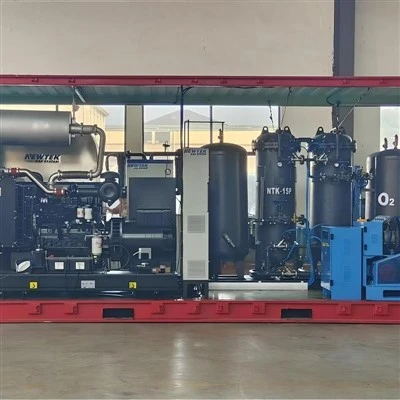
Medical oxygen is not simply oxygen with a high concentration. In a healthcare environment, the oxygen source must provide controlled gas quality, stable concentration, sufficient pressure and flow, continuous availability, and a distribution system compatible with medical use.
A PSA oxygen plant is one of the technologies used to generate oxygen directly at a healthcare facility. PSA stands for Pressure Swing Adsorption. The system separates oxygen from compressed ambient air using molecular sieve adsorbents that preferentially retain nitrogen.
For medical applications, the oxygen-generation system must be designed around applicable medical-gas standards and validated for the intended use. The commonly referenced PSA product gas for medical oxygen is around 93% oxygen, with an allowable specification range depending on the applicable standard and jurisdiction. The World Health Organization describes PSA oxygen systems as a source of oxygen at approximately 93% ± 3% oxygen concentration for medical applications.
The key question, therefore, is not simply "How pure is the oxygen?" It is:
Can the oxygen-generation system consistently produce gas that meets the required medical specification and deliver it safely and continuously to the point of care?

What Is Medical-Grade PSA Oxygen?
Medical-grade PSA oxygen is oxygen generated on site through a Pressure Swing Adsorption oxygen-generation system and produced under a specification suitable for medical oxygen service.
A typical system follows this process:
Ambient Air → Air Compressor → Air Treatment → PSA Adsorption → Oxygen Buffer → Quality Monitoring → Medical Gas Distribution
The PSA section normally contains multiple adsorption vessels filled with molecular sieve.
During pressurization:
Compressed air enters one adsorption vessel.
Nitrogen is preferentially adsorbed.
Oxygen-enriched gas passes through the adsorbent bed.
Product oxygen enters the buffer/storage section.
The saturated adsorbent is depressurized.
Nitrogen is released.
The adsorbent is regenerated.
Another vessel takes over adsorption.
The alternating operation allows oxygen generation to continue while individual adsorption vessels are regenerated.
For medical applications, the generator is only one part of the system. Air treatment, oxygen analysis, storage, pressure regulation, distribution, alarms, electrical supply, ventilation, and backup oxygen all affect the reliability of the medical oxygen supply.
Medical-Grade Oxygen Is Different From Ordinary Industrial Oxygen
The term "oxygen" alone does not define whether a gas is suitable for medical use.
Medical oxygen is subject to requirements concerning:
oxygen concentration;
impurities;
moisture;
pressure;
delivery reliability;
monitoring;
storage;
distribution;
and applicable regulatory standards.
This distinction matters because PSA systems can be designed for many industrial applications.
For example, an industrial PSA oxygen generator may supply oxygen to:
wastewater treatment;
aquaculture;
metal processing;
ozone generation;
glass production;
or mineral processing.
These applications have different gas-quality requirements from a hospital medical-gas system.
A medical PSA installation therefore needs to be designed as a medical oxygen system, rather than taking a general industrial oxygen generator and simply connecting it to a hospital pipeline.
The Core Application: Hospital Medical Gas Systems
The most important application scenario for medical-grade PSA oxygen is the centralized medical gas system of a hospital.
A typical architecture is:
PSA Oxygen Plant
↓
Oxygen Storage/Buffer
↓
Pressure Regulation
↓
Medical Oxygen Pipeline
↓
Ward / ICU / Operating Room / Emergency Department
The oxygen is distributed through a dedicated medical gas pipeline to terminal units located near patient beds or medical equipment.
This arrangement eliminates the need to move individual cylinders to every oxygen-use location during normal operation.
The PSA plant therefore functions as part of the hospital's central utility infrastructure.
For larger hospitals, the system may also incorporate:
oxygen manifolds;
backup cylinders;
automatic changeover;
vacuum systems;
medical air;
medical gas alarms;
and centralized monitoring.

Intensive Care Units
ICUs can have highly variable oxygen demand.
Patients may require oxygen through:
nasal cannulas;
masks;
high-flow oxygen systems;
non-invasive ventilation;
or mechanical ventilation.
A sudden increase in patient numbers or respiratory support intensity can significantly change oxygen consumption.
For this reason, ICU oxygen supply should not be designed solely around average hospital consumption.
Engineers need to consider:
Normal Load + Peak Load + Emergency Load + Reserve Capacity
A PSA system can provide continuous oxygen generation for the normal hospital load while an oxygen buffer and secondary supply source provide additional protection against sudden demand increases or equipment downtime.
This is why redundancy is an important component of medical PSA system design.
Operating Rooms
Operating rooms use oxygen as part of anesthesia and respiratory support systems.
The oxygen supply must therefore maintain stable pressure and availability at the medical gas terminal.
A centralized PSA system can supply oxygen through the hospital pipeline rather than requiring cylinders to be positioned individually in every operating room.
The system must also account for simultaneous operation of multiple operating rooms.
For example, a hospital with:
4 operating rooms;
2 ICUs;
emergency treatment areas;
general wards;
will have a very different oxygen-demand profile from a small outpatient clinic.
The PSA plant should therefore be sized according to the whole medical gas system, not a single department.
Emergency Departments
Emergency departments are characterized by unpredictable demand.
A normal operating period may require relatively moderate oxygen flow, while mass-casualty events can create sudden demand peaks.
A medical oxygen system should therefore provide:
sufficient normal production;
oxygen reserve;
pressure stability;
alarm functions;
emergency backup;
and reliable power.
PSA can serve as the primary oxygen source, while cylinders or another approved oxygen source provide emergency backup.
This hybrid arrangement is particularly important because a PSA generator depends on electrical power and mechanical equipment.
Oxygen Supply for Rural and Remote Hospitals
Medical PSA systems are particularly relevant to hospitals located far from industrial gas suppliers.
A conventional cylinder-based system requires:
Gas Supplier → Filling Station → Transportation → Hospital → Cylinder Storage → Patient
If the hospital is located in a remote region, every additional transportation step increases the importance of logistics planning.
A PSA plant changes the supply model:
Ambient Air → PSA Generator → Hospital Medical Gas Pipeline
The hospital still needs electricity and maintenance support, but the continuous transport of oxygen cylinders is reduced.
This is one reason WHO has promoted oxygen-generation technologies, including PSA, for healthcare facilities where reliable oxygen supply is difficult to maintain.
PSA Oxygen for Field Hospitals and Temporary Medical Facilities
PSA technology can also be integrated into modular or containerized medical oxygen systems.
A containerized configuration may integrate:
air compressor;
air dryer;
filtration system;
PSA oxygen generator;
oxygen buffer tank;
oxygen analyzer;
control system;
oxygen booster;
and cylinder-filling equipment.
The exact configuration depends on the intended application.
For a temporary medical facility, the containerized approach can reduce on-site construction requirements.
The system can be transported to the required location, connected to power and medical-gas distribution infrastructure, commissioned, and later relocated if necessary.
This configuration is particularly relevant to:
emergency medical facilities;
disaster-response hospitals;
remote medical stations;
temporary treatment centers;
and humanitarian healthcare projects.
PSA Oxygen and Cylinder Filling
Not every medical facility distributes oxygen exclusively through pipelines.
Cylinders remain important for mobile and remote applications.
A PSA oxygen plant can therefore be combined with a high-pressure oxygen booster.
The configuration becomes:
PSA Generator → Oxygen Buffer → Oxygen Booster → Filling Manifold → Cylinders
The PSA generator produces oxygen at its normal product pressure, while the booster raises the gas pressure to the level required for cylinder filling.
Filled cylinders can then be transported to:
ambulances;
satellite clinics;
remote wards;
emergency stations;
or other medical facilities.
This gives the hospital two distribution modes:
Pipeline Oxygen + Cylinder Oxygen
That flexibility is particularly valuable when the healthcare network extends beyond the main hospital building.
Medical Oxygen Purity Must Be Continuously Monitored
One of the most important components of a medical PSA system is the oxygen analyzer.
The analyzer measures oxygen concentration in the product gas.
This provides a direct indication of whether the PSA system is operating within its specified oxygen-quality range.
A typical monitoring architecture may include:
PSA → Oxygen Analyzer → PLC → Alarm / Control System
If oxygen concentration falls outside the specified range, the control system can generate an alarm or take predefined protective action depending on the system design.
For medical applications, this monitoring function is much more important than simply displaying the generator's nominal oxygen purity on a product datasheet.
The objective is to verify actual product-gas quality during operation.
Why Feed-Air Treatment Is Critical
PSA oxygen generation starts with compressed ambient air.
However, atmospheric air contains contaminants that must be removed before entering the molecular sieve.
Compressed air may contain:
water;
oil aerosols;
particulates;
and other contaminants.
A typical air-treatment sequence can include:
Compressor → Aftercooler → Water Separator → Filters → Dryer → PSA
Poor feed-air treatment can affect molecular-sieve performance and shorten adsorbent service life.
In medical applications, air treatment also contributes to the consistency of the generated oxygen.
Therefore, a PSA oxygen plant should be evaluated as:
Compressor + Air Treatment + PSA + Monitoring
rather than treating the PSA adsorption towers as the complete oxygen-generation system.
Oxygen Buffering Provides Demand Stability
PSA oxygen generation is cyclic, while hospital oxygen consumption can change continuously.
An oxygen buffer tank helps separate these two operating patterns.
The buffer can:
stabilize outlet pressure;
absorb short-term demand fluctuations;
reduce rapid pressure changes;
support downstream flow control;
and provide a limited amount of stored oxygen.
A simplified system is:
PSA Production → Oxygen Buffer → Medical Gas Pipeline
During a temporary demand increase, the buffer can provide additional oxygen while PSA production responds.
The buffer should not, however, be confused with a large emergency oxygen reserve.
For critical applications, separate backup capacity may still be required.
Medical PSA Systems Need Reliable Power
A major difference between PSA oxygen and stored oxygen cylinders is power dependency.
A cylinder already contains compressed oxygen.
A PSA generator requires electricity to operate:
the compressor;
valves;
control systems;
dryers;
cooling equipment;
and potentially oxygen boosters.
Therefore, a hospital relying on PSA as its primary oxygen source should consider:
Normal Power Supply → Backup Power → Oxygen Reserve
For critical healthcare facilities, backup generators and stored oxygen are commonly incorporated into the system design.
WHO guidance emphasizes reliable power and backup arrangements when planning PSA oxygen-generation systems.
This leads to an important engineering principle:
A medical PSA system should be designed for oxygen continuity, not simply oxygen production.
PSA Oxygen for Neonatal and Pediatric Care
Neonatal and pediatric departments may require oxygen delivery at carefully controlled flow rates.
The challenge is not necessarily extremely high oxygen consumption.
Instead, the system requires:
stable oxygen quality;
appropriate pressure;
accurate flow regulation;
reliable distribution;
and suitable clinical equipment.
The PSA plant therefore forms the upstream oxygen source, while regulators, flowmeters, oxygen blenders, and medical devices control delivery at the patient level.
The oxygen generator should not be considered responsible for the final patient-side flow control.
The complete chain is:
PSA → Hospital Pipeline → Pressure Regulation → Flow Control → Clinical Device → Patient
Medical PSA Oxygen in Respiratory Therapy
Respiratory therapy can involve oxygen supplied to:
ventilators;
CPAP systems;
BiPAP systems;
high-flow nasal oxygen systems;
and other respiratory-support equipment.
These devices can have very different instantaneous oxygen-flow requirements.
High-flow systems can produce particularly significant demand peaks.
Consequently, medical oxygen system design should consider simultaneous peak consumption.
For example, the design question should be:
How many oxygen-consuming devices may operate simultaneously at maximum expected demand?
rather than:
How much oxygen does the average patient use?
This distinction is essential when determining PSA capacity and pipeline sizing.
PSA Oxygen for Dental and Outpatient Facilities
Smaller healthcare facilities generally have lower oxygen consumption than large hospitals.
Applications may include:
dental surgery;
outpatient procedures;
minor emergency treatment;
recovery rooms;
and small clinics.
For these facilities, a full PSA system may or may not be appropriate.
The decision depends on:
daily oxygen consumption;
peak flow;
available electrical power;
cylinder delivery reliability;
available installation space;
and required backup capacity.
If oxygen demand is very low and intermittent, cylinders can remain the simpler option.
PSA becomes more attractive as the facility moves toward regular and continuous oxygen consumption.
Medical Oxygen vs. Industrial Oxygen: A Critical Distinction
A PSA oxygen generator for wastewater treatment and a PSA oxygen plant for a hospital may use the same basic adsorption principle.
But the system requirements can be very different.
| Parameter | Industrial Oxygen Application | Medical Oxygen Application |
|---|---|---|
| Main objective | Process reaction | Patient treatment |
| Gas quality | Application-specific | Medical specification |
| Monitoring | Process dependent | Strict quality monitoring |
| Distribution | Process pipeline | Medical gas pipeline |
| Backup | Depends on process | Critical |
| Alarms | Application dependent | Essential |
| Regulatory requirements | Industrial standards | Medical-gas regulations |
| Installation | Industrial environment | Healthcare environment |
| Documentation | Equipment-focused | Equipment + medical-system requirements |
This is why simply changing the label from "industrial oxygen generator" to "medical oxygen generator" is not sufficient.
The complete system must be designed around the intended medical application.
Core Technical Parameters of a Medical PSA Oxygen Plant
When evaluating a medical PSA oxygen system, several parameters should be considered early in the project.
| Parameter | Typical Design Question |
|---|---|
| Oxygen purity | Does the product gas meet the applicable medical specification? |
| Oxygen capacity | What is the average and peak hospital demand? |
| Outlet pressure | Is pressure compatible with the medical gas pipeline? |
| Product flow | Can the system support simultaneous users? |
| Air compressor | Does it provide sufficient feed-air capacity? |
| Air treatment | Is feed air adequately filtered and dried? |
| Oxygen buffer | Can short-term demand fluctuations be absorbed? |
| Oxygen analyzer | Is product quality continuously monitored? |
| Control system | Are alarms and automatic protection provided? |
| Backup source | What happens during PSA or power failure? |
| Cylinder filling | Is mobile oxygen distribution required? |
| Redundancy | Can the hospital maintain supply during maintenance? |
| Site conditions | Are temperature, altitude and ventilation considered? |
The exact numerical specifications should always be determined according to the applicable medical-gas standard and the hospital's actual oxygen-demand profile.
Why Redundancy Matters More in Medical Applications
In many industrial processes, a temporary oxygen interruption may reduce production efficiency.
In healthcare, the consequences can be much more serious.
Therefore, medical oxygen systems commonly need multiple layers of protection.
A robust architecture may include:
Primary PSA Oxygen Plant
Secondary PSA Module
Oxygen Buffer
Backup Cylinder Manifold
Emergency Power
The specific arrangement depends on the facility's risk assessment and regulatory requirements.
Modular PSA systems can also make maintenance easier.
For example:
PSA Module A + PSA Module B + PSA Module C
If one module is taken offline, the remaining modules can potentially continue supplying part of the hospital demand, provided the system has been sized for the required redundancy.
Containerized Medical PSA Oxygen Plants
For hospitals in remote areas or temporary healthcare projects, containerization can combine oxygen generation and mobility.
A containerized medical oxygen system can potentially integrate:
compressor;
air treatment;
PSA oxygen generator;
oxygen buffer;
analyzer;
PLC;
electrical system;
ventilation;
oxygen booster;
and cylinder filling equipment.
The container should be engineered around the local climate.
High temperatures may require additional cooling capacity.
Cold climates may require heating and insulation.
High-altitude sites require correction of compressor and PSA performance.
Dusty environments require enhanced filtration and maintenance planning.
Therefore, containerization does not eliminate engineering requirements; it packages them into a transportable system.
What Are the Core Application Scenarios?
Medical-grade PSA oxygen can be applied across several healthcare scenarios.
General Hospitals
Central oxygen production and pipeline distribution.
Intensive Care Units
Continuous oxygen supply for respiratory-support equipment.
Operating Rooms
Oxygen supply for anesthesia and respiratory support.
Emergency Departments
High-reliability oxygen availability for unpredictable demand.
Neonatal and Pediatric Units
Stable and controlled oxygen supply.
Rural Hospitals
On-site generation where external cylinder logistics are difficult.
Field Hospitals
Containerized or modular oxygen generation for temporary facilities.
Medical Oxygen Cylinder Filling
PSA combined with an oxygen booster for mobile oxygen distribution.
Satellite Clinics
Central PSA production with cylinder distribution to remote healthcare locations.
Emergency Backup Systems
PSA can supplement cylinder-based or bulk oxygen systems depending on the facility architecture.
When Should a Hospital Consider PSA Oxygen?
PSA oxygen becomes particularly relevant when several conditions exist simultaneously:
oxygen is consumed continuously;
external cylinder deliveries are frequent;
the hospital is located far from oxygen suppliers;
oxygen demand is growing;
a medical gas pipeline is already installed;
reliable electrical power is available;
and the hospital requires greater control over oxygen supply.
Conversely, a small clinic with very low oxygen consumption may not need a dedicated PSA plant.
The correct decision should be based on the complete oxygen-demand profile and infrastructure conditions.
PSA Oxygen Is a System, Not Just a Generator
One of the most important concepts in medical oxygen engineering is that the PSA generator is only the center of a larger system.
A complete installation may include:
Air Compressor
↓
Air Treatment
↓
PSA Oxygen Generator
↓
Oxygen Analyzer
↓
Oxygen Buffer
↓
Pressure Regulation
↓
Medical Gas Pipeline
↓
Clinical Terminal Units
with:
Backup Oxygen + Backup Power + Alarm System
This architecture explains why selecting a PSA oxygen generator only by its oxygen purity or nominal capacity can result in an inadequate system.
The compressor may be undersized.
The pipeline may have excessive pressure loss.
The backup supply may be insufficient.
The oxygen analyzer may not provide appropriate monitoring.
The electrical system may not support continuous operation.
A medical oxygen project must therefore be engineered as an integrated utility system.
Conclusion
Medical-grade PSA oxygen is oxygen generated on site through pressure swing adsorption and produced, monitored, stored, and distributed according to the requirements of medical oxygen service.
Its core application is continuous oxygen supply for healthcare facilities, particularly hospitals with centralized medical-gas pipelines. It can support ICUs, operating rooms, emergency departments, neonatal units, general wards, rural hospitals, field hospitals, and cylinder-filling stations.
The most important advantage of PSA is not simply that it produces oxygen at approximately 93% concentration. Its real significance is that it allows healthcare facilities to establish an on-site oxygen-generation infrastructure rather than relying entirely on externally delivered cylinders or bulk oxygen.
For a properly engineered medical PSA system, the complete chain matters:
Reliable Air → Clean Compressed Air → PSA Separation → Verified Oxygen Quality → Buffering → Stable Distribution → Backup Supply
That is the foundation of a reliable medical oxygen system.
For continuous-demand healthcare facilities, the most appropriate configuration is often not "PSA instead of cylinders," but rather:
PSA as the primary oxygen source + buffer/storage + cylinders or another approved source as backup.
This combination addresses the two fundamental requirements of medical oxygen infrastructure: continuous routine supply and resilience when the primary system is unavailable.