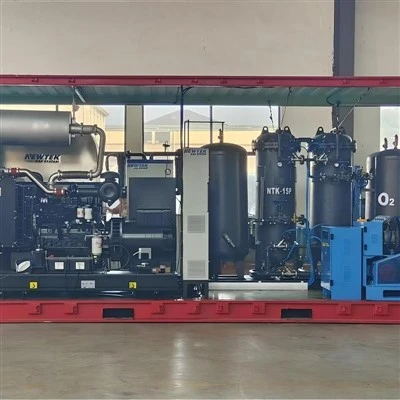
In healthcare, a stable and reliable oxygen supply is a core lifeline for patient care. Traditional liquid oxygen tanks and cylinder systems are constrained by transportation costs, storage risks, and response delays, struggling to meet modern hospitals' flexible oxygen demands. As a leader in industrial gas solutions, NEWTEK's PSA (Pressure Swing Adsorption) modular oxygen generators are revolutionizing hospital oxygen supply through precise molecular sieving technology and intelligent design. This article, informed by NEWTEK's technical practices, analyzes why PSA generators are reshaping hospital oxygen systems, exploring technical principles, clinical value, cost efficiency, and real-world case studies.

Technical Core and Healthcare Value of PSA Oxygen Generators
PSA oxygen generators leverage Pressure Swing Adsorption (PSA) technology, efficiently separating oxygen by selectively adsorbing nitrogen, CO₂, and impurities from air using zeolite molecular sieves. Core advantages include:
High Purity & Stability: NEWTEK's PSA systems deliver 93%±3% oxygen, complying with ISO 10083 and Chinese Pharmacopoeia WS1-XG-008-2012 standards.
Rapid Startup & Low Energy Use: Stable oxygen supply in 15–30 minutes, with energy consumption 1/3 of cryogenic methods (1.2 kWh/ton O₂).
Modular Design: Single-unit capacity ranges 5–300 Nm³/h, supporting parallel expansion for hospitals of all sizes.
In healthcare, PSA generators offer:
Autonomous Oxygen Production: Eliminates reliance on external liquid oxygen transport, preventing supply crises during supply chain disruptions (e.g., remote areas or extreme weather).
Precision Flow Control: Dynamically adjusts flow to meet departmental needs, reducing waste from "excess supply" in traditional liquid oxygen systems.
Green Sustainability: No liquid oxygen transport reduces carbon emissions; reusable molecular sieves minimize waste.
Core Optimization Mechanisms of PSA Generators for Hospital Oxygen Supply
Real-Time Supply & Purity Assurance: 93%±3% Medical-Grade Oxygen
Oxygen purity directly impacts patient outcomes. NEWTEK's PSA systems ensure quality via:
Multi-Stage Filtration: Air pretreatment removes dust, moisture, and oil; molecular sieves adsorb nitrogen/CO₂, yielding 93%±3% oxygen.
Intelligent Monitoring & Alarms: Integrated O₂ sensors monitor purity in real time, auto-switching to backup units and triggering alarms during anomalies.
Case Data: An ICU in a tertiary hospital using NEWTEK's PSA system saw 30% improved ventilator oxygen stability, with SpO₂达标率 (standard compliance rate) rising from 85% to 98%.
Energy & Cost Control: 1.2 kWh/ton O₂ Power Consumption
Traditional liquid oxygen tanks suffer high transport costs and evaporation losses (1%–3% daily). NEWTEK's PSA systems cut costs via:
Low-Power Design: Efficient roots blowers and smart pressure algorithms reduce power consumption 20% below industry averages.
Maintenance-Free Operation: Molecular sieves last 8–10 years; no regular core component replacements, with annual maintenance <3% of equipment cost.
Economic Comparison: A hospital using 500 Nm³ O₂ daily saves ~¥800,000/year with PSA vs. liquid oxygen.
System Flexibility: Modular Deployment & Emergency Response
Hospitals face departmental expansions and fluctuating oxygen demands. NEWTEK's PSA systems offer:
Modular Expansion: Add units gradually to avoid upfront costs. For example, a county hospital deployed 50 Nm³/h first stage, expanding to 150 Nm³/h later.
Dynamic Flow Adjustment: PLC systems monitor departmental O₂ use in real time, adjusting production flow within <10 seconds.
Emergency Redundancy: Dual-unit configurations ensure "one in use, one on standby," maintaining supply during maintenance/failures.
NEWTEK's PSA Oxygen Generator Solutions
Product Features: High Purity, Intelligent & Compact Design
NEWTEK's PSA generators feature:
Dual-Tower Adsorption: Alternating towers ensure continuous supply with purity fluctuation <±1%.
Intelligent Control System: AI algorithms optimize adsorption cycles/pressures, reducing energy use by 15%+.
Compact Footprint: Containerized units occupy 1/3 the space of traditional systems, fitting the hospital machine room.
Safety Redundancy: Multiple sensors and protections (O₂ concentration alarms, molecular sieve blockage warnings).
Application Cases: Breakthroughs in Tertiary & Primary Care
Tertiary Hospital Case:
A provincial people's hospital replaced liquid oxygen with NEWTEK's 200 Nm³/h PSA system, cutting 全院 (hospital-wide) oxygen costs by 40% and resolving ER supply fluctuations from delayed liquid oxygen transport. The system integrates with the hospital's HIS for real-time O₂ data monitoring.
Primary Care in High Altitude:
A Tibetan plateau clinic used NEWTEK's customized PSA system, producing 90% pure O₂ at 4,500m altitude. This ensured emergency care in -20℃ conditions, increasing treatment capacity by 50% vs. traditional methods.
Mobile Medical Applications:
NEWTEK's portable PSA generators (e.g., 5 Nm³/h models) are widely used in ambulances and temporary medical sites, rapidly responding to emergencies like traffic accidents or natural disasters.
Technical Challenges & Future Trends
While PSA generators excel in hospitals, challenges remain:
High-Humidity Adaptability: Tropical regions need advanced pretreatment (deep drying) to prevent molecular sieve degradation. NEWTEK controls dew point below -43℃ via optimized activated alumina loading, ensuring stability at >95% humidity.
Integration with Other Technologies: Seamless coordination with ventilators requires precise flow/pressure control. NEWTEK's systems integrate with major ventilator brands, boosting O₂-ventilation efficiency by 20%.
Future developments focus on intelligence and sustainability:
AI-Driven Optimization: Machine learning predicts departmental O₂ demand, further reducing energy use. NEWTEK's pilot hospital achieved 1.0 kWh/ton O₂.
Renewable Energy Integration: Solar/wind-powered PSA systems achieve "zero-carbon oxygen." A NEWTEK pilot cut carbon footprint by 60%.
Material Innovation: New lithium-based molecular sieves increase adsorption to 22 ml/g while lowering costs by 10%.
Frequently Asked Questions (FAQ)
Q: How do PSA generators compare to traditional liquid oxygen tanks?
A: PSA eliminates liquid O₂ transport/storage, avoiding 1%–3% daily evaporation losses, while cutting energy use by 60% and maintenance costs to 1/5 of liquid O₂ systems.
Q: Can systems operate in high-altitude, low-pressure environments?
A: Yes. NEWTEK's customized systems work stably below 5,000m, maintaining 90%+ O₂ purity and increasing capacity by 30%–50% vs. traditional methods.
Q: Is maintenance complex?
A: Maintenance-free design: molecular sieves last 8–10 years. Routine care only requires air filter replacement (every 6 months), with minimal costs.
Q: Can they integrate with existing hospital oxygen systems?
A: Yes. Modular design integrates with central oxygen pipelines/ventilators, supporting PLC/SCADA protocols.
Q: How quickly do PSA generators respond in emergencies?
A: Stable supply in 15–30 minutes, with dynamic flow adjustment (<10-second response) for sudden demands in ER/ICU.
Conclusion
PSA oxygen generators are pivotal for modern hospital oxygen supply, enabling autonomous production, precise control, and flexible deployment. With its full product range, advanced technology, and healthcare expertise, NEWTEK drives PSA adoption in tertiary hospitals, primary care, and mobile medical settings. For technical details or custom solutions, visit NEWTEK's website or contact us.