

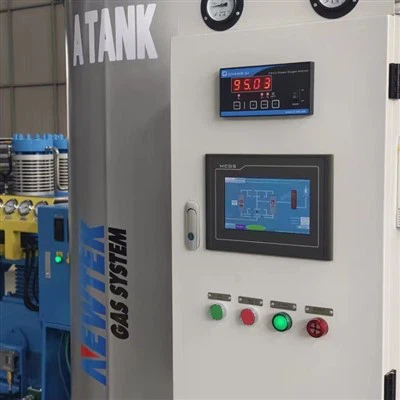
The pressure swing adsorption oxygen generator mainly consists of a blower, a vacuum pump, a switching valve, an adsorber, and an oxygen balance tank. After removing dust particles through the intake filter, the raw air is pressurized to 0.3-0.5 barg by a Roots blower and enters one of the adsorbers. The adsorber is filled with adsorbent, in which water, carbon dioxide, and a small amount of other gas components are adsorbed by the activated alumina loaded at the bottom at the inlet of the adsorber, and then nitrogen is adsorbed by the zeolite molecular sieve loaded on the top of the activated alumina. And oxygen (including argon), as a non adsorbent component, is discharged from the top outlet of the adsorber as product gas to the oxygen balance tank.
When the adsorber adsorbs to a certain extent, the adsorbent will reach saturation. At this time, a vacuum pump is used to evacuate it (opposite to the adsorption direction) through a switching valve, with a vacuum degree of 0.65-0.75 barg. The adsorbed water, carbon dioxide, nitrogen, and a small amount of other gas components are extracted and discharged into the atmosphere, and the adsorbent is regenerated.
Process Description Of Pressure Swing Adsorption Oxygen Generator


Send Inquiry