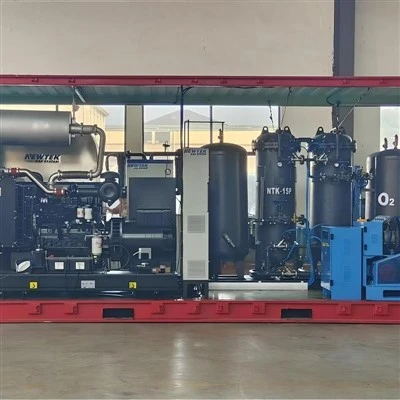
As global demands for industrial wastewater treatment continue to rise, efficient and flexible oxygen supply technologies have become pivotal for improving treatment efficiency and reducing operational costs. As a leader in industrial gas solutions, NEWTEK's PSA (Pressure Swing Adsorption) modular oxygen systems are reshaping core wastewater treatment processes through precise molecular sieving technology and intelligent design, delivering stable and cost-effective oxygen supply to treatment plants. This article, informed by NEWTEK's technical practices, analyzes how PSA modular oxygen enhances wastewater treatment operations, exploring mechanisms, application scenarios, and real-world case studies.

Technical Core and Industrial Value of PSA Modular Oxygen
PSA modular oxygen systems leverage Pressure Swing Adsorption (PSA) technology, efficiently separating oxygen by selectively adsorbing nitrogen, carbon dioxide, and other impurities from air using zeolite molecular sieves. Core advantages include:
High Purity and Stability: NEWTEK's PSA systems stably produce oxygen with 93%±3% purity, meeting diverse process requirements.
Rapid Startup and Low Energy Consumption: From startup to stable oxygen supply in just 15–30 minutes, with energy consumption only 1/3 of cryogenic methods, and power consumption as low as 0.4–0.6 kWh per ton of oxygen.
Modular Design: Single-unit capacity ranges from 5–300 Nm³/h, supporting parallel expansion to adapt to treatment plants of varying scales.
In wastewater treatment, PSA modular oxygen delivers value through:
Precision Oxygen Supply: Real-time adjustment of flow based on aeration tank oxygen demand, avoiding "excess supply" issues typical of traditional liquid oxygen tanks.
Green Sustainability: Eliminates liquid oxygen transportation, reducing carbon emissions; molecular sieves are reusable, minimizing waste.
Controlled Costs: Short initial investment payback period (typically 1–2 years), with maintenance costs only 1/5 of traditional equipment.
Core Optimization Mechanisms of PSA Oxygen Systems for Wastewater Treatment
Enhanced Biochemical Reaction Efficiency: Accelerating Organic Matter Degradation and Sludge Reduction
In activated sludge processes, oxygen is critical for microbial decomposition of organic matter. NEWTEK's PSA systems enhance biochemical efficiency through:
Oxygen-Enriched Aeration: Increasing dissolved oxygen (DO) concentration in aeration tanks from 2–4 mg/L to 6–8 mg/L, boosting COD removal rates by 15%–20% and reducing sludge yield by 30%.
Synergistic Nitrification-Denitrification: Precisely controlling oxygen concentration in anoxic zones to promote ammonia nitrogen conversion to nitrogen, achieving total nitrogen (TN) removal rates of 85% or higher.
Case Data: A municipal wastewater treatment plant using NEWTEK's PSA system increased treatment capacity from 50,000 to 80,000 tons/day, while reducing sludge dewatering frequency from 3 to 1 times daily.
Energy and Cost Control: Low Power Consumption and Maintenance-Free Design
Traditional liquid oxygen tanks suffer from high transportation costs and significant evaporation losses (1%–3% daily). NEWTEK's PSA systems cut costs through:
Low Power Design: Using efficient roots blowers and intelligent pressure regulation algorithms, power consumption per ton of oxygen is 20% lower than industry averages.
Maintenance-Free Advantage: Molecular sieves last 8–10 years, and equipment requires no regular core component replacement, with annual maintenance costs <3% of the equipment's original value.
Economic Comparison: For a 100,000-ton/day wastewater treatment plant, PSA systems save approximately ¥1.2 million annually compared to liquid oxygen solutions.
System Flexibility: Modular Deployment and Dynamic Flow Regulation
Wastewater treatment plants often face fluctuating influent 水质 (water quality) and expansion needs. NEWTEK's PSA systems enhance flexibility via:
Modular Expansion: Gradually add units based on treatment capacity, avoiding excessive upfront investment. For example, a chemical wastewater plant deployed 50 Nm³/h in phase 1 and expanded to 150 Nm³/h in phase 2.
Dynamic Flow Adjustment: Real-time oxygen demand monitoring via PLC control systems, automatically adjusting oxygen production flow with <10-second response.
Extreme Environment Adaptability: Stable operation in high humidity (>95%) and dusty conditions, such as a paper mill's wastewater workshop that ran continuously for 3 years without failure in high-temperature, high-humidity environments.
NEWTEK's PSA Modular Oxygen Solutions
Product Features: High Purity, Intelligent and Modular Design
NEWTEK's PSA modular oxygen systems offer:
Dual-Tower Adsorption Structure: Continuous oxygen supply via alternating adsorption/desorption in two towers, with purity fluctuation <±1%.
Intelligent Control System: Integrated AI algorithms optimize adsorption cycles and pressure parameters, reducing energy consumption by 15%+.
Compact Design: Containerized units occupy only 1/3 the footprint of traditional equipment, enabling rapid deployment in existing plants.
Safety Redundancy: Multiple sensors and automatic protection mechanisms, including oxygen concentration alarm and molecular sieve blockage warning.
Application Cases: Practical Breakthroughs in Municipal and Industrial Wastewater Treatment
Municipal Wastewater Treatment:
A southern city's wastewater plant replaced liquid oxygen tanks with NEWTEK's 100 Nm³/h PSA system. Post-upgrade, DO in aeration tanks stabilized at 7 mg/L, COD removal rose from 82% to 91%, and annual operation costs dropped 40%.
Industrial Wastewater Treatment:
An electroplating plant introduced NEWTEK's 50 Nm³/h system for Fenton oxidation. 93% pure oxygen reduced H₂O₂ consumption by 25%, iron sludge production by 30%, and treated wastewater COD from 500 mg/L to 80 mg/L, meeting reuse standards.
High-Altitude Applications:
A Tibetan plateau wastewater plant used NEWTEK's customized PSA system, producing 90% pure oxygen at 4,500 meters above sea level. This ensured biochemical efficiency in low temperatures (-20℃), increasing treatment capacity by 50% versus traditional processes.
Technical Challenges and Future Trends
While PSA modular oxygen excels in wastewater treatment, challenges remain:
High-Humidity Adaptability: In tropical rainy regions, advanced pretreatment (e.g., deep drying) is needed to prevent molecular sieve degradation. NEWTEK optimizes activated alumina loading to control dew point below -43℃, ensuring stability at >95% humidity.
Synergy with Other Technologies: E.g., precise oxygen flow and pressure control for ozone oxidation. NEWTEK's intelligent systems seamlessly integrate with ozone generators, boosting oxygen-ozone efficiency by 20%.
Future developments will focus on intelligence and green innovation:
AI-Driven Optimization: Machine learning algorithms to predict oxygen demand, further reducing energy use and extending equipment life.
Renewable Energy Integration: Pairing with solar or wind power for "zero-carbon oxygen production." NEWTEK's Tibetan pilot using solar-powered PSA systems has cut power consumption to 0.28 kWh/ton, reducing carbon footprint by 60%.
Material Innovation: Developing new lithium-based molecular sieves to increase adsorption capacity to 22 ml/g while lowering costs by 10%.
Frequently Asked Questions (FAQ)
Q: How do PSA modular oxygen systems compare to traditional liquid oxygen tanks?
A: PSA systems eliminate liquid oxygen transportation and storage, avoiding 1%–3% daily evaporation losses, while reducing energy consumption by 60% and maintenance costs to 1/5 of liquid oxygen solutions.
Q: Can the system adapt to wastewater treatment with highly fluctuating water quality?
A: Yes. NEWTEK's intelligent control system monitors oxygen demand in real time, adjusting flow dynamically with <10-second response, suitable for industrial wastewater with frequent quality fluctuations.
Q: How does the PSA system perform in high-altitude areas?
A: NEWTEK's customized systems operate stably below 5,000 meters altitude, maintaining oxygen purity >90% through optimized molecular sieve efficiency, increasing treatment capacity by 30%–50% versus traditional processes.
Q: Is equipment maintenance complex?
A: The system features maintenance-free design, with molecular sieves lasting 8–10 years. Routine maintenance only requires air filter replacement (every 6 months), ensuring minimal costs.
Q: Does it support integration with existing wastewater treatment systems?
A: Yes. NEWTEK's modular design seamlessly integrates with aeration systems, ozone generators, etc., supporting mainstream control system protocols like PLC and SCADA.
Conclusion
PSA modular oxygen systems are revolutionizing wastewater treatment operations through precise oxygen supply, energy efficiency, and flexible deployment. With its full product range, advanced technology, and industry expertise, NEWTEK is driving widespread adoption of this technology in municipal and industrial wastewater applications. For technical details or customized solutions, visit NEWTEK's official website or contact us.