Across mining, metallurgy, chemical processing, wastewater treatment, glass manufacturing, and energy industries, oxygen demand is becoming less predictable and more fragmented. Production volumes fluctuate, project lifecycles shorten, and plant locations increasingly shift toward remote, temporary, or capacity-constrained sites.
Traditional centralized oxygen supply models-large cryogenic ASUs or permanently installed PSA systems-were designed for stable, long-term, single-location operations. While technically robust, these systems often lack the flexibility required by modern industrial operations
Understanding Modular and Skid-Mounted PSA Oxygen Systems
What Defines a Modular PSA Oxygen Plant
A modular PSA oxygen plant is engineered as a set of standardized functional modules, each performing a defined role within the oxygen generation system:
Air compression and pretreatment module
PSA adsorption module (valve skid, sieve beds)
Oxygen buffering and purity control module
Electrical control and automation module
Each module is designed with predefined mechanical, electrical, and control interfaces, allowing them to be combined, expanded, or replaced without redesigning the entire system.
What Makes a System Skid-Mounted
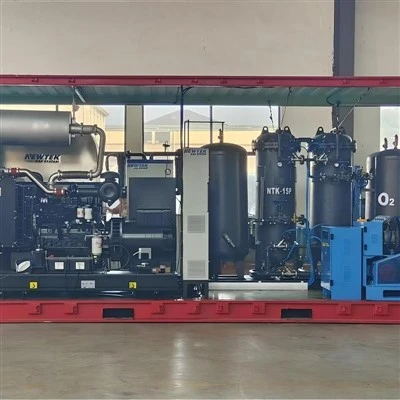
A skid-mounted PSA oxygen plant integrates all critical components onto one or multiple steel skids, fully assembled and tested at the factory:
Structural base frame
Piping and manifolds
Instrumentation and cabling
Control panels and safety devices
The result is a plug-and-play oxygen generation unit that can be transported, installed, and commissioned with minimal on-site work.


Flexibility Starts at the Engineering Level
Industrial flexibility is not achieved through operation alone-it must be designed into the system architecture.
Decoupling Oxygen Capacity from Fixed Infrastructure
Traditional oxygen plants are tightly bound to:
Civil foundations
Dedicated buildings
Permanent utility routing
Modular skid-mounted PSA plants decouple oxygen capacity from fixed infrastructure by:
Requiring minimal foundations
Eliminating the need for custom buildings
Allowing relocation without structural dismantling
This decoupling enables oxygen supply to follow process demand, not the other way around.
Standardized Interfaces Enable Rapid Reconfiguration
Because modules are engineered with standardized interfaces:
Capacity can be increased by adding PSA skids
Redundancy can be achieved through parallel modules
Maintenance can be performed without full system shutdown
From an engineering management perspective, this reduces system risk concentration and improves operational continuity.
Faster Deployment Cycles Mean Faster Production Start-Up
Factory Integration vs. On-Site Construction
One of the most significant advantages of skid-mounted PSA plants is the shift of complexity from site to factory.
Factory-based integration allows:
Controlled assembly conditions
Pre-installation of piping and cabling
Full functional testing before shipment
On-site scope is reduced to:
Positioning the skid
Connecting power and process interfaces
System validation
This approach typically shortens deployment timelines from months to weeks, which is critical for projects with tight schedules or delayed upstream approvals.
Reduced Dependence on Local Technical Resources
In many industrial regions, skilled labor availability is inconsistent. Modular PSA systems reduce reliance on local expertise by:
Minimizing field welding and wiring
Using pre-configured automation logic
Providing standardized commissioning procedures
For EPC contractors and plant owners, this translates into predictable installation outcomes across different geographies.
Scalability Without Overinvestment
Incremental Capacity Expansion
Industrial oxygen demand rarely remains constant. Modular PSA plants allow capacity to be:
Installed in phases
Expanded based on actual consumption
Matched to production ramp-up curves
Instead of oversizing a system at the initial investment stage, operators can align capital expenditure with demand growth.
Avoiding Stranded Assets
In industries such as mining or specialty chemicals, projects may have:
Limited operational lifetimes
Shifting process flows
Variable feedstock quality
Skid-mounted PSA units can be redeployed to new sites once a project ends, avoiding stranded oxygen assets and improving long-term ROI.
Operational Flexibility in Challenging Environments
Remote and Decentralized Operations
Many industrial sites operate far from centralized infrastructure:
Mines
Remote refineries
Construction-based processing plants
Modular PSA oxygen plants support these environments by:
Operating independently from bulk oxygen logistics
Reducing reliance on liquid oxygen deliveries
Providing on-demand oxygen generation at site
This autonomy significantly improves supply security and cost predictability.
Adaptability to Process Variability
PSA systems inherently allow:
Adjustable oxygen purity
Variable flow rates
Load-following operation
When packaged in modular form, these capabilities become easier to manage at system scale, enabling operators to respond quickly to:
Process upsets
Production schedule changes
Energy optimization strategies
Maintenance and Lifecycle Management Advantages
Module-Level Maintenance Strategy
Instead of treating the oxygen plant as a single monolithic system, modular PSA plants enable:
Maintenance at module level
Isolation of individual skids
Replacement rather than on-site repair
This approach reduces:
Mean time to repair (MTTR)
Maintenance-induced downtime
Exposure of on-site personnel to complex tasks
Simplified Spare Parts and Service Planning
Standardized modules mean:
Fewer unique spare parts
Interchangeable components
Predictable service procedures
For multi-site operators, this standardization enables centralized maintenance planning and lower inventory costs.
Energy and Control Optimization Through System Design
Distributed Energy Management
Modular PSA systems allow energy consumption to be optimized by:
Running only required modules
Shutting down excess capacity during low demand
Sequencing compressors and PSA skids efficiently
This modular control philosophy supports energy proportionality, a key objective in modern industrial energy management.
Advanced Automation and Integration
Skid-mounted PSA plants are typically delivered with:
PLC-based control systems
Remote monitoring capability
SCADA or DCS integration readiness
Because control logic is developed and tested at factory level, system behavior is predictable and repeatable, reducing commissioning risk.
Strategic Value for EPCs and Industrial Groups
Simplifying EPC Project Execution
For EPC contractors, modular PSA oxygen plants offer:
Clear scope boundaries
Reduced interface risks
Shorter construction schedules
This improves project controllability and reduces exposure to delays caused by site conditions or subcontractor performance.
Supporting Group-Level Standardization
Industrial groups operating multiple plants benefit from:
Unified oxygen system architecture
Standard operating procedures
Easier cross-site training and support
Modular PSA systems fit naturally into group-level engineering standards, supporting long-term operational consistency.
From Equipment Supply to System Solutions
The real value of modular and skid-mounted PSA oxygen plants lies not only in hardware, but in system-level thinking:
Oxygen generation as a configurable utility
Capacity as a scalable resource
Infrastructure as a movable asset
This shift aligns with how modern industries manage risk, capital, and operational flexibility.
Rather than committing to rigid, site-specific oxygen infrastructure, industrial operators can adopt adaptive oxygen systems that evolve with their processes, projects, and markets.
Flexibility as a Core Design Principle
Modular and skid-mounted PSA oxygen plants are not a temporary trend-they represent a structural evolution in industrial oxygen supply.
By embedding flexibility into engineering design, these systems enable:
Faster deployment
Scalable capacity
Reduced lifecycle cost
Improved operational resilience
For industries facing uncertainty, decentralization, and performance pressure, modular PSA oxygen plants provide a practical, proven pathway to flexible oxygen infrastructure-without compromising reliability or control.