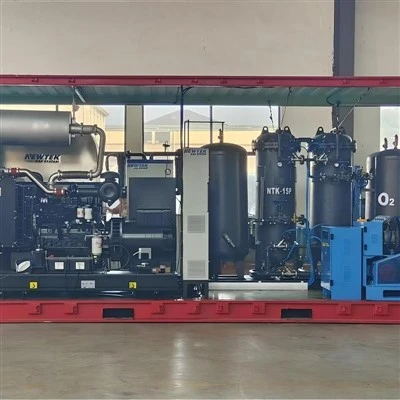
Pressure Swing Adsorption (PSA) technology has become one of the most widely adopted methods for on-site gas generation, especially for oxygen and nitrogen production. Its ability to deliver continuous, high-purity gas using only ambient air and electricity makes PSA systems indispensable in industries such as medical care, metallurgy, electronics, mining, aquaculture, chemical processing, food packaging, and many more.
To fully appreciate the advantages of PSA systems-and to make informed decisions about system selection, plant design, and operation-users must understand how PSA technology works at a fundamental level. This article provides a thorough, engineering-based explanation of PSA working principles, exploring adsorption theory, cycle design, molecular sieve behavior, control sequencing, and real-world factors that influence performance.
Introduction to PSA Technology
Pressure Swing Adsorption is a physical gas separation process that relies on selective adsorption. When air is compressed and passed through an adsorbent material, certain gas molecules are attracted and held on the surface of the material more strongly than others.
In oxygen generators, the adsorbent is typically zeolite molecular sieve, which selectively adsorbs nitrogen and allows oxygen to pass through. In nitrogen generators, carbon molecular sieve (CMS) adsorbs oxygen preferentially.
PSA systems operate at ambient temperature, making them energy-efficient and suitable for continuous industrial operation without cryogenic equipment or stored liquid gases.
The Science Behind Adsorption
Adsorption is the adhesion of gas molecules onto a solid surface. It is influenced by:
Molecular size
Polarity
Surface charge
Pore structure of the adsorbent
Physical Adsorption
PSA technology is based on physical adsorption, not chemical bonding. The forces involved are:
Van der Waals forces
Electrostatic attraction
Dipole interactions
Because these forces are reversible, the adsorbent can be regenerated repeatedly by reducing pressure.
The Role of Zeolite Molecular Sieve
Zeolite is an engineered aluminosilicate crystal with a highly uniform microstructure. In PSA oxygen systems:
Zeolite strongly adsorbs nitrogen
Adsorbs argon very mildly
Does not adsorb oxygen significantly
This selectivity forms the basis of oxygen concentration.
Zeolites have:
High surface area
Precisely controlled pore sizes
Strong nitrogen affinity
Fast adsorption/desorption kinetics
Excellent mechanical strength for repeated cycling
Core Components of a PSA Oxygen System
A typical PSA system includes:
Air compressor
Air pretreatment system (filters + dryer)
Air receiver tank
Twin adsorption towers (A and B) filled with zeolite molecular sieve
Valves for cycle switching
Product oxygen storage tank
Control system & oxygen analyzer
Each component plays a specific role in delivering clean, dry, high-pressure air to the adsorption towers and distributing oxygen continuously.


The PSA Cycle: Step-by-Step
The working principle of PSA lies in its cyclic adsorption and desorption processes. Most systems use two towers operating alternately to provide an uninterrupted oxygen flow.
Step 1: Air Compression
Ambient air is drawn into the compressor, increasing pressure to typically 6–10 bar for oxygen systems.
This step enables nitrogen adsorption on the zeolite.
Step 2: Air Pretreatment
Compressed air contains:
Dust
Moisture
Oil vapors
Micro-aerosols
These contaminants must be removed before air contacts the zeolite. Pretreatment typically includes:
Coarse filters
Coalescing filters
Activated carbon filters
Refrigerant or desiccant dryers
Moisture control is especially critical because water can irreversibly damage the molecular sieve.
Step 3: Adsorption (Tower A Working)
Clean, dry compressed air enters Tower A, where:
Nitrogen is adsorbed by the zeolite
Oxygen and argon pass through to the product end
Because argon is not removed by zeolite, PSA oxygen purity is typically 93% ± 2%, with argon making up the remainder.
As nitrogen accumulates on the zeolite surface, the tower approaches saturation.
Step 4: Tower Switching
Before Tower A reaches full saturation, the system switches flow to Tower B, allowing Tower A to regenerate.
This switching is precisely controlled by:
Solenoid valves
Pneumatic valves
PLC timing sequences
Step 5: Desorption (Regeneration of Tower A)
Regeneration occurs when pressure in Tower A is released to atmospheric levels.
Because adsorption capacity decreases sharply with pressure, nitrogen desorbs naturally and is vented out.
Step 6: Equalization
Many PSA systems use pressure equalization between towers to improve efficiency. Excess pressure from the adsorbing tower is transferred to the regenerating tower to:
Reduce energy consumption
Decrease compressor load
Extend zeolite lifespan
Step 7: Purge
A small portion (about 5–7%) of produced oxygen is used to purge the regenerating tower to remove residual nitrogen.
This step restores high purity for the next adsorption cycle.
Step 8: Repressurization
Before Tower A re-enters the adsorption phase, it is slowly repressurized to stabilize flow and purity.
This completes the PSA cycle.
Why PSA Technology Works: The Theory Behind Pressure Swing
Adsorption Is Pressure Dependent
At high pressure:
Nitrogen is strongly attracted to zeolite
Large quantities of nitrogen accumulate on the adsorbent
Oxygen passes through
At low pressure:
Adsorption capacity drops
Nitrogen is released
This difference in adsorption strength between high and low pressure allows continuous separation.
Fast Cycle Time
PSA systems typically switch cycles every:
5–10 seconds in smaller systems
20–60 seconds in larger industrial units
This rapid cycling enables uninterrupted oxygen generation.
Temperature Stability
PSA operates at ambient temperature. No refrigeration or heat-based distillation is needed, making it:
Energy-efficient
Low-maintenance
Suitable for remote or harsh industrial locations
Factors Influencing PSA System Performance
Understanding performance variables is essential for selecting the right system and maintaining stable operation.
Air Quality
The biggest determinant of PSA efficiency and sieve life is air quality. Contaminants like oil or moisture reduce adsorption performance.
Ambient Temperature
High temperatures reduce adsorption efficiency because nitrogen molecules have more kinetic energy and bind less effectively.
Pressure Stability
Pressure fluctuations can cause:
Purity drops
Reduced flowrate
Increased sieve stress
Valve Switching Accuracy
Valve timing must be precise. Even slight delays can:
Reduce cycle efficiency
Cause breakthrough of nitrogen
Damage molecular sieves
Purity and Flow Demand
Oxygen purity (90–95% standard for PSA) varies with:
Cycle timing
Sieve condition
Tower pressure
Purge ratio
Advantages of PSA Technology
PSA has replaced traditional oxygen supply models in many industries due to its operational advantages.
On-Demand Gas Production
PSA systems generate oxygen on-site and on-demand, reducing dependence on:
High-pressure cylinders
Cryogenic liquid deliveries
High Reliability
With minimal moving parts and no thermal processes, PSA systems offer long equipment life.
Low Operating Costs
Electricity and ambient air are the primary inputs.
Environmental Benefits
PSA reduces:
Carbon emissions from truck deliveries
High-pressure cylinder risks
Cryogenic energy waste
Modular Scalability
Systems can be expanded based on production needs.
PSA Technology vs. Other Gas Separation Methods
Cryogenic Distillation
Produces ultra-high purity (up to 99.999%)
Requires complex refrigeration systems
Best for large-scale plants
Membrane Separation
Suitable for medium purity requirements
Lower maintenance
Less selective compared to PSA
VPSA (Vacuum PSA)
Higher energy efficiency
Larger equipment footprint
More complex operation
PSA remains the most balanced method for small-to-medium oxygen production.
Common Applications of PSA Oxygen Systems
Medical and Hospital Oxygen Supply
On-site PSA plants ensure uninterrupted oxygen availability.
Gold Mining / Cyanidation
Oxygen improves gold leaching kinetics significantly.
Aquaculture
Increases dissolved oxygen in water, improving fish growth.
Metal Cutting and Welding
Provides stable oxygen for fabrication and steel processing.
Wastewater Treatment
Enhances aerobic bacterial decomposition.
Food & Beverage
Used in MAP packaging, fermentation, and ozone generation.