

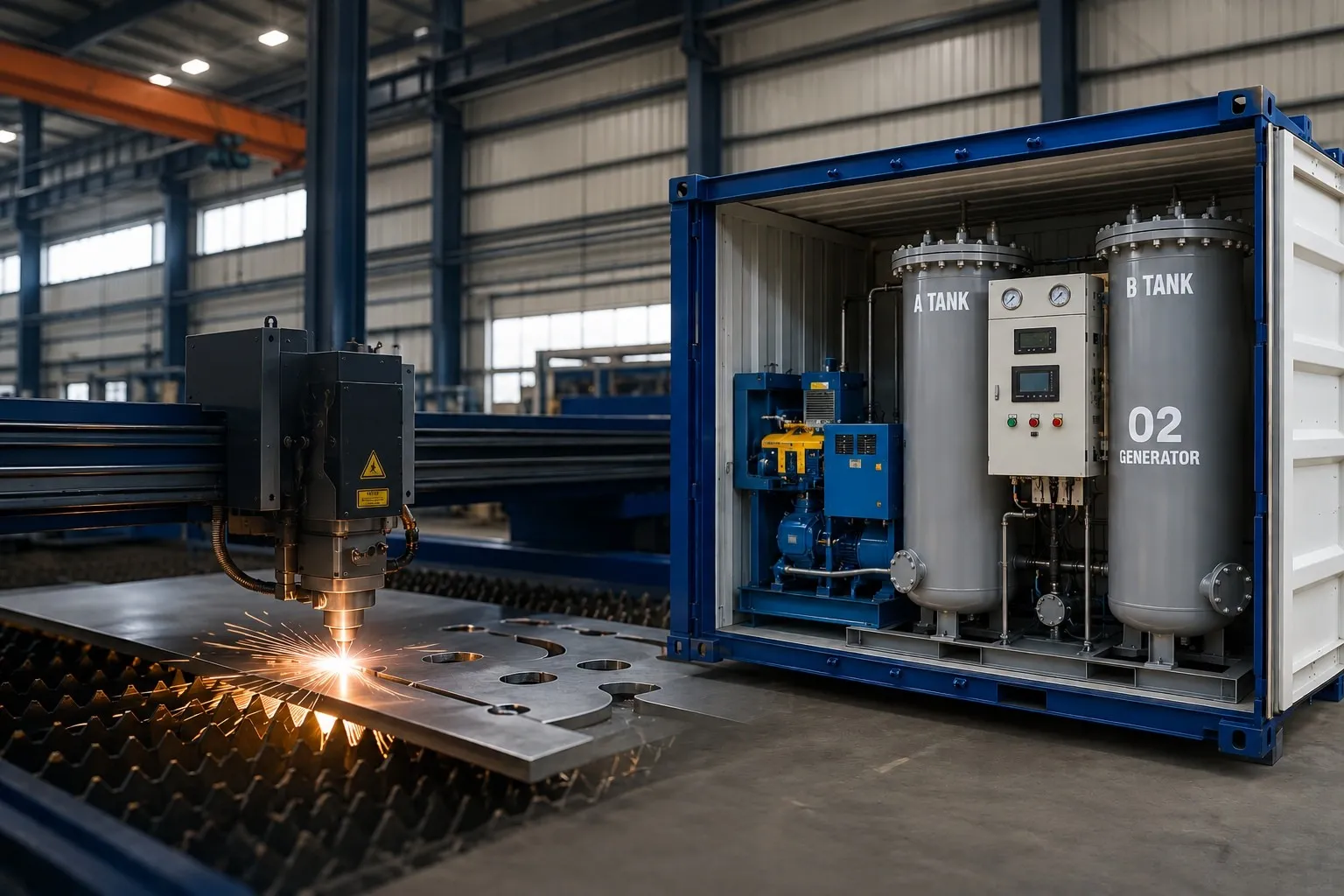
Laser cutting workshops depend on process gases to achieve specific cutting results. Among the gases used in fiber laser and CO₂ laser systems, oxygen plays a direct role in carbon steel cutting by supporting the oxidation reaction at the cutting zone. The gas not only removes molten metal from the kerf but also contributes additional thermal energy during the cutting process.
Many fabrication workshops obtain oxygen through cylinder bundles or bulk liquid oxygen systems. However, increasing production volumes, fluctuating gas consumption, and rising logistics costs have led many metal processing facilities to evaluate on-site oxygen generation using PSA (Pressure Swing Adsorption) technology.
A PSA oxygen system produces oxygen directly from compressed air and supplies a continuous gas source to laser cutting equipment. When properly integrated with oxygen storage tanks, booster compressors, and pipeline networks, the system can support stable cutting conditions throughout multiple production shifts.
This article examines how PSA oxygen generation affects laser cutting precision, how the technology works, and how fabrication workshops integrate PSA systems into cutting operations.
Understanding Oxygen's Role in Laser Cutting
Oxygen Functions as a Reactive Cutting Gas
In carbon steel laser cutting, oxygen performs two simultaneous functions.
First, oxygen ejects molten material from the cutting kerf.
Second, oxygen reacts chemically with heated steel.
The oxidation reaction generates additional heat:
Fe + O₂ → FeO + Heat
This reaction increases thermal energy within the cut zone and assists material removal. As a result, oxygen-assisted cutting generally achieves thicker carbon steel cutting compared with nitrogen-assisted cutting using the same laser power.
Typical oxygen supply pressure ranges between:
· 0.3 bar
· 6 bar
depending on:
· Material thickness
· Laser power
· Cutting speed
· Nozzle design
Oxygen Purity Influences Cutting Stability
The cutting process depends on maintaining a consistent oxygen concentration. When oxygen purity decreases, several process changes may occur:
· Slower oxidation rate
· Increased slag formation
· Rougher cut surfaces
· Reduced cutting speed
· Incomplete penetration
For example, cutting 12 mm carbon steel with 99.5% oxygen may produce different edge conditions compared with lower oxygen concentrations. Workshop operators therefore monitor:
· Oxygen purity
· Flow rate
· Delivery pressure
to maintain repeatable cutting conditions.
Gas Flow Directly Affects Kerf Formation
The nozzle directs oxygen toward the cutting zone. Gas flow must perform two actions simultaneously:
1. Support oxidation.
2. Remove molten material.
Insufficient gas flow may allow molten metal to solidify inside the kerf. Excessive pressure may disturb the molten pool and affect edge quality. Stable oxygen delivery helps maintain consistent kerf width and edge geometry across production batches.
How PSA Oxygen Generation Works
Air Becomes the Raw Material
PSA oxygen generators separate oxygen from atmospheric air. Atmospheric air contains approximately:
· 78% nitrogen
· 21% oxygen
· 1% argon and trace gases
Instead of transporting oxygen cylinders to the workshop, the PSA system extracts oxygen from the surrounding air. The process converts electrical power and compressed air into a continuous oxygen supply.
Main Components of a PSA Oxygen System
A laser cutting oxygen generation station typically contains:
How Dual-Tower PSA Systems Maintain Stable Oxygen Supply
Nitrogen Adsorption Process: Compressed air enters the adsorption vessel. The zeolite molecular sieve selectively adsorbs nitrogen molecules. Oxygen passes through the adsorption bed and enters the storage tank. Typical PSA oxygen purity for industrial applications: · 90% · 93% · 95% depending on production capacity and design requirements.
Continuous Switching Between Towers: The PSA process relies on alternating adsorption cycles. While Tower A adsorbs nitrogen: · Tower B regenerates. When Tower A approaches saturation, the PLC controller switches the valves. The process then reverses. Typical cycle times range from: · 45 seconds · 120 seconds depending on system design. This arrangement prevents oxygen production interruptions.
Pressure Stabilization Through Buffer Storage: Laser cutting machines perform best when gas delivery conditions remain stable. The oxygen buffer tank absorbs pressure fluctuations generated by adsorption tower switching. This stabilizes: · Oxygen pressure · Flow rate · Supply continuity before oxygen enters the cutting system.
How PSA Oxygen Supports Cutting Precision
Consistent Oxygen Availability During Production
Workshops operating multiple laser machines can consume large oxygen volumes. For example: A workshop operating: · Three 12 kW fiber lasers · Two production shifts may consume oxygen continuously throughout the day. A PSA system produces oxygen on-site and transfers gas directly into the workshop pipeline network. Continuous production reduces dependency on cylinder replacement schedules during active cutting operations.
Reduced Pressure Variation
Cylinder banks gradually lose pressure as oxygen is consumed. Operators often switch between cylinder groups to maintain supply. Pressure transitions may influence gas delivery conditions. A PSA system combined with: · Buffer tanks · Pressure regulators · Oxygen boosters maintains a more stable delivery profile. Stable pressure helps maintain repeatable nozzle performance.
Improved Batch Consistency & Automated Support
Laser cutting workshops frequently process: · Structural steel parts · Agricultural equipment components · Construction machinery parts · Sheet metal assemblies. Production batches may include hundreds or thousands of identical components. Stable oxygen supply conditions help maintain: · Similar kerf geometry · Similar oxidation behavior · Similar edge appearance across production runs.
Modern fabrication facilities often integrate: · CNC loading systems · Automated sheet handling · Conveyor unloading systems. These systems operate continuously. Interruptions caused by cylinder replacement can affect production scheduling. An on-site PSA system supplies oxygen directly to the distribution network, reducing dependence on manual cylinder exchanges.
Containerized PSA Oxygen Plants for Laser Cutting Workshops
What Is a Containerized Oxygen Plant?
A containerized oxygen plant installs the entire oxygen generation system inside a standard ISO container. Typical equipment includes: · Air compressor · Air dryer · Filters · PSA oxygen generator · Oxygen storage tank · Control cabinet. The container serves as: · Equipment enclosure · Transport structure · Environmental protection system.
Advantages for Fabrication Facilities & Factory Assembly
Many laser cutting workshops have limited indoor floor space. Installing the oxygen system inside a container allows operators to position the equipment: · Adjacent to the workshop · Behind production buildings · Near utility areas. This approach separates oxygen generation equipment from production machinery.
Containerized systems arrive with pre-installed components. Field installation generally includes: · Foundation preparation · Electrical connection · Pipeline connection. This reduces on-site assembly requirements. For expanding fabrication facilities, containerized systems simplify oxygen infrastructure deployment.
Comparing PSA Oxygen with Cylinder Supply Systems
Oxygen Source: Cylinder systems depend on external oxygen suppliers. PSA systems generate oxygen from: · Atmospheric air · Electrical power. The oxygen source remains available as long as utility power and equipment operation continue.
Logistics Requirements: Cylinder supply requires: · Delivery scheduling · Inventory management · Cylinder handling. PSA systems shift operational focus toward: · Compressor maintenance · Filter replacement · Performance monitoring.
Workshop Expansion: When oxygen consumption increases, cylinder demand increases proportionally. PSA systems can often expand through: · Additional adsorption towers · Larger compressors · Additional storage tanks depending on facility requirements.
Installation & Maintenance Considerations
Pipeline Materials: Oxygen distribution networks commonly use: · Stainless steel tubing · Oxygen-clean copper piping. Materials must be compatible with oxygen service. Oil-contaminated components should never be installed in oxygen pipelines.
Ventilation Requirements: Compressors generate heat during operation. Equipment rooms or containers typically incorporate: · Ventilation louvers · Exhaust fans · Temperature monitoring to remove heat from the enclosure.
Oxygen Monitoring: Workshops should continuously monitor: · Oxygen purity · Delivery pressure · Flow rate. Monitoring devices help operators identify performance changes before cutting quality is affected.
Maintenance Routines: Filter replacement removes contaminants before compressed air reaches sieve beds (blocked filters drop system efficiency). Adsorption performance molecular sieve trends are evaluated via purity logs. Finally, check pneumatic valves, solenoid components, and actuator seals to prevent cycle leakage errors.
FAQ
Can PSA oxygen replace cylinder oxygen for laser cutting?
In many carbon steel cutting applications, PSA oxygen systems can provide a continuous oxygen source when properly sized for workshop demand and integrated with suitable storage and pressure control equipment.
What oxygen purity is commonly produced by PSA systems?
Industrial PSA oxygen systems typically produce oxygen between 90% and 95% purity depending on flow rate and system design.
Can one PSA system support multiple laser cutting machines?
Yes. Oxygen distribution networks can connect multiple cutting machines to a common oxygen generation station, provided the system capacity matches total consumption requirements.
Are containerized oxygen plants suitable for fabrication workshops?
Yes. Containerized systems allow oxygen generation equipment to be installed outside the production area while maintaining direct pipeline connections to workshop machinery.
Conclusion
Laser cutting precision depends on maintaining stable cutting conditions, including oxygen purity, pressure, and flow consistency. PSA oxygen systems generate oxygen directly from compressed air using dual-tower adsorption technology and supply gas continuously to laser cutting operations. When integrated with oxygen storage tanks, booster compressors, and automated control systems, PSA oxygen generation can support uninterrupted production schedules and stable cutting conditions. Containerized oxygen plants further simplify installation by integrating compressors, filtration equipment, adsorption towers, storage vessels, and controls into a transportable enclosure. For projects evaluating on-site oxygen generation, engineers should calculate oxygen demand, cylinder turnover rate, filling pressure, compressor capacity, adsorption tower sizing, and available installation space before selecting a PSA oxygen generation and filling system configuration.
Evaluate Your Gas Requirements
Provide your parameter profiles to configure a stable containerized PSA oxygen module layout for your shop floors:
- Fish species & stocking targets
- Daily biomass & water volume
- Oxygen consumption targets
- Available electrical power
- Installation site profiles
Industrial Gas Options
Dual-Tower PSA Platforms
Continuous alternating gas generation flows.
Containerized ISO Gas Plants
Drop-in weatherproof structures for outdoor placement.
High-Pressure Boosters
Oil-free reciprocating lines built for cutting setups.


