Oxygen Has Become a Primary Limiting Factor in Intensive Shrimp Culture
Modern shrimp farming systems continue increasing stocking density to improve annual production per hectare. Traditional semi-intensive ponds operating at 20–40 shrimp/m² are being replaced by high-density layouts: 150–300 shrimp/m² in lined ponds, 300–500 shrimp/m² in greenhouse raceways, and over 500 shrimp/m² in indoor recirculating systems.
As biomass density increases, oxygen consumption rises rapidly. Shifting dissolved oxygen (DO) levels from 5 mg/L to 3 mg/L during the night can trigger sudden feeding reduction, surface swimming behavior, poor molting stability, and catastrophic mortality events.
To protect these investments, forward-thinking operators are replacing traditional aeration-only systems with on-site PSA oxygen generation systems that inject concentrated gas directly into circulation lines.
1. Oxygen Demand Increases Rapidly in High-Density Shrimp Farming
Shrimp Respiration Increases With Biomass Density
Shrimp consume oxygen continuously through gill respiration. In intensive ponds operating above 20–30 tons/hectare production capacity, DO declines rapidly during peak feeding periods and critical nighttime hours.
| Pond Condition | Approximate Oxygen Consumption Trend |
|---|---|
| Early juvenile stage | Low oxygen load |
| Mid-growth stage | Increasing nighttime demand |
| Harvest-size biomass | Continuous high oxygen demand |
Limitations of Traditional Paddlewheel Aerators
While surface paddlewheels agitate the water surface to transfer atmospheric gas, their efficiency drops severely in warm water (above 30°C) and heavy organic loads. Crucially, oxygen deficiency always begins near the pond bottom where organic sludge decomposes and shrimp feed, rendering surface-level mechanical agitation inadequate.
2. What Is a PSA Oxygen System?
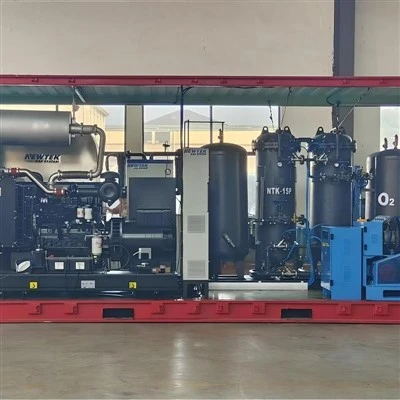
Pressure Swing Adsorption (PSA) systems separate pure oxygen directly from ambient air using zeolite molecular sieve beds, supplying a steady flow without external logistics dependence.
| Component | System Function |
|---|---|
| Screw Air Compressor | Compresses ambient air continuously |
| Air Treatment Dryer & Filters | Removes water vapor, oils, and particulate matter |
| Twin PSA Towers | Zeolite sieves adsorb nitrogen gas under pressure |
| Buffer Tank & Analyzer | Stabilizes downstream pressure and monitors purity (90–95%) |
Integration with Specialized Dissolution Gear: PSA generators easily route gas directly into venturi injectors, nanobubble generators, oxygen cones, or custom bottom-diffuser grids to dissolve pure gas thoroughly into deep water layers.
3. Why PSA Oxygen Systems Support High-Density Shrimp Farming
- Continuous Flow Security: Eliminates reliance on cylinder swaps or bulk liquid supply trucks. It delivers 24/7 reliability during sudden nighttime respiration spikes or unpredictable weather shifts.
- Optimized Feed Conversion: When DO drops below 4–5 mg/L, shrimp stop feeding, leaving wasted inputs that rot and strip even more oxygen. Stable DO stops this cycle.
- Targeted Bottom Delivery: By connecting pure gas loops to bottom water circulation circuits, oxygen reaches critical feeding zones and central sludge drains efficiently.
- Mitigation of Algae Crashes: Sudden phytoplankton die-offs throw sudden organic demands on a pond. On-site PSA plants scale up output immediately to shield biomass from emergency hypoxia.
Containerized On-Site Security:
For rural or coastal ponds, road blockages or weather delays pose major logistical risks. Placing an integrated, weather-resistant PSA steel container system right beside your ponds establishes absolute supply-chain independence.
4. Typical PSA System Configurations for Shrimp Farming
Small & Nursery Ponds
Uses 10–30 Nm³/h skids, air-cooled screw compressors, and single buffer tanks coupled to simple venturi injectors.
Medium Intensive Farms
Deploys 50–100 Nm³/h generators with multi-stage filtration and automated PLC control manifolds linking to UPVC distribution lines.
Super-Intensive & Biofloc
Combines parallel high-output PSA skids, nanobubble mixers, and automated loops to offset heavy microbial organic processing loads.
Smart Automation: Modern setups link optical dissolved oxygen sensors directly to PLC loops and VFD compressors, automatically regulating gas flow rates to counter late-night demand surges.
5. FAQ
What oxygen purity do PSA systems provide for shrimp farming?
Most shrimp farming PSA systems produce oxygen between 90% and 95% purity depending on operating pressure and flow rate configurations.
Why does shrimp farming require more oxygen at night?
At night, algae photosynthesis stops and shifts to respiration. Concurrently, shrimp breathing, sludge decomposition, and bacterial processing continue stripping DO from the water columns.
Can PSA oxygen completely replace paddlewheel aerators?
Usually no. PSA systems work best alongside paddlewheel units or water moving equipment. Aerators keep currents flowing to move waste, while the PSA system injects the necessary deep oxygen volume.
Can PSA systems support biofloc shrimp farming?
Yes. Biofloc systems contain high suspended microbial biomass that continuously consumes oxygen to digest waste, making stable gas injection an absolute operational necessity.
PSA Oxygen Systems Help Stabilize Intensive Shrimp Farming Conditions
High-density shrimp farming increases oxygen demand continuously as biomass, feeding rate, and bacterial activity rise. PSA oxygen systems generate oxygen continuously from compressed air and transfer concentrated oxygen directly into circulation networks, preserving optimal feeding metrics, stable water quality, and higher harvest-stage survival rates.
Need an On-Site Shrimp Oxygen System?
NEWTEK designs customized, weather-resistant PSA oxygen systems for intensive ponds, greenhouse raceways, hatcheries, and biofloc configurations.
Consult with Engineers ➔Related Solutions
PSA Oxygen Skids
Compact continuous oxygen generation.
Containerized Oxygen Station
Heavy salt-air corrosion resistant design.
Nanobubble Injection Units
High-efficiency bottom DO enrichment.