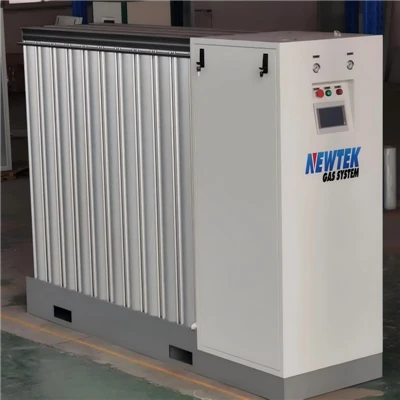
Oxygen plays an important role in modern mining operations, particularly in gold leaching, copper bioleaching, hydrometallurgy, and wastewater treatment. Many of these processes require a continuous oxygen supply to support chemical reactions, improve oxidation efficiency, or maintain suitable conditions for biological activity.
As mining projects expand into remote regions, on-site oxygen generation has become an increasingly practical alternative to traditional oxygen cylinder deliveries and liquid oxygen supply. Two technologies are commonly considered for this purpose: Pressure Swing Adsorption (PSA) and membrane oxygen separation.
Both technologies separate oxygen from ambient air, but they use different physical mechanisms and produce different gas qualities. PSA technology uses zeolite molecular sieves to selectively adsorb nitrogen, typically producing oxygen at approximately 90–95% purity. Membrane separation relies on differences in gas permeability and generally produces oxygen-enriched air at lower purity levels.
These differences affect production capacity, energy consumption, equipment requirements, and suitability for specific mining processes. Understanding their technical characteristics helps mining operators select an oxygen generation system that matches actual production requirements and long-term operating conditions.
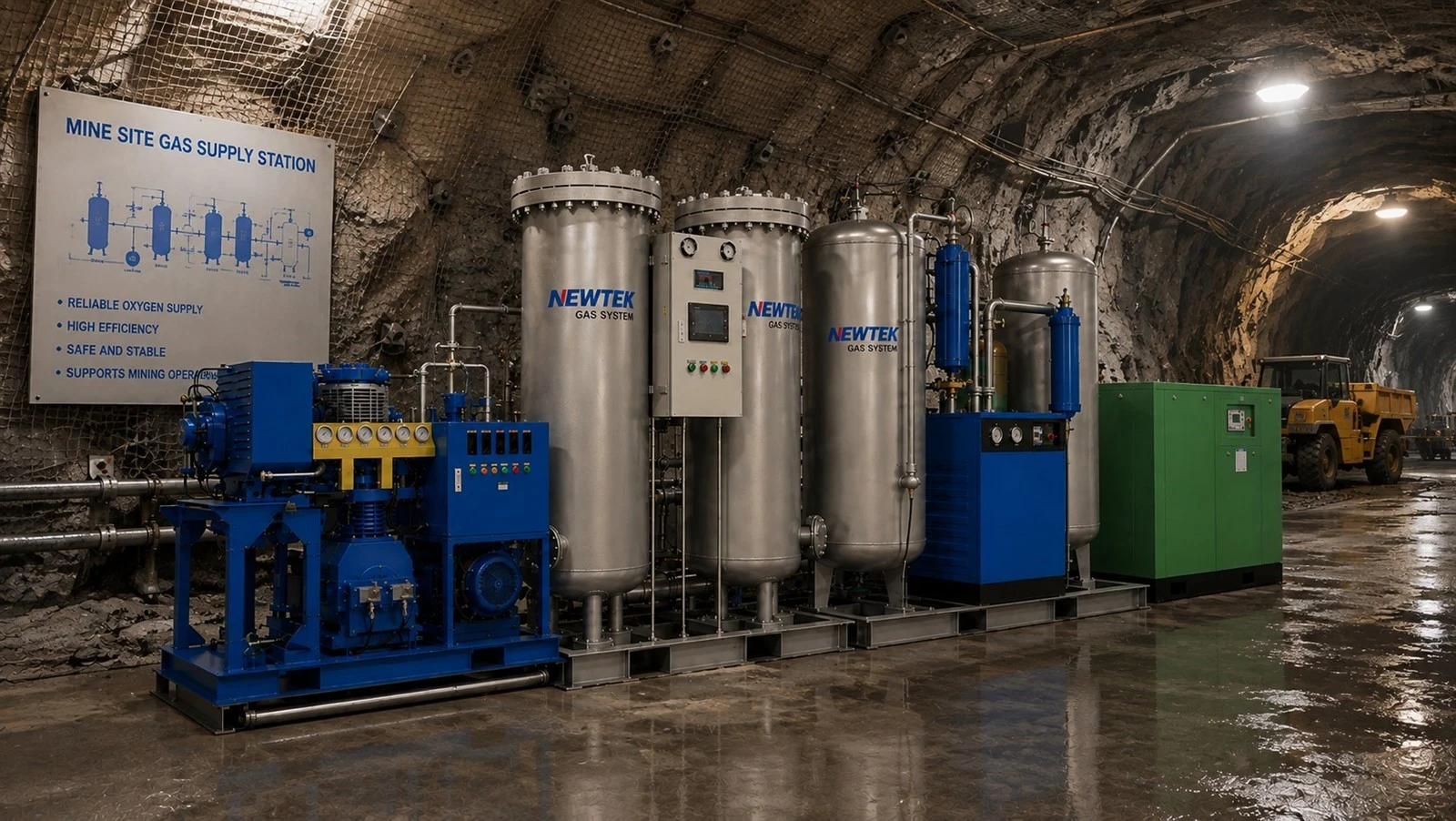
Understanding PSA and Membrane Oxygen Separation
How PSA Oxygen Generation Works
Pressure Swing Adsorption is a gas separation process that uses the different adsorption characteristics of nitrogen and oxygen.
A typical industrial PSA oxygen generator uses zeolite molecular sieves to selectively adsorb nitrogen from compressed air while allowing oxygen and argon to pass through.
The production process involves several stages:
Air compression: Ambient air is compressed to the pressure required by the system.
Air pretreatment: Filters, coolers, and dryers remove dust, moisture, oil aerosols, and other contaminants.
Nitrogen adsorption: Compressed air enters an adsorption vessel, where the molecular sieve retains nitrogen.
Oxygen collection: The oxygen-rich gas enters a buffer tank for temporary storage and supply stabilization.
Adsorbent regeneration: The vessel pressure is reduced to release the adsorbed nitrogen.
Cycle switching: Another adsorption vessel takes over production while the first vessel regenerates.
Multiple adsorption vessels operate in alternating cycles to maintain continuous oxygen generation.
Industrial PSA oxygen generators commonly produce oxygen at approximately 90–95% purity. The actual output depends on equipment design, operating pressure, molecular sieve performance, and production requirements.
For mining operations, this relatively high-purity output is useful when processes require substantial oxygen input without introducing excessive nitrogen into the gas distribution system.
How Membrane Oxygen Separation Works
Membrane oxygen separation uses selective gas permeation rather than adsorption.
A membrane module contains specialized materials that allow different gases to pass through at different rates. When compressed air flows across the membrane surface, oxygen generally permeates faster than nitrogen because of differences in gas permeability.
The process produces two gas streams:
An oxygen-enriched stream that passes through the membrane.
A nitrogen-enriched stream that remains on the feed side or exits through the retentate outlet.
The separation performance depends on membrane material, permeability, pressure difference, temperature, and membrane area.
Conventional polymeric membrane systems designed for oxygen enrichment generally produce oxygen-enriched air at approximately 25–40% oxygen, although specialized configurations may achieve different results.
Their main advantages include compact equipment, modular construction, continuous operation, and relatively simple mechanical arrangements.
However, achieving higher oxygen purity generally requires additional membrane stages, greater membrane area, or more demanding operating conditions. This can increase equipment complexity and energy consumption.
Therefore, membrane technology is generally more suitable for applications that can operate with oxygen-enriched air rather than those requiring high-purity industrial oxygen.
Why Oxygen Supply Matters in Mining Operations
Different mining processes have different oxygen requirements. The required gas quality depends on the chemical or biological reactions involved, the operating conditions, and the efficiency of oxygen transfer.
Gold Leaching and Precious Metal Recovery
Oxygen is an important component of many gold cyanidation processes. During leaching, dissolved oxygen participates in the oxidation of gold, allowing it to form soluble gold-cyanide complexes.
Mining operators introduce oxygen into leach tanks through direct injection, fine-bubble aeration, spargers, or gas-liquid mixing equipment.
A higher-purity oxygen supply provides more oxygen per unit volume of injected gas than conventional air or moderately enriched air. This can be advantageous when oxygen demand is high, tank space is limited, or operators need to improve gas delivery efficiency.
However, oxygen purity alone does not determine leaching performance. Bubble size, mixing intensity, slurry characteristics, residence time, and dissolved oxygen control also influence the effectiveness of oxygen transfer.
Copper Bioleaching and Hydrometallurgy
Oxygen supports aerobic microorganisms involved in the oxidation of iron and sulfur compounds during copper bioleaching.
Oxygen requirements vary according to ore mineralogy, microbial activity, temperature, acidity, and process design.
Heap bioleaching commonly uses aeration networks to distribute air through the ore bed, while stirred-tank bioleaching may require controlled gas injection and efficient mixing.
Oxygen-enriched air may be sufficient for some operations, whereas higher-purity oxygen may be preferable when biological oxygen demand is substantial or gas transfer limits process performance.
The selection should consider actual oxygen consumption and transfer efficiency rather than nominal generator output alone.
Wastewater Treatment and Mine Water Management
Mining wastewater treatment may involve aerobic biological processes that use oxygen to support microorganisms responsible for reducing biodegradable organic matter.
Oxygen is typically introduced through diffused aeration, mechanical aerators, or dedicated oxygen injection systems.
Conventional atmospheric air may be sufficient for many treatment facilities. However, where oxygen transfer efficiency or biological loading creates additional requirements, oxygen-enriched air or high-purity oxygen may offer operational advantages.
Membrane systems can be considered when moderate oxygen enrichment is sufficient. PSA systems are more relevant when the treatment process requires a higher oxygen fraction or a controlled industrial oxygen supply.
PSA vs. Membrane Oxygen Separation: Key Technical Differences
The two technologies should be evaluated according to the actual oxygen requirements of the mining process.
| Comparison Factor | PSA Oxygen Generation | Membrane Oxygen Separation |
|---|---|---|
| Separation mechanism | Selective nitrogen adsorption | Selective gas permeation |
| Main separation material | Zeolite molecular sieve | Polymer membrane |
| Typical oxygen purity | 90–95% | 25–40% for conventional systems |
| Operating mode | Alternating adsorption and regeneration | Continuous separation |
| Product gas | High-purity oxygen-rich gas | Oxygen-enriched air |
| Equipment structure | Multiple vessels and auxiliary equipment | Compact membrane modules |
| Main advantage | Higher oxygen purity | Modular and compact design |
| Main limitation | More mechanical and control components | Lower oxygen purity |
These figures represent typical industrial ranges, not guaranteed specifications for every system.
Oxygen Purity and Actual Production Capacity
Oxygen purity is one of the most important differences between PSA and membrane technology.
A PSA system producing 93% oxygen delivers substantially more oxygen per cubic meter of product gas than a conventional membrane system producing 30% oxygen.
Mining operators should therefore compare actual oxygen output rather than total product-gas flow.
The theoretical oxygen output can be calculated using:
Oxygen output (Nm³/h) = Product-gas flow rate (Nm³/h) × Oxygen purity (%) ÷ 100
Where:
Oxygen output: The volume of oxygen produced per hour.
Product-gas flow rate: The total volume of generated gas per hour.
Oxygen purity: The percentage of oxygen in the product gas.
For example:
| Parameter | PSA System | Membrane System |
|---|---|---|
| Product-gas flow | 100 Nm³/h | 100 Nm³/h |
| Oxygen purity | 93% | 30% |
| Theoretical oxygen output | 93 Nm³/h | 30 Nm³/h |
This illustrative comparison shows why nominal airflow is not an adequate basis for selecting an oxygen generation system.
Energy Consumption and Operating Efficiency
Both technologies require compressed air, making compressor performance a major factor in electricity consumption.
PSA energy requirements are influenced by compressor efficiency, operating pressure, adsorption cycle design, air pretreatment, oxygen production rate, and product-gas pressure.
Membrane systems also depend on feed-air compression. Their energy requirements are affected by membrane permeability, pressure difference, recovery rate, and the amount of feed air needed to achieve the required oxygen output.
Although membrane equipment may have a simpler structure, it does not necessarily consume less electricity per unit of usable oxygen. Its relatively low oxygen output per unit of product gas may require greater airflow to meet the same oxygen demand.
A more meaningful comparison uses specific energy consumption:
Specific energy consumption = Total electrical energy consumed (kWh) ÷ Usable oxygen produced (Nm³)
A lower value indicates less electricity consumption per cubic meter of usable oxygen.
Both systems should be evaluated using consistent gas reference conditions and system boundaries, including compressors, cooling equipment, and any downstream oxygen boosting.
Equipment Footprint and Installation
Membrane systems generally have a compact structure because they do not require large adsorption vessels or cyclic regeneration equipment.
Their modular configuration can simplify transportation and installation, particularly at smaller mining facilities with limited available space.
PSA systems typically require compressors, air coolers, moisture separators, filters, dryers, adsorption vessels, oxygen buffer tanks, automatic valves, and control equipment.
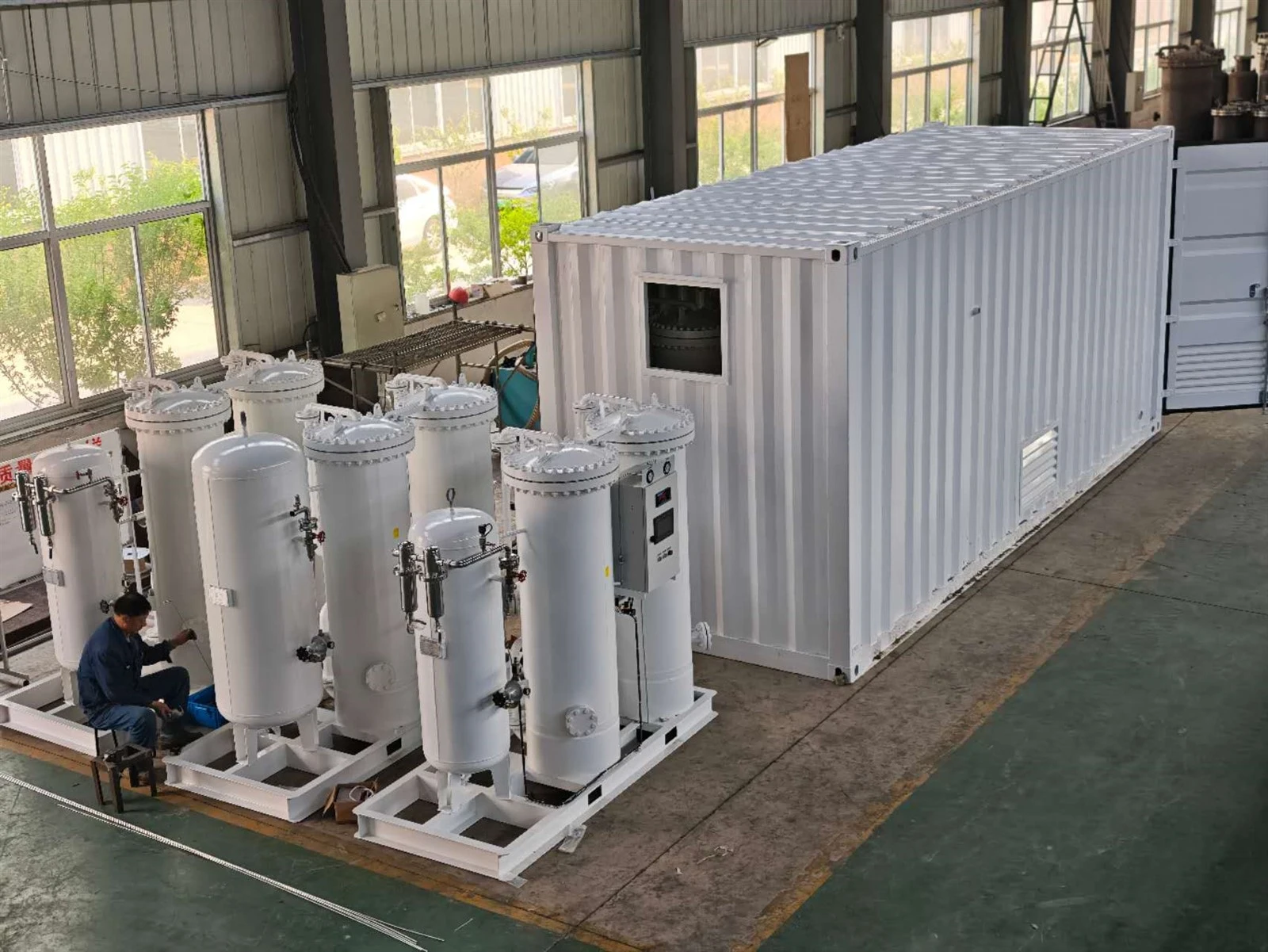
Although this increases installation requirements, containerized PSA systems can simplify transportation and deployment at remote mining sites.
Installation planning should include maintenance access, ventilation, compressor cooling, electrical connections, and oxygen pipeline routing.
Maintenance and Operational Reliability
Mining environments expose industrial equipment to dust, vibration, temperature fluctuations, and continuous operating demands.
PSA systems require regular inspection of compressors, filters, dryers, switching valves, pressure sensors, and molecular sieves. Excessive moisture, oil, or dust can damage the adsorbent and reduce separation performance.
Membrane systems require feed-air filtration, moisture and oil removal, differential-pressure monitoring, membrane inspection, and periodic replacement of damaged or degraded membrane elements.
Neither technology is maintenance-free. PSA maintenance focuses heavily on adsorption-cycle components and air-treatment performance, while membrane maintenance places greater emphasis on membrane integrity and feed-gas quality.
For remote mining operations, spare-parts availability, technical support, operator training, and equipment recovery time should also be included in the reliability assessment.
How Mining Site Conditions Influence Technology Selection
Mining projects frequently operate in environments with high elevations, extreme temperatures, airborne dust, and limited infrastructure. These conditions can directly affect oxygen generation performance.
High-Altitude Operations
Lower atmospheric pressure at high elevations reduces ambient air density and the amount of oxygen entering the compressor per unit of intake volume.
For PSA systems, this can affect compressor capacity, adsorption pressure, and oxygen production.
Membrane systems are also affected because gas permeation depends on the partial-pressure difference across the membrane.
Mining operators should request equipment performance calculations based on the actual installation altitude rather than relying exclusively on standard sea-level specifications.
High Temperatures and Dust
Elevated temperatures can increase compressor discharge temperatures and place additional demands on cooling and air-treatment equipment.
For PSA systems, excessive moisture entering the adsorption vessels can reduce molecular sieve performance. For membrane systems, temperature changes may affect membrane permeability, selectivity, and mechanical stability.
Dust and oil contamination can also damage separation components in both systems. Effective filtration, moisture removal, and appropriate air intake positioning are therefore essential.
Remote Locations and Limited Infrastructure
Remote mines may lack reliable electricity, convenient transportation routes, and readily available technical services.
Important selection considerations include:
Electrical power availability and reliability.
Compressor servicing requirements.
Spare-parts supply.
Accessibility for routine inspections.
Transportation dimensions and equipment weight.
Backup oxygen arrangements.
Remote monitoring capabilities.
A compact membrane system may be suitable when oxygen demand is relatively modest. PSA may provide greater value when higher-purity oxygen and continuous industrial production are required.
Operating Costs and Long-Term Economic Considerations
The initial equipment price is only one part of the total investment. Mining operators should evaluate capital expenditure (CAPEX), operating expenditure (OPEX), maintenance, and replacement costs over the expected operating life of the facility.
Initial Investment and Electricity Costs
Membrane systems may offer lower initial equipment costs in applications requiring moderate oxygen enrichment. Their compact structure can also reduce installation requirements.
PSA systems generally involve more components, including compressors, dryers, filters, adsorption vessels, buffer tanks, and automatic control equipment.
However, equipment prices should only be compared when both systems meet the same oxygen delivery requirements.
Electricity is another major recurring expense. Annual operating costs depend on operating hours, electricity tariffs, compressor efficiency, actual oxygen production, and auxiliary equipment consumption.
A lower purchase price does not necessarily indicate a lower long-term operating cost.
Consumables and Replacement Costs
PSA systems require periodic replacement of filters and air-treatment components. Molecular sieve replacement may also be necessary after prolonged operation or performance deterioration.
Membrane systems require inspection and eventual replacement of membrane elements when their performance declines or physical damage occurs.
Other expenses may include compressor lubricants, valve maintenance, instrumentation calibration, cooling-system servicing, and spare parts.
Total Cost of Ownership
A complete financial comparison should consider total cost of ownership:
TCO=CAPEX+OPEX+M+R
Where:
(CAPEX) = Initial equipment and installation investment.
(OPEX) = Electricity and routine operating expenses.
(M) = Maintenance and servicing costs.
(R) = Replacement and refurbishment costs.
A membrane system may have an attractive purchase price, but insufficient oxygen output could require additional modules or supplementary oxygen supplies. Conversely, installing PSA equipment for a process that only requires moderate oxygen enrichment may result in unnecessary investment.
The most economical solution is the one that delivers the required oxygen quality and output at the lowest overall operating cost.
Which Technology Is More Suitable for Different Mining Applications?
The following comparison provides a practical starting point for technology selection.
| Mining Application | Main Oxygen Requirement | Potentially Suitable Technology |
|---|---|---|
| Gold cyanide leaching | Oxygen for gold oxidation | PSA |
| Copper bioleaching | Oxygen for microbial activity | PSA or membrane |
| Mine wastewater treatment | Oxygen for aerobic biological treatment | Membrane or PSA |
| Mineral processing oxidation | Oxygen for chemical reactions | PSA |
| Low-intensity aeration | Moderate oxygen enrichment | Membrane |
| Remote processing facilities | Independent oxygen supply | PSA or membrane |
| Small-scale oxidation systems | Moderate oxygen-enriched gas flow | Membrane |
These are general guidelines rather than fixed assignments. Actual suitability depends on process testing, oxygen demand, and delivery conditions.
When PSA Is the Better Choice
PSA is generally more suitable when mining operations require relatively high-purity oxygen.
Typical applications include gold leaching with substantial oxygen demand, hydrometallurgical processes requiring controlled oxygen injection, and processing plants where oxygen-enriched air cannot provide sufficient process performance.
Its ability to produce oxygen at approximately 90–95% purity makes it a practical option for continuous on-site industrial oxygen generation.
When Membrane Separation Is the Better Choice
Membrane separation may be appropriate when moderate oxygen enrichment is sufficient.
Potential applications include smaller aeration systems, facilities with limited installation space, and projects where compact modular equipment is an important consideration.
Operators should verify the achievable oxygen output at the actual operating pressure and flow rate. Maximum advertised performance should not be treated as guaranteed output under every operating condition.
Key Engineering Factors Before Purchasing an Oxygen Generation System
Selecting the appropriate technology requires a detailed understanding of the mining process and installation environment.
Determine Actual Oxygen Demand
The first step is to establish the required oxygen supply.
Important parameters include:
Required oxygen flow rate in Nm³/h.
Daily and hourly oxygen consumption.
Average and peak demand.
Required oxygen purity.
Delivery pressure.
Continuous or intermittent operation.
Expected production expansion.
Two mining facilities with similar processing capacities may have different oxygen requirements because of variations in ore mineralogy, pulp density, leaching conditions, and gas-transfer efficiency.
Evaluate Oxygen Transfer Efficiency
The oxygen produced by the generator must eventually enter the process.
In a leaching tank, oxygen transfer depends on gas flow, bubble size, mixing intensity, tank geometry, slurry characteristics, and dissolved oxygen conditions.
A high-purity oxygen supply does not automatically guarantee improved recovery if the gas injection system cannot transfer oxygen efficiently.
The generator and gas distribution system should therefore be evaluated as one integrated solution.
Check Delivery Pressure and Backup Requirements
Oxygen production pressure and delivery pressure are not necessarily the same. Pipeline length, diameter, pressure losses, elevation differences, and injection equipment requirements can influence the required output pressure.
Both PSA and membrane installations also depend on electricity. Mining projects with unstable power supplies may require backup generators, emergency oxygen storage, or supplementary oxygen sources.
A buffer tank can stabilize short-term demand fluctuations, but it cannot replace adequate production capacity or a properly designed backup system.
Consider Automation and Process Integration
Modern oxygen generation installations can incorporate automatic controls and monitoring systems.
For PSA systems, important parameters include adsorption vessel pressure, switching valve operation, product oxygen purity, gas flow, delivery pressure, and feed-air dew point.
For membrane systems, monitoring should include feed-air pressure, product oxygen level, gas flow, differential pressure, and operating temperature.
Integration with PLC or SCADA systems can help mining operators monitor oxygen supply alongside leaching, aeration, and other processing operations.
Oxygen Safety and System Design in Mining Facilities
Oxygen supports combustion, meaning materials can ignite more easily and burn more intensely in oxygen-enriched environments.
Pipelines, valves, seals, regulators, and other oxygen-contact components must be suitable for oxygen service. Equipment should be properly cleaned, and oil or grease contamination must be prevented.
Mining facilities should also consider adequate ventilation, oxygen monitoring in enclosed areas, clearly marked pipelines, leak detection, emergency isolation valves, and personnel training.
Both PSA and membrane systems require appropriate pressure protection, including pressure relief devices, alarms, and automatic shutdown functions. System design should comply with applicable industrial oxygen safety requirements.
The Future of Oxygen Separation Technology in Mining
Further development of PSA technology is focused on improving molecular sieve performance, adsorption vessel design, gas distribution, and automatic control. These improvements aim to reduce pressure losses, increase oxygen recovery, and lower electricity consumption.
Membrane research focuses on improving gas permeability, oxygen selectivity, durability, and temperature resistance. Advanced polymer membranes, carbon molecular sieve membranes, and mixed-matrix materials may expand the range of applications where membrane separation is practical.
Hybrid systems combining membrane separation and PSA are also being explored. Such configurations may balance equipment investment, energy consumption, and final gas quality. However, their economic advantages must be demonstrated through project-specific technical assessments.
Conclusion: Choosing the Right Oxygen Generation Technology for Mining
PSA and membrane oxygen separation offer different advantages for mining operations. PSA technology is generally more suitable when high-purity oxygen, typically around 90–95%, is required for gold leaching, hydrometallurgy, and other oxygen-intensive processes. Its established adsorption process and flexible industrial configuration make it a practical option for continuous on-site oxygen generation.
Membrane separation is more appropriate when moderate oxygen enrichment is sufficient. Its compact design, modular structure, and continuous operation can benefit smaller installations and applications that do not require high-purity oxygen.
The final selection should consider actual oxygen demand, required purity, production capacity, electricity consumption, installation conditions, maintenance requirements, delivery pressure, and process compatibility. Oxygen transfer efficiency and backup supply arrangements are equally important because generator performance alone does not determine the effectiveness of the complete oxygen supply system.
Ultimately, the objective is to establish a reliable oxygen supply that meets mining process requirements throughout the facility's operating life. For projects requiring high-purity oxygen and dependable on-site production, PSA is generally the more practical choice. Where oxygen-enriched air is sufficient and equipment simplicity is a priority, membrane separation deserves consideration. A process-based technical and economic comparison provides the most reliable foundation for selecting the appropriate technology.