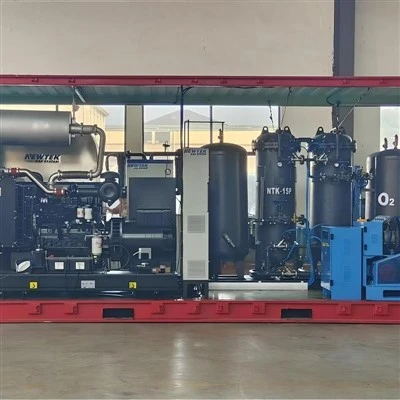
Oxygen cylinder filling is not simply a matter of producing oxygen and transferring it into high-pressure cylinders. For industrial gas suppliers, medical oxygen plants, cylinder filling stations, and decentralized oxygen production facilities, the oxygen purity target must be matched with the intended cylinder application, production technology, filling pressure, flow rate, and applicable quality requirements.
A PSA oxygen plant can produce oxygen-enriched gas directly from ambient air, and its operating parameters can be configured around a defined purity and capacity range. However, increasing oxygen generation normally affects production capacity and specific energy consumption. A system designed to maximize purity may therefore behave very differently from one optimized for high-volume cylinder filling.
This relationship becomes particularly important when the same oxygen generation system is expected to serve different cylinder specifications. A medical oxygen supplier may require a controlled oxygen generation range, while an industrial customer may prioritize production volume and operating cost. A laboratory, cutting operation, wastewater plant, aquaculture facility, or chemical process may have completely different oxygen-quality requirements.
The correct approach is therefore not to ask, "How can oxygen purity be increased?" but rather:
What oxygen purity is required, at what flow rate and pressure, for which cylinder application, and how should the separation system be configured to maintain that specification continuously?

Oxygen Purity and Cylinder Filling: Why the Specification Matters
Oxygen purity refers to the volumetric generation of oxygen in the produced gas. For example, an oxygen stream containing 93% O₂ has approximately 93% oxygen by volume, with the balance consisting primarily of nitrogen and argon.
For cylinder filling, purity should be considered together with:
Oxygen generation
Product flow rate
Product pressure
Moisture content
Oil and hydrocarbon contamination
Particulate contamination
Cylinder cleanliness
Residual gas in the cylinder
Filling temperature
Required final cylinder pressure
Applicable local or international standards
These parameters are interconnected.
A plant may theoretically produce high-purity oxygen, but if the production rate falls sharply at that purity level, the system may not be commercially suitable for a cylinder filling operation.
For example, a cylinder filling station may require a large number of cylinders to be filled every day. If the PSA system is operated at an unnecessarily high purity target, the operator may sacrifice substantial oxygen output without gaining a meaningful benefit for the actual application.
This is why oxygen generation systems should be engineered around a defined purity-capacity operating point rather than an isolated purity number.
Different Oxygen Applications Require Different Purity Strategies
There is no universal oxygen purity value suitable for every cylinder filling application.
The required specification depends on the downstream process.
Typical application categories
| Application | Typical Oxygen Quality Consideration | Main Engineering Priority |
|---|---|---|
| Medical oxygen | Regulated medical-grade specification | Purity consistency and quality control |
| Industrial combustion | Application-dependent | Oxygen flow and operating cost |
| Metal cutting | Application-dependent | Stable oxygen generation and pressure |
| Wastewater treatment | Often oxygen-enriched air or high-purity oxygen | Mass transfer efficiency |
| Aquaculture | Application-dependent | Dissolved oxygen transfer efficiency |
| Ozone generation | Often high-purity oxygen preferred | Stable feed-gas quality |
| Chemical processing | Process-specific | Purity and contaminant control |
| Laboratory use | Application-specific | Gas quality and analytical consistency |
| Emergency oxygen supply | Applicable medical specification | Reliability and traceability |
These categories should not be treated as interchangeable.
For medical applications, the applicable pharmacopoeia, national regulation, procurement specification, and facility requirements determine the acceptable oxygen generation. WHO documentation, for example, identifies PSA-produced medical oxygen as 93% ± 3% O₂, while oxygen produced through air liquefaction has a different specification.
The United States Pharmacopeia also defines oxygen as containing not less than 99.0% oxygen by volume for its oxygen monograph.
Therefore, a cylinder filling project should never select an oxygen purity target merely because a particular percentage is commonly advertised by equipment suppliers.
The target must be derived from the actual product specification and regulatory framework applicable to the cylinder's end use.

How PSA Oxygen Production Determines Purity
A PSA oxygen generation system separates oxygen from compressed atmospheric air using a selective adsorbent, commonly a molecular sieve.
Atmospheric air contains approximately:
78% nitrogen
21% oxygen
Approximately 1% argon and other gases
During PSA operation, compressed air enters an adsorption vessel containing molecular sieve material. Nitrogen is preferentially adsorbed, while oxygen and argon pass through as the product gas.
The process generally includes:
Air compression
Air cooling
Condensate separation
Air filtration
Air drying
PSA adsorption
Nitrogen desorption
Oxygen buffering
Oxygen quality monitoring
Oxygen compression
Cylinder filling
WHO describes PSA oxygen plants as systems incorporating components such as an air compressor, dryer, filters, dual separation chambers, reservoir, and control system. Oxygen can then be compressed through a booster compressor and transferred to a cylinder filling ramp.
The key engineering point is that oxygen purity is determined by the interaction between adsorption efficiency and operating conditions.
It is not controlled by one component alone.
The Main Parameters That Affect Oxygen Purity
When an operator needs to adjust oxygen purity, several process parameters should be evaluated simultaneously.
Adsorption Pressure
Increasing adsorption pressure generally increases the amount of nitrogen that can be adsorbed by the molecular sieve.
Within the designed operating range, higher effective adsorption pressure can improve separation performance.
However, pressure should not be increased blindly.
Excessive pressure may:
Increase compressor power consumption
Increase mechanical stress
Increase heat generation
Reduce overall system efficiency
Create unfavorable cycle conditions
The pressure must therefore remain within the molecular sieve manufacturer's specified operating window.
Desorption Pressure
After adsorption, the molecular sieve must be regenerated by reducing pressure and releasing the adsorbed nitrogen.
If regeneration is incomplete, nitrogen loading accumulates in the adsorbent.
This can progressively reduce oxygen generation.
Effective regeneration requires appropriate:
Pressure reduction
Equalization strategy
Purge flow
Regeneration time
Valve timing
Therefore, when oxygen purity decreases, the correct response is not necessarily to increase adsorption pressure. The regeneration side of the PSA cycle must also be checked.
PSA Cycle Time
Cycle timing is one of the most important variables in oxygen purity control.
A simplified PSA cycle includes:
Adsorption
Pressure equalization
Depressurization
Regeneration
Repressurization
If the adsorption period is too long, the molecular sieve may approach saturation with nitrogen.
This can allow more nitrogen to pass into the product stream, reducing oxygen generation.
If the adsorption period is too short, the adsorbent may not be used efficiently and the system may lose production capacity.
Consequently, cycle timing represents a compromise between:
purity + capacity + adsorbent utilization + energy consumption.

Oxygen Purity vs. Oxygen Production Capacity
One of the most important concepts for cylinder filling is the relationship between oxygen purity and production capacity.
In many PSA systems, operating at a higher purity target means accepting a lower product flow rate.
A simplified engineering relationship can be expressed conceptually as:
Higher purity → stronger separation requirement → lower practical product flow
while:
Higher flow → greater nitrogen breakthrough risk → lower achievable purity
The exact relationship depends on:
Molecular sieve type
Adsorption vessel dimensions
Feed-air pressure
Feed-air temperature
Feed-air humidity
Cycle configuration
Valve response
Purge ratio
Oxygen recovery target
Product pressure
Therefore, a supplier should not specify a PSA plant using only:
99% oxygen
or:
93% oxygen
The specification should include the corresponding production rate.
For example:
| Design Point | Oxygen Purity | Product Flow | Typical Engineering Objective |
| Point A | 90–93% | High | Maximize production efficiency |
| Point B | 93–95% | Medium-high | Balanced operation |
| Point C | 95–97% | Medium | Higher generation |
| Point D | 97–99%+ | Lower | High-purity applications |
These values are illustrative rather than universal equipment ratings. Actual performance must be established through the specific PSA design.
For cylinder filling, the purity-flow combination is much more meaningful than purity alone.
How to Adjust Purity Without Destabilizing the System
A proper purity adjustment procedure should be performed progressively.
Step 1: Establish the Required Cylinder Specification
Before changing machine settings, determine:
End-use application
Required oxygen generation
Applicable standard
Cylinder working pressure
Cylinder water capacity
Number of cylinders per batch
Daily filling quantity
Required filling time
Required storage pressure
This establishes the actual operating target.
Step 2: Verify the Oxygen Analyzer
A purity adjustment should never be based solely on assumptions.
The oxygen analyzer should be:
Correctly installed
Properly calibrated
Suitable for the required generation range
Located at an appropriate sampling point
Protected from excessive moisture
Checked against a suitable reference gas where required
A faulty analyzer can create a false purity problem.
For example, if the analyzer reads 90% while the actual gas is 93%, an operator may unnecessarily modify the PSA cycle and reduce production efficiency.
Step 3: Check Feed-Air Conditions
Before changing PSA parameters, inspect the compressed-air side.
Important parameters include:
Feed-air pressure
Feed-air temperature
Relative humidity
Oil carryover
Liquid water
Filter differential pressure
Dryer performance
Compressor condition
Molecular sieve performance is sensitive to contamination.
Water and oil are especially important because they can occupy adsorption sites or damage the adsorbent over time.
A purity decline caused by contaminated molecular sieve cannot be reliably corrected through control-parameter adjustment alone.
Adjusting Purity Through PSA Cycle Optimization
If feed-air quality and instrumentation are confirmed to be normal, the next stage is optimization of the PSA cycle.
Adjust Adsorption Time
Reducing adsorption time can prevent excessive nitrogen loading.
This may improve oxygen generation.
However, it can also reduce the amount of oxygen produced per cycle.
The correct value must therefore be established experimentally or through the equipment manufacturer's validated control logic.
Optimize Regeneration
Regeneration efficiency has a direct effect on the next adsorption cycle.
Parameters may include:
Regeneration duration
Vacuum level, if vacuum-assisted PSA is used
Purge ratio
Equalization timing
Exhaust valve opening
Repressurization rate
Poor regeneration can cause nitrogen accumulation and gradually reduce oxygen purity.
Optimize Purge Gas
A small quantity of oxygen product may be used to purge the molecular sieve during regeneration.
Increasing purge flow can improve regeneration and therefore improve purity.
But purge gas is product gas that is not delivered to the cylinder.
This produces an important trade-off:
More purge → potentially higher purity but lower oxygen recovery.
For a high-volume cylinder filling plant, excessive purge can significantly affect operating cost.
Oxygen Buffer Tanks and Purity Stabilization
A buffer tank is not simply an oxygen storage vessel.
In a PSA system, it can also contribute to stable downstream operation.
The PSA process is cyclic, while cylinder filling may require relatively stable flow.
The buffer tank helps decouple:
cyclic PSA production
from
continuous or semi-continuous cylinder filling demand.
A properly sized oxygen buffer can:
Reduce pressure fluctuations
Stabilize product flow
Provide short-term demand balancing
Reduce frequent PSA operating changes
Support stable analyzer readings
However, the buffer tank should not be regarded as a method of correcting poor oxygen purity.
If the PSA outlet is consistently below specification, storing more of the same gas does not improve its quality.
The upstream separation process must still produce compliant oxygen.
Why Cylinder Filling Pressure Is a Separate Issue from Oxygen Purity
Oxygen purity and cylinder filling pressure are often confused.
They are different parameters.
Purity describes gas composition.
Pressure describes the amount of gas stored in the cylinder.
A PSA plant may generate oxygen at a relatively low pressure, while the cylinder may require a much higher filling pressure. This is why a dedicated high-pressure oxygen booster compressor is commonly installed between the oxygen generation system and the filling manifold.
WHO's medical oxygen guidance describes the cylinder filling station as consisting of a booster compressor and filling ramp, and notes that the booster compressor's capacity should be matched to plant production and the expected number and size of cylinders.
For medical oxygen systems, WHO also specifies an oil-free booster compressor for cylinder filling applications.
The process can therefore be represented as:
Ambient Air → Air Treatment → PSA Separation → Oxygen Buffer → Oxygen Analyzer → Booster Compressor → Filling Manifold → Cylinders
Each stage has a different engineering responsibility.
Different Cylinder Sizes Change the Filling Strategy
Cylinder size affects the required filling flow and filling time.
For example, a cylinder filling station may handle:
Small portable cylinders
Medium medical cylinders
Large industrial cylinders
High-capacity bundle cylinders
The total gas volume required per filling batch depends on:
Cylinder water capacity × filling pressure
with appropriate consideration for temperature and gas behavior.
A simplified relationship is:
Required gas volume ∝ cylinder internal volume × pressure increase
This means that a plant filling 100 small cylinders is not necessarily equivalent to a plant filling 20 large cylinders.
The cylinder filling system should therefore be designed based on:
Number of cylinders
Cylinder volume
Starting pressure
Final pressure
Required filling time
Booster compressor capacity
PSA oxygen production rate
How to Handle Different Purity Requirements on One Production Site
Some facilities need to supply oxygen to multiple markets.
For example:
Medical cylinders
Industrial cylinders
Process oxygen
Oxygen for ozone generation
In this situation, simply changing the analyzer setpoint is not sufficient.
The production architecture should be considered.
Configuration A: Single purity specification
The entire plant produces one validated oxygen quality.
This is the simplest configuration.
Advantages include:
Simple control
Simple quality management
Lower risk of cross-contamination
Easier cylinder traceability
Configuration B: Multiple production modes
The PSA system operates under different validated operating recipes.
For example:
Mode 1 - High-capacity operation
Optimized for maximum oxygen production within the approved purity specification.
Mode 2 - Higher-purity operation
Optimized for higher oxygen generation at reduced product flow.
This approach requires careful validation because changing cycle parameters can affect both purity and recovery.
Configuration C: Separate oxygen generation trains
For facilities with significantly different requirements, separate PSA trains may be more practical.
For example:
| Production Train | Main Application | Priority |
| Train A | Medical cylinders | Quality consistency |
| Train B | Industrial cylinders | Production economics |
| Train C | High-purity process gas | Oxygen generation |
This increases capital expenditure but can simplify process control and quality assurance.
Oxygen Purity Monitoring During Cylinder Filling
Purity should be monitored at multiple points where practical.
A typical monitoring architecture may include:
Point 1 - PSA outlet
Confirms oxygen quality immediately after separation.
Point 2 - Buffer tank outlet
Confirms the gas supplied to the compression system.
Point 3 - High-pressure filling line
Checks whether compression and distribution equipment introduce contamination or quality deviations.
Point 4 - Cylinder or batch sampling
Provides final quality verification according to the applicable quality system.
This layered approach helps identify where a deviation occurs.
For example:
| PSA Outlet | Filling Line | Possible Interpretation |
| Normal | Normal | System operating correctly |
| Low | Low | PSA separation issue |
| Normal | Low | Downstream contamination or mixing |
| Normal | Unstable | Buffer/filling system issue |
| High | Lower after compression | Investigate downstream system |
The analyzer should therefore be considered part of the process-control system rather than simply a display instrument.
What Causes Oxygen Purity to Fall Unexpectedly?
A sudden or gradual purity decline can originate from several areas.
Feed-Air Problems
Potential causes include:
Excessive humidity
Compressor oil carryover
Inadequate filtration
Dryer malfunction
High inlet temperature
Reduced feed pressure
PSA Problems
Potential causes include:
Molecular sieve aging
Adsorbent contamination
Incorrect cycle timing
Valve leakage
Unequal vessel performance
Poor regeneration
Excessive product flow
Instrumentation Problems
Potential causes include:
Analyzer drift
Sensor aging
Incorrect calibration
Sample-line leakage
Condensation in the sample line
Downstream Problems
Potential causes include:
Incorrect valve configuration
Gas mixing
Backflow
Cylinder contamination
Manifold leakage
Improper purge procedures
A systematic troubleshooting process should always identify the location of the problem before changing PSA parameters.
Why Increasing Oxygen Purity Can Increase Operating Cost
Higher oxygen generation normally requires more selective separation.
This can increase:
Compressor energy consumption per unit of oxygen
Purge-gas consumption
Molecular sieve loading
Cycle optimization requirements
Oxygen losses
Equipment capacity requirements
For this reason, the highest achievable purity is not automatically the most economical operating point.
For a cylinder filling business, a more useful metric is:
Cost per filled cylinder at the required oxygen specification
rather than:
Maximum oxygen purity available from the plant.
For example, if an application accepts a lower oxygen generation but the operator unnecessarily runs the PSA system at a higher purity, the facility may consume more electricity while filling fewer cylinders per day.
The correct target is therefore the lowest validated purity that fully satisfies the intended application and applicable requirements.
This principle is particularly important for large-scale oxygen production.
Purity Adjustment Should Be Based on Capacity Curves
A professional oxygen plant supplier should provide a performance curve or operating envelope showing the relationship between:
Oxygen purity
Oxygen flow
Feed pressure
Ambient conditions
Product pressure
Energy consumption
A simplified example is shown below.
| Operating Mode | Purity Target | Relative Production Capacity | Typical Objective |
| High Recovery | 90–93% | High | Maximum output |
| Balanced | 93–95% | Medium-high | General-purpose operation |
| High Purity | 95–97% | Medium | Higher generation |
| Maximum Purity | 97–99%+ | Lower | Specialized applications |
Again, these ranges are illustrative. Actual PSA performance depends on the specific adsorbent, vessel design, compressor, cycle, and operating conditions.
For procurement purposes, the supplier should provide guaranteed performance at a defined operating point, rather than presenting only a maximum purity number.
Medical Cylinder Filling Requires Additional Quality Controls
Medical oxygen should not be treated as ordinary industrial oxygen.
The applicable regulatory framework must be established before equipment configuration.
WHO identifies PSA medical oxygen as oxygen produced from ambient air at a generation of 93% ± 3%, while also distinguishing this from oxygen produced through other production routes.
The cylinder filling process should therefore consider:
Oxygen generation
Gas cleanliness
Oil-free compression
Cylinder inspection
Cylinder cleaning
Cylinder evacuation or purging
Filling pressure
Batch identification
Quality testing
Storage conditions
Traceability
WHO's medical oxygen documentation specifically describes cylinder filling as a downstream application of PSA oxygen plants and emphasizes the need for appropriately configured booster compressors and filling ramps.
The exact quality specification must be determined by the jurisdiction and intended medical use.
Cylinder Purging Is Essential to Final Gas Quality
One often-overlooked factor is the gas already inside the cylinder.
Suppose a cylinder contains residual nitrogen or another gas before filling.
Even if the PSA system produces oxygen at the correct purity, the final cylinder composition can be affected by residual gas.
Therefore, cylinder preparation may include:
Inspection
Depressurization
Residual gas removal
Vacuum evacuation where required
Purging
Filling
Pressure stabilization
Final quality verification
The filling station therefore cannot be evaluated independently from cylinder preparation.
A high-quality oxygen generator connected to poorly prepared cylinders may still produce inconsistent final cylinder gas.
The Role of Cylinder Filling Manifolds
The filling manifold distributes high-pressure oxygen from the booster compressor to multiple cylinders.
A typical manifold includes:
Main header
Branch lines
Isolation valves
Flexible pigtails
Check valves where required
Pressure gauges
Safety devices
Cylinder connections
The manifold should be designed around the required cylinder type and operating pressure.
The number of cylinders filled simultaneously affects:
Flow distribution
Pressure equalization
Filling time
Compressor loading
Temperature rise
Batch management
A manifold that is too large for the booster compressor can result in inefficient filling.
A manifold that is too small can create unnecessary bottlenecks.
How to Select a PSA System for Cylinder Filling
When evaluating an oxygen generation plant for cylinder filling, buyers should request more than a basic purity specification.
A professional technical inquiry should include the following.
Oxygen specification
Required O₂ generation
Permitted tolerance
Required purity stability
Production requirement
Nm³/h oxygen production
Cylinders/day
Peak filling demand
Required operating hours
Cylinder specification
Cylinder water capacity
Working pressure
Final filling pressure
Number of cylinders per batch
Environmental conditions
Ambient temperature
Relative humidity
Altitude
Cooling conditions
Equipment configuration
Air compressor
Air dryer
Filtration system
PSA adsorber
Oxygen buffer tank
Oxygen analyzer
Booster compressor
Filling ramp
Control system
WHO's procurement guidance also emphasizes the importance of defining site information such as elevation, temperature, humidity, existing oxygen infrastructure, and the required plant configuration during project specification.
Designing for a Medical Cylinder Filling Station
Consider a facility that needs to produce PSA oxygen for cylinder distribution to healthcare facilities.
The engineering workflow would be:
Requirement
Medical application
Defined medical oxygen specification
Multiple cylinders per filling batch
Continuous daily production
Generation
Ambient air enters the compressor and air-treatment system.
Separation
The PSA vessels separate nitrogen from oxygen-rich product gas.
Quality control
An oxygen analyzer continuously monitors product generation.
Buffering
The oxygen buffer tank stabilizes downstream supply.
Compression
An oil-free booster compressor increases oxygen pressure to the cylinder filling pressure.
Filling
A manifold distributes oxygen to multiple cylinders.
Verification
Filled cylinders are managed according to the applicable quality and traceability requirements.
The important point is that purity adjustment occurs primarily within the oxygen-generation process, while pressure adjustment occurs mainly within the compression and filling system.
These functions should not be confused.
Common Mistakes When Adjusting Oxygen Purity
Mistake 1: Chasing the Highest Purity
Maximum purity is not always the best production point.
It may reduce oxygen recovery and increase energy consumption.
Mistake 2: Adjusting Cycle Parameters Without Checking Feed Air
If moisture or oil contamination is damaging the molecular sieve, changing cycle time may only mask the underlying problem.
Mistake 3: Ignoring Oxygen Flow
A statement such as "the plant produces 95% oxygen" is incomplete.
The buyer should also know:
At what flow rate?
Mistake 4: Treating Analyzer Readings as Absolute
Analyzer calibration and sample-line conditions can influence readings.
Instrumentation must be verified before modifying the process.
Mistake 5: Using the Same Purity Target for Every Application
Medical, industrial, aquaculture, ozone, combustion, and chemical applications have different gas-quality requirements.
Mistake 6: Ignoring Cylinder Residual Gas
Final cylinder composition depends on cylinder preparation as well as PSA output.
A Practical Purity-Adjustment Workflow
A controlled procedure can follow this sequence:
Stage 1 - Define the target
Determine the required oxygen generation and applicable standard.
Stage 2 - Confirm analyzer accuracy
Verify calibration and sample conditions.
Stage 3 - Check feed air
Inspect pressure, temperature, humidity, filters, and dryer performance.
Stage 4 - Check PSA operating conditions
Review:
Adsorption pressure
Desorption pressure
Cycle time
Equalization
Purge
Valve timing
Stage 5 - Check product flow
Confirm that oxygen demand has not exceeded the system's rated operating point.
Stage 6 - Optimize purity and recovery
Adjust parameters within the manufacturer's validated range.
Stage 7 - Verify stability
Monitor oxygen generation over a sufficiently long operating period.
Stage 8 - Verify filling performance
Check booster compressor operation, manifold pressure, and cylinder filling rate.
Stage 9 - Confirm final product quality
Test the filled cylinders according to the applicable quality-control procedure.
This approach is much more reliable than simply changing one control parameter until the analyzer displays a desired number.
Purity Adjustment and Automation
Modern PSA oxygen plants increasingly use PLC-based control systems to manage the separation cycle.
A typical automated system can monitor:
Oxygen generation
Product pressure
Feed pressure
Compressor status
Valve position
Cycle timing
Buffer tank pressure
Alarm conditions
Operating hours
An oxygen analyzer can be integrated into the control logic to provide alarms when generation falls outside the configured operating range.
For example:
O₂ generation below target → alarm
O₂ generation stable → normal operation
O₂ generation above target → optional optimization mode
However, automatic adjustment should remain within a validated operating envelope.
A control system should not continuously change PSA parameters without engineering limits because uncontrolled optimization can negatively affect adsorbent life, valve performance, oxygen recovery, and equipment stability.
How to Balance Purity, Capacity and Energy Consumption
For B2B oxygen projects, three variables should always be evaluated together:
1. Purity
Does the gas meet the required oxygen specification?
2. Capacity
Can the plant produce enough oxygen to fill the required number of cylinders?
3. Energy efficiency
Can it do so at an acceptable electricity consumption per Nm³ of oxygen?
The ideal operating point is therefore not:
Maximum purity
but:
Required purity + required capacity + acceptable operating cost.
This is particularly important when oxygen cylinders are filled commercially.
If electricity costs represent a major proportion of production cost, operating the PSA plant several percentage points above the required specification may have a direct impact on cylinder production economics.
How Equipment Suppliers Should Specify Oxygen Cylinder Filling Systems
A technically useful quotation should include a detailed performance table.
| Parameter | Recommended Specification |
| Oxygen production capacity | ___ Nm³/h |
| Oxygen generation | ___ % O₂ |
| Purity tolerance | ___ |
| Product pressure from PSA | ___ bar |
| Final cylinder pressure | ___ bar |
| Oxygen booster type | Oil-free |
| Booster capacity | ___ Nm³/h |
| Cylinder size | ___ L water capacity |
| Number of cylinders/filling batch | ___ |
| Filling manifold | ___ outlets |
| Oxygen analyzer | Online |
| Air dryer | Included |
| Air filtration | Included |
| Buffer tank | ___ m³ |
| Control system | PLC + HMI |
| Ambient design temperature | ___ °C |
| Ambient design humidity | ___ % RH |
| Altitude correction | Required where applicable |
This type of specification allows the buyer to compare complete oxygen production systems rather than comparing isolated equipment names.
Final Engineering Principle
Adjusting oxygen purity for cylinder filling is fundamentally a process optimization problem, not a simple setpoint adjustment.
The oxygen generation system must balance:
adsorption performance
with
oxygen recovery
and
production capacity
while maintaining the required gas quality.
For a cylinder filling station, the complete process is:
Air Treatment → PSA Separation → Oxygen Analysis → Buffer Storage → High-Pressure Compression → Cylinder Manifold → Cylinder Preparation → Filling → Quality Verification
Every stage can influence the final result.
The correct purity target should therefore be established from the end application first. Once the specification is known, the PSA operating point can be selected to provide the required oxygen generation at the required flow rate. The booster compressor and filling manifold should then be sized around the cylinder population and filling pressure.
For medical applications in particular, the applicable regulatory and pharmacopoeial requirements must take precedence over generic equipment specifications. WHO identifies PSA medical oxygen at 93% ± 3% O₂, while other oxygen production routes and pharmacopeial definitions may specify different generations.
The most important procurement question is therefore not:
"What is the highest oxygen purity your plant can produce?"
A better question is:
"At our required oxygen purity, what guaranteed flow rate, filling capacity, pressure, energy consumption and quality-control performance can the complete system deliver?"
That question forces the oxygen generator, booster compressor, filling manifold, cylinder preparation system, and quality-control equipment to be evaluated as one integrated production system.
For a commercial cylinder filling operation, this integrated approach is what determines whether the plant can consistently produce compliant oxygen, fill cylinders efficiently, control operating costs, and maintain stable production over the long term.