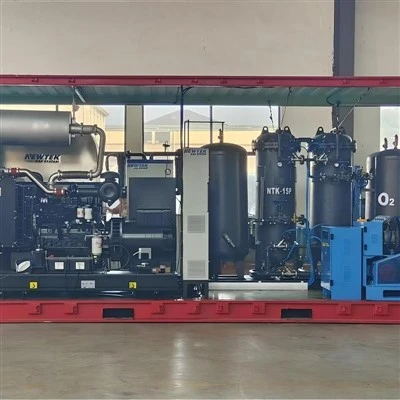
In wastewater treatment, PSA and VPSA oxygen systems both use molecular sieve adsorption to separate oxygen from air, but their pressure cycles, air supply equipment, regeneration methods, and downstream integration are different.
PSA uses compressed air for pressurized adsorption and normally relies on depressurization for regeneration. VPSA uses a blower to supply air at a lower pressure and uses a vacuum pump to assist desorption. These differences affect oxygen outlet pressure, power consumption, equipment configuration, installation requirements, and compatibility with aeration systems.
For wastewater treatment plants, the selection should be based on oxygen demand, aeration basin depth, diffuser pressure, operating hours, installation space, available utilities, and the required oxygen supply pressure.
PSA Oxygen Technology in Wastewater Treatment
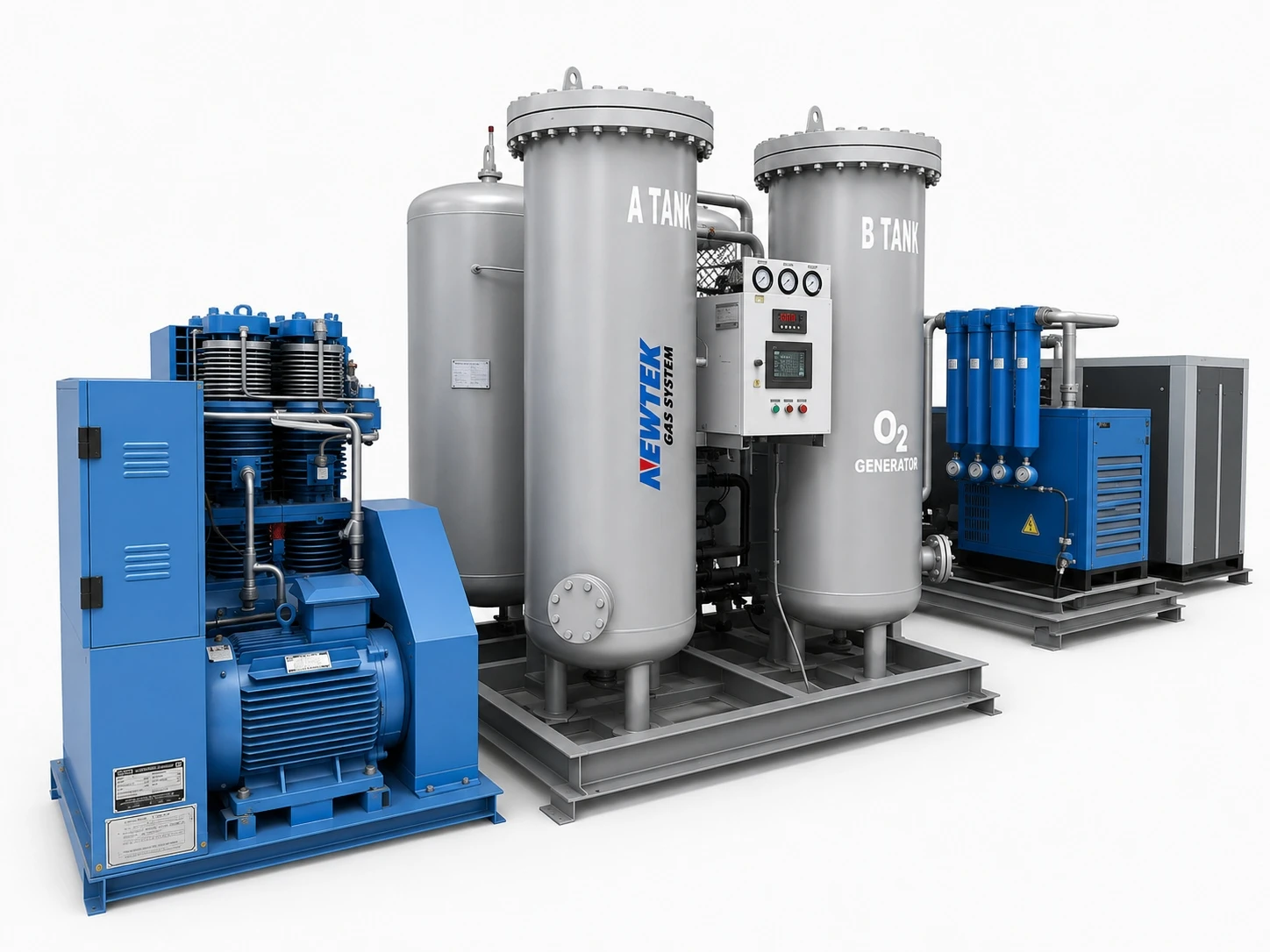
A PSA oxygen generator normally combines an air compressor, air purification equipment, adsorption vessels, switching valves, oxygen buffer equipment, sensors, and an automatic control system.
The process can be divided into several stages:
- Atmospheric air is compressed.
- Filters and drying equipment remove contaminants and moisture.
- Treated compressed air enters the molecular sieve bed.
- Nitrogen is preferentially adsorbed.
- Oxygen-enriched gas leaves the adsorption vessel.
The saturated bed is depressurized for regeneration.
The control system switches the gas path between adsorption vessels.
The adsorption vessels operate cyclically, so one vessel can produce oxygen while another is being regenerated. This arrangement provides a continuous oxygen stream for downstream equipment.
In wastewater treatment, PSA oxygen can be connected to oxygen pipelines, diffusers, oxygenation systems, or other gas-transfer equipment. The required outlet pressure must be compared with diffuser submergence depth, pipeline pressure loss, valves, and other downstream resistance.
NEWTEK's published PSA oxygen information lists oxygen production from 1 to 300 Nm³/h, oxygen purity of 93% ±3%, and oxygen pressure of 0.01–0.5 MPa, depending on system configuration.
VPSA Oxygen Technology in Wastewater Treatment
VPSA uses the same basic adsorption principle but changes the pressure cycle and air-supply arrangement.
A typical VPSA system contains:
- Air blower
- Air filtration equipment
- Adsorption vessels
- Vacuum pump
- Switching valves
- Oxygen buffer equipment
- Pressure and vacuum sensors
- Automatic control system
The operating process generally follows this sequence:
The blower supplies atmospheric air to the adsorption vessel.
Nitrogen is adsorbed by the molecular sieve.
Oxygen-enriched gas leaves the adsorption bed.
The adsorption vessel is depressurized.
A vacuum pump reduces the bed pressure further.
Adsorbed nitrogen is removed from the molecular sieve.
The bed is returned to the adsorption stage.
The major difference from PSA is therefore not the molecular sieve itself, but the way pressure is created and removed during the adsorption-regeneration cycle.
Because VPSA normally operates with lower oxygen delivery pressure, the downstream oxygen distribution system needs to be designed accordingly.
PSA vs VPSA: Main Engineering Differences
| Parameter | PSA Oxygen | VPSA Oxygen |
|---|---|---|
| Feed-air equipment | Air compressor | Air blower |
| Adsorption condition | Pressurized | Relatively low pressure |
| Regeneration method | Depressurization/desorption | Vacuum-assisted desorption |
| Vacuum pump | Normally not required | Required |
| Oxygen outlet pressure | Generally suitable for higher-pressure distribution | Generally suited to lower-pressure delivery |
| Main power-consuming equipment | Compressor | Blower and vacuum pump |
| Key design issue | Compressed-air pressure and treatment | Blower/vacuum sizing and low-pressure oxygen delivery |
| Downstream requirement | Can accommodate pressurized oxygen distribution | Requires compatible low-pressure oxygen system |
The comparison should not be based only on oxygen purity or generator capacity. The pressure relationship between the generator and aeration equipment is equally important.
Oxygen Demand Is a Major Selection Factor
Wastewater treatment plants normally calculate oxygen demand from biological loading, ammonia oxidation requirements, dissolved oxygen targets, water temperature, wastewater characteristics, and the operating condition of the biological reactor.
For example, an activated-sludge process may require continuous oxygen transfer into an aeration basin. The oxygen generation system must therefore be sized according to the required oxygen mass flow rather than simply selecting a generator based on its nominal gas flow.
A larger treatment plant may require several oxygen generation modules operating in parallel. This allows the system to match oxygen production with variations in biological load, seasonal wastewater volume, or changes in aeration demand.
For smaller or medium-sized installations, PSA may provide a more straightforward configuration when oxygen pressure is also required. For large-flow applications where low-pressure oxygen can be directly connected to an aeration system, VPSA becomes an important alternative for engineering evaluation.
Oxygen Pressure Affects Aeration System Design
Oxygen must overcome the pressure generated by the wastewater treatment system before it can pass through the diffuser and enter the water.
For a submerged diffuser, the required gas pressure is affected by:
- Water depth
- Diffuser operating pressure
- Pipeline length
- Pipe diameter
- Valves and fittings
- Gas flow rate
Pressure loss through the diffuser
A deeper aeration basin generally requires a higher gas pressure at the diffuser inlet.
This is an important difference when comparing PSA and VPSA. PSA can provide oxygen at a pressure suitable for pressurized distribution, while VPSA generally operates with lower oxygen outlet pressure.
For example, if the oxygen generator is located far from a deep aeration basin, pipeline pressure loss and diffuser pressure should be calculated before selecting a low-pressure oxygen system.
Compressed-Air Quality and Molecular Sieve Protection
Both systems depend on molecular sieve adsorption, so feed-air treatment directly affects the adsorption beds.
Oil, liquid water, particulate contamination, and excessive moisture can damage or contaminate molecular sieve material and increase pressure drop through the adsorption bed. The air-treatment section therefore normally includes filtration, moisture separation, and drying equipment appropriate to the generator configuration.
PSA systems typically place greater emphasis on compressed-air quality because atmospheric air first passes through the compressor before entering the adsorption vessels. Compressor discharge temperature, oil carryover, moisture content, filter condition, and dryer performance must be monitored.
VPSA systems use blower-based air supply, but this does not eliminate the need for feed-air treatment. Dust filtration and moisture control remain important because contaminants can enter the molecular sieve beds and affect adsorption capacity.
For both technologies, molecular sieve replacement should be considered as a maintenance item rather than an indefinite-life component.
Power Consumption Has Different Sources
The electrical load of PSA and VPSA comes mainly from different pieces of equipment.
The major electrical load normally comes from the air compressor. Its power requirement depends on:
- Required compressed-air pressure
- Air flow
- Compressor efficiency
- Operating hours
- Dryer and auxiliary equipment
VPSA normally distributes its major electrical load between the air blower and vacuum pump. Their requirements depend on:
- Air flow
- Adsorption pressure
- Vacuum level
- Vacuum pump capacity
- Cycle time
- Pipeline and equipment pressure losses
For procurement, the useful comparison is specific power consumption per unit of oxygen produced, rather than comparing compressor and blower nameplate power alone.
The comparison should also use the same oxygen flow, purity, operating hours, and outlet-pressure conditions.
Integration With Wastewater Aeration Equipment
The oxygen generator is only one part of the oxygen-transfer system.
A complete installation may include:
- Oxygen generator
- Oxygen buffer tank
- Distribution pipeline
- Flow-control valves
- Pressure sensors
- Oxygen concentration sensors
- Dissolved oxygen sensors
- Fine-bubble or other oxygen-transfer equipment
- PLC/SCADA interface
For PSA, the oxygen buffer can reduce the effect of generator cycling on the downstream oxygen supply. Pressure sensors can monitor the distribution line, while oxygen sensors can monitor product-gas concentration.
VPSA can also be integrated with oxygen storage and automatic control, but the oxygen pipeline and downstream pressure-control equipment must be designed around its lower delivery pressure.
Where dissolved oxygen sensors are connected to the plant control system, oxygen generation can be adjusted according to actual reactor conditions rather than operating continuously at a fixed output.
Maintenance Differences
PSA maintenance is strongly associated with the compressed-air side. Typical inspection points include compressor oil condition, air filters, dryers, valves, pressure sensors, oxygen sensors, and molecular sieve performance.
VPSA maintenance shifts part of the equipment focus toward the blower and vacuum system. Vacuum pump condition, seals, filters, valves, vacuum pressure, and adsorption-bed pressure behavior need regular inspection.
For both systems, abnormal pressure drop, longer cycle time, reduced oxygen purity, unstable oxygen flow, and increased power consumption can indicate problems in the air-treatment system, switching valves, molecular sieve, sensors, or control sequence.
A maintenance plan should therefore monitor operating data rather than relying only on scheduled component replacement.
What Should Wastewater Treatment Buyers Compare?
A technical comparison should include more than generator capacity.
| Buyer Parameter | Engineering Significance |
|---|---|
| Oxygen flow | Determines adsorption-bed and equipment capacity |
| Oxygen purity | Determines oxygen concentration supplied to the process |
| Outlet pressure | Must match diffuser and pipeline requirements |
| Specific power consumption | Allows comparison of operating energy |
| Peak oxygen demand | Determines generator and buffer capacity |
| Operating hours | Affects annual electricity consumption |
| Aeration basin depth | Influences required gas pressure |
| Pipeline distance | Determines distribution pressure loss |
| Feed-air quality | Protects molecular sieve and valves |
| Installation area | Determines equipment arrangement |
| Control interface | Determines PLC/SCADA integration |
| Maintenance access | Affects service time and downtime |
| Future expansion | Determines modular capacity requirements |
The most useful purchasing comparison is therefore based on the complete oxygen-generation and oxygen-transfer system.
NEWTEK Oxygen Generation for Wastewater Treatment
NEWTEK focuses on on-site PSA oxygen and nitrogen generation systems. Its PSA oxygen configuration combines air purification, zeolite molecular sieve adsorption, adsorption vessels, pressure and oxygen sensors, automatic control, gas piping, and oxygen storage/control components.
For wastewater treatment applications, the relevant equipment parameters include oxygen flow, purity, outlet pressure, dew point, air consumption, pipe size, and control configuration. NEWTEK's published PSA oxygen data covers production capacities from 1 to 300 Nm³/h, with oxygen purity of 93% ±3%, oxygen pressure of 0.01–0.5 MPa, and an atmospheric oxygen dew point range of -40°C to -75°C.
The correct system configuration should be determined from the wastewater plant's actual oxygen demand and aeration conditions, then matched with the generator capacity, oxygen pressure, control system, and installation environment.