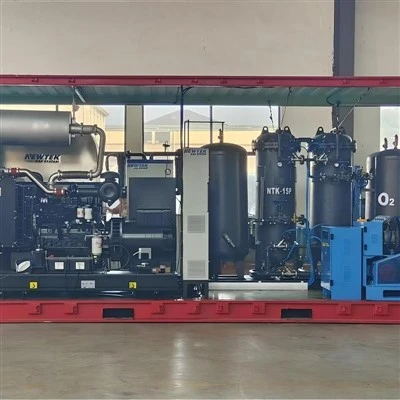
Commercial aquaculture requires continuous oxygen transfer because fish and shrimp consume dissolved oxygen while biological filtration, organic decomposition, and other processes also consume oxygen. Oxygen demand changes with biomass, stocking density, water temperature, feeding activity, and nighttime conditions. A PSA oxygen system addresses this requirement by separating oxygen from compressed air and supplying oxygen-enriched gas to ponds, tanks, oxygen cones, or recirculating aquaculture systems.
PSA oxygen generation uses adsorption vessels filled with molecular sieve. A compressor supplies filtered and dried air to the adsorption beds, where the molecular sieve preferentially adsorbs nitrogen. Oxygen-rich gas passes to an oxygen receiver and then enters the water-side oxygenation system. The adsorption beds alternate between pressurization and regeneration to maintain gas production.
On-Site Oxygen Generation Changes the Supply Structure
A commercial farm using oxygen cylinders or liquid oxygen depends on an external supply chain: gas production, transportation, storage, and delivery to the farm. A PSA installation moves the oxygen-generation process onto the farm.
The basic process is:
Ambient air → compressor → air treatment → PSA adsorption → oxygen receiver → oxygen distribution → water oxygenation
The system therefore requires more than an adsorption unit. The compressor must provide the required feed-air flow, filters and dryers must remove contaminants and moisture, and the oxygen receiver must buffer the gas before it reaches the distribution network.
For farms operating in remote areas or requiring continuous oxygen supply, the procurement calculation should include electricity consumption, maintenance, spare parts, and the cost of transporting externally supplied oxygen.
Higher Oxygen Concentration Reduces the Gas Volume Required for Oxygen Transfer
Atmospheric air contains approximately 21% oxygen. Conventional aeration equipment must move a large volume of air through the water to transfer the required oxygen quantity.
A PSA generator separates nitrogen from compressed air and produces oxygen-enriched gas. NEWTEK's published aquaculture configurations include oxygen purity ranges from approximately 90% to 99.5%, depending on configuration, with standard PSA oxygen systems commonly specified around 93% ± 3%.
The higher oxygen concentration changes the water-side transfer process. Instead of transferring oxygen from a large quantity of atmospheric air, the diffuser or oxygen cone receives a gas stream with a higher oxygen concentration.
Actual transfer depends on:
- Gas flow rate
- Water depth
- Bubble diameter
- Water temperature
- Contact time
- Operating pressure
- Diffuser or oxygen-cone structure
Therefore, PSA output should be evaluated together with the oxygen-transfer equipment rather than as an isolated gas specification.
PSA Oxygen Can Supply High-Density Aquaculture Systems
As stocking density increases, the oxygen requirement per unit of water volume also becomes a critical design parameter. Fish and shrimp consume oxygen continuously, while oxygen availability can decrease rapidly when aeration capacity does not match biological demand.
A PSA system can feed oxygen into:
- Intensive fish ponds
- Shrimp ponds
- Hatchery tanks
- Recirculating aquaculture systems
- Indoor culture tanks
- Live-fish holding tanks
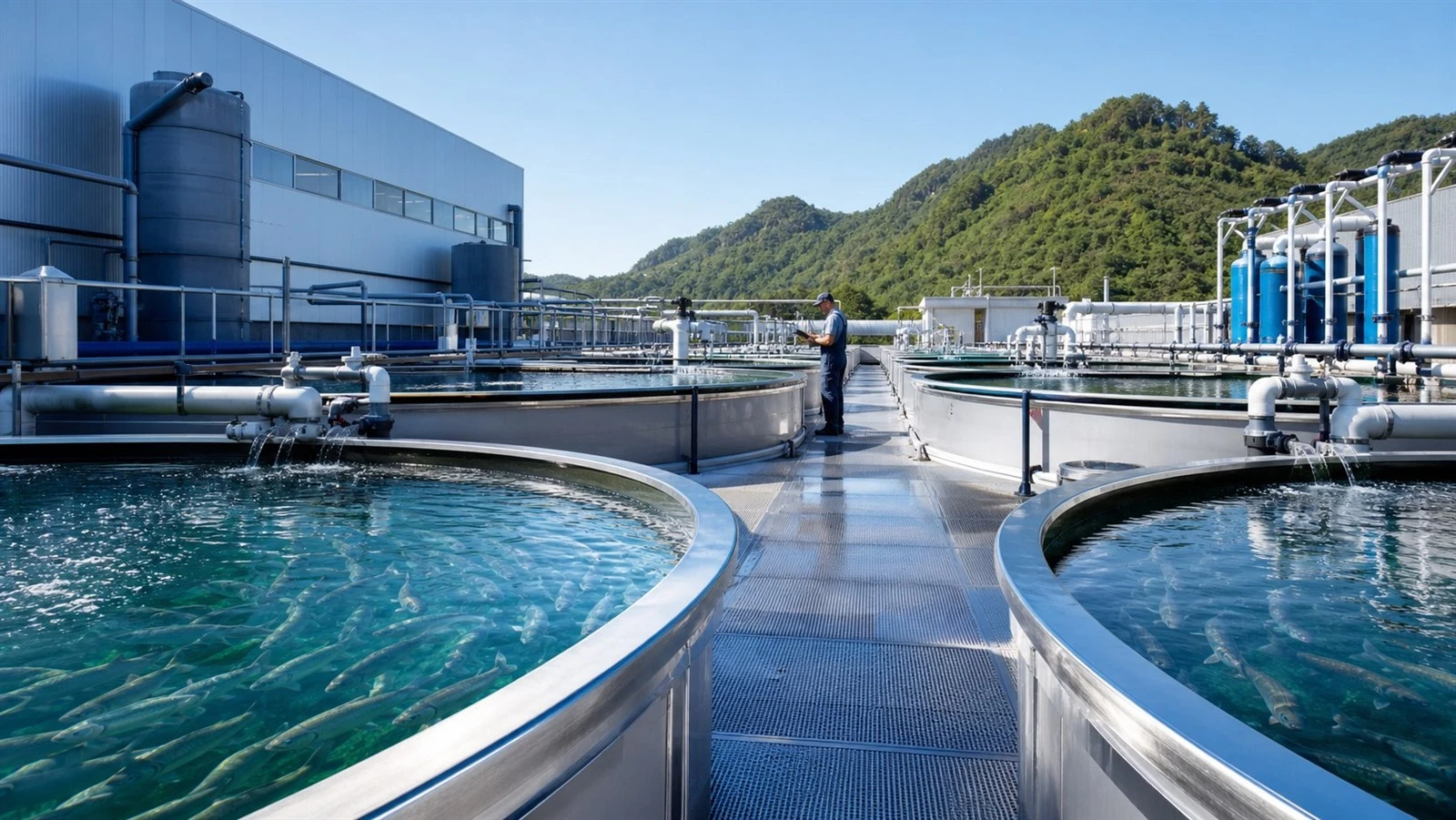
In an RAS installation, for example, water passes through mechanical filtration and biological treatment before returning to the culture tank. Oxygen can be injected downstream through an oxygen cone or diffuser before the treated water returns to the fish tanks.
The oxygen generator therefore becomes part of the water-treatment loop:
Culture tank → filtration → biological treatment → oxygenation → culture tank
Oxygen Production Can Be Matched to Actual Farm Demand
The PSA capacity should be calculated from oxygen demand rather than pond area alone.
The main inputs include:
| Design Parameter | Engineering Function |
|---|---|
| Biomass | Determines biological oxygen consumption |
| Stocking density | Determines oxygen demand per unit water volume |
| Water temperature | Changes oxygen solubility and metabolic demand |
| Target DO | Defines the required dissolved oxygen condition |
| Peak demand | Determines maximum generator capacity |
| Oxygen-transfer efficiency | Determines how much generated oxygen enters the water |
| Operating hours | Determines daily oxygen production |
| Future biomass | Determines expansion requirements |
For example, if a farm requires 30 Nm³/h of oxygen entering the water but the oxygen-transfer system transfers only 75% of the supplied oxygen, the generator must provide more than 30 Nm³/h.
A simplified design relationship is:
Required oxygen production = required oxygen transfer ÷ transfer efficiency
The calculation should use measured or supplier-specified transfer performance rather than assuming that all oxygen leaving the PSA generator enters the water.
Dissolved Oxygen Sensors Can Control Oxygen Supply
PSA oxygen production becomes more useful when it is connected to dissolved oxygen monitoring.
A dissolved oxygen sensor measures the actual DO level in the culture water. The signal can enter a PLC, which controls an oxygen valve, oxygen flow rate, or additional PSA capacity according to predefined operating limits.
The control loop can be structured as:
DO sensor → PLC → oxygen-flow control → diffuser/oxygen cone → culture water
When DO decreases below the configured range, the control system can increase oxygen delivery. When DO returns to the required range, the system can reduce oxygen flow.
NEWTEK's PSA systems include oxygen sensors, pressure sensors, automatic control, and industrial communication interfaces such as Modbus, Profibus, and Ethernet.
This arrangement allows the oxygen system to respond to measurable water conditions instead of operating the generator at maximum output throughout the entire production cycle.
Oxygen Buffer Storage Separates Generation From Demand Fluctuation
The PSA adsorption cycle and the farm's oxygen demand do not necessarily change at the same rate. A buffer tank can separate these two operating conditions.
The PSA generator fills the oxygen receiver, while the downstream oxygenation system draws gas according to water-side demand. The receiver therefore absorbs short-term differences between oxygen production and consumption.
The required tank volume depends on:
- PSA oxygen production
- Oxygen demand
- Operating pressure
- Peak flow
- Pressure range
- Required reserve time
An undersized receiver can cause rapid pressure changes when several culture tanks demand oxygen simultaneously. An oversized receiver increases equipment volume and capital cost without increasing the oxygen-generation capacity.
PSA Oxygen Can Operate Together With Mechanical Aeration
PSA oxygen does not necessarily replace mechanical aerators.
Mechanical aerators move water and atmospheric air, while PSA equipment supplies oxygen-enriched gas. The two systems can perform different functions within the same pond or tank.
A combined arrangement may use:
Mechanical aerator → water circulation
PSA oxygen → concentrated oxygen supply
DO sensor → control signal
This configuration allows the mechanical equipment to maintain water movement while the PSA system supplies additional oxygen when biological demand exceeds the oxygen contribution from normal aeration.
The appropriate arrangement depends on pond depth, water circulation pattern, biomass, diffuser location, and required DO.
PSA Oxygen Supports RAS Oxygenation
RAS facilities continuously circulate water through filtration and biological treatment. Nitrifying bacteria in biofilters consume oxygen while converting ammonia and nitrite, so oxygen demand exists outside the fish tanks themselves.
A typical RAS oxygenation process can include:
- Culture water leaves the tank.
- Mechanical filtration removes suspended solids.
- Biofiltration converts nitrogen compounds.
- Oxygen is injected through a diffuser or oxygen cone.
- Oxygenated water returns to the culture tanks.
The PSA generator must therefore supply sufficient oxygen for both biological and aquatic oxygen consumption.
The oxygen injection point should be selected according to water pressure, flow rate, contact time, and oxygen-transfer equipment. Simply increasing PSA gas output does not guarantee proportional increases in dissolved oxygen if the water-side transfer device has reached its transfer limit.
Automatic Monitoring Can Identify Oxygen-System Failures
A commercial aquaculture oxygen system should monitor both gas-side and water-side conditions.
| Parameter | What It Indicates |
|---|---|
| Dissolved oxygen | Actual oxygen condition in culture water |
| Oxygen purity | PSA separation condition |
| Oxygen flow | Gas delivery to the water |
| PSA pressure | Adsorption-system operating condition |
| Compressor pressure | Feed-air availability |
| Water temperature | Changes in oxygen solubility and biological demand |
| Alarm status | Equipment or sensor abnormality |
For example, falling oxygen purity may indicate molecular sieve contamination, valve switching problems, excessive demand, or feed-air problems. Falling oxygen pressure can indicate compressor capacity limitations, filter blockage, valve problems, or excessive downstream flow.
The control system should use these signals to generate alarms and isolate abnormal equipment rather than relying solely on manual inspection.
PSA Oxygen and Conventional Aeration: Structural Difference
Conventional aeration introduces atmospheric air directly into the water. The oxygen supply is therefore limited by the oxygen concentration in atmospheric air and the transfer efficiency of the aerator.
PSA oxygen separates oxygen from air before the gas enters the water-side system.
| Factor | Conventional Aeration | PSA Oxygen System |
|---|---|---|
| Gas supplied | Atmospheric air | Oxygen-enriched gas |
| Main separation equipment | None | Molecular sieve adsorption vessels |
| Air supply | Blower/aerator | Air compressor |
| Oxygen control | Airflow and aerator operation | Oxygen flow, purity and DO control |
| Water-side equipment | Paddle wheel, blower or diffuser | Oxygen diffuser, oxygen cone or similar equipment |
| Main maintenance | Aerator, motor, bearings, diffuser | Compressor, filters, valves, analyzer, molecular sieve |
| System integration | Direct air-water mixing | PSA + receiver + oxygen distribution + water oxygenation |
For high-density aquaculture, PSA oxygen can supplement mechanical aeration when the oxygen requirement exceeds what atmospheric-air aeration can transfer. The appropriate configuration depends on biomass, water volume, temperature, DO target, oxygen-transfer efficiency, and operating schedule.
About NEWTEK
NEWTEK develops on-site PSA oxygen and nitrogen generation systems. Its PSA oxygen process uses zeolite molecular sieve adsorption, with compressed and purified air entering adsorption vessels, nitrogen being preferentially adsorbed, and oxygen-rich gas leaving the adsorption bed.
The system configuration includes air purification, adsorption vessels, pressure sensors, oxygen sensors, automatic control, gas piping, and communication interfaces. NEWTEK's published PSA oxygen specifications include production capacities from 1–300 Nm³/h, oxygen purity of 93% ± 3%, and oxygen outlet pressure of 0.01–0.5 MPa, depending on configuration.
For commercial aquaculture, the PSA system can be connected to oxygen receivers, oxygen cones, diffusers, dissolved oxygen sensors, and water-treatment equipment. The final capacity should be calculated from biomass, water temperature, target DO, peak oxygen demand, oxygen-transfer efficiency, and planned production expansion rather than from pond area alone.