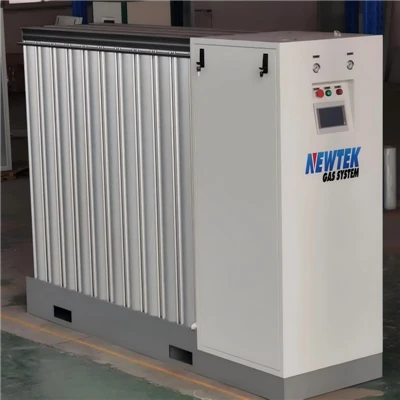
In the tertiary treatment stage of wastewater plants, ozone (O₃) has emerged as a critical technology for removing refractory organics, disinfection, and deodorization. Oxygen (O₂), as the raw material for ozone generation, directly influences the efficiency and economics of ozone systems through its purity, stability, and supply mode. This article analyzes the pivotal role of oxygen in ozone production from technical principles, gas source selection, economic benefits, and environmental impacts, using the latest industry advancements and real-world cases to explore innovative applications in wastewater treatment.

Ozone Generation Principles and Oxygen's Core Role
Ozone generation involves converting oxygen molecules (O₂) into ozone (O₃) using external energy. The dominant technology is corona discharge, supported by two secondary methods:
Corona Discharge Method
Mechanism: High-voltage electricity ionizes oxygen into free oxygen atoms (O), which combine with O₂ to form O₃:₂₂₃
Equipment: Comprises discharge chambers, high-voltage power supplies, and gas pretreatment systems. Dielectric Barrier Discharge (DBD) enhances ozone production efficiency.
Oxygen Requirement: Purity ≥90% is critical; impurities like nitrogen and moisture reduce ozone concentration and accelerate equipment corrosion.
UV Irradiation Method
Mechanism: Ultraviolet light (185nm wavelength) splits O₂ into O atoms, which form O₃. Suitable for small-scale use but has low yield (≤1% ozone concentration).
Limitations: Requires efficient gas-liquid mixing and frequent UV lamp replacements (8,000-hour lifespan), increasing maintenance costs.
Electrolytic Water Method
Mechanism: Electrolyzes water to produce O₂ and H₂, with partial O₂ further oxidized to O₃. Generates high-purity ozonated water but is energy-intensive (10–20kWh/kg O₃).
Oxygen's Indispensable Role
Purity-Driven Concentration: A 1% increase in oxygen purity boosts ozone concentration by 2–5%. For example, 90% pure oxygen yields 100–120mg/L ozone, compared to 20–30mg/L from air (21% O₂).
Stability for Reliability: Steady high-purity oxygen from liquid oxygen (LOX) or on-site PSA systems prevents output fluctuations that disrupt treatment processes.
Gas Source Comparison: Liquid Oxygen, PSA Oxygen, and Air Supply
Wastewater plants choose gas sources based on scale, cost, and site conditions:
Liquid Oxygen (LOX)
Advantages: Purity >99.5% enables ozone concentrations of 120–150mg/L, ideal for high-load scenarios.
Disadvantages: High initial investment (storage tanks: ~500,000–1,000,000 RMB), 20–30% transport costs, and evaporation losses (0.5–1% daily).
On-Site PSA/VPSA Oxygen
Technology: Molecular sieves adsorb nitrogen from air, producing 90–95% pure oxygen. VPSA reduces energy use by 50% (0.3–0.5kWh/m³) compared to traditional PSA.
Economics: 40–60% lower 10-year lifecycle costs than LOX, with a 3-year payback period for 10,000m³/day plants.
NEWTEK Solution: The NT-O2 series offers modular design (50–5,000m³/h output), adapting to plants of all sizes.
Air Supply
Advantages: Low initial cost, no extra equipment.
Disadvantages: Low ozone concentration (20–30mg/L), high energy use (0.8–1.2kWh/m³), and complex pretreatment (oil/water removal) to prevent equipment blockages.
Gas Source Comparison Table
| Indicator | Liquid Oxygen (LOX) | PSA-Generated Oxygen | Air Supply |
|---|---|---|---|
| Oxygen Purity | 99.5%+ | 90–95% | 21% |
| Ozone Concentration | 120–150mg/L | 80–120mg/L | 20–30mg/L |
| Energy Consumption | 0.2–0.3kWh/m³ | 0.3–0.5kWh/m³ | 0.8–1.2kWh/m³ |
| Suitable Scale | Large plants | Medium to large plants | Small plants/emergency |
Impact of Oxygen Purity on Ozone Yield and Treatment Efficiency
Purity-Yield Relationship
Data Insight: A 5% increase in oxygen purity (90% to 95%) boosts ozone yield by 15–20%. A wastewater plant using 93% pure PSA oxygen achieved 8kg/h ozone output-3x higher than air-based systems.
Treatment Improvement: High-purity oxygen increases COD removal from 60% to 85% and reduces chromaticity from 600x to <30x.
Risks of Im purities
Nitrogen: Forms NOx with ozone, reducing oxidation efficiency and increasing tail gas treatment costs.
Moisture: Causes condensation in discharge chambers, shortening equipment life, and consumes ozone (H₂O + O₃ → 2O₂ + 2OH⁻).
Application Scenarios: From Disinfection to Microcontaminant Removal
Disinfection
Mechanism: Ozone inactivates microbes by damaging cell membranes and DNA, achieving >99.9% kill rates for E. coli and viruses without chlorination byproducts.
Case: A medical wastewater plant using ozone-UV combined treatment met GB 18466-2005 standards with <10CFU/L fecal coliforms.
Color and Odor Removal
Advantage: Breaks down chromophores (azo, quinone compounds) in textile wastewater, reducing chromaticity from 600x to 30x, and eliminates H₂S/ammonia odors.
Economics: 40% lower cost than activated carbon, with no solid waste disposal needed.
Microcontaminant Degradation
Emerging Use: Removes pharmaceuticals (antibiotics), endocrine disruptors (bisphenol A), etc. A chemical plant reduced microcontaminants from 500ppb to <10ppb via ozonation.
Membrane Pretreatment
Synergy: Ozone pre-treatment extends RO membrane life by 2–3x by reducing colloids and organics, cutting chemical cleaning frequency.
Economic and Environmental Analysis
Cost Comparison
Initial Investment: Ozone systems (including oxygen generation) cost 800,000–2,000,000 RMB-30–50% higher than Fenton oxidation-but save 50% over 10 years.
Operating Cost: Electricity dominates (0.3–0.5 RMB/Nm³), versus 1,000,000–2,000,000 RMB annual reagent costs for Fenton at 10,000m³/day plants.
Environmental Benefits
No Secondary Pollution: Ozone decomposes to oxygen, avoiding chlorinated byproducts from traditional agents.
Low-Carbon Path: On-site VPSA with green energy (solar/wind) achieves carbon-neutral ozone generation.
Case Studies: Large-Scale Project Validations
Case 1: Municipal Wastewater Tertiary Treatment
Technology: PSA oxygen + catalytic ozonation for 50,000m³/day treatment.
Results:
COD reduced from 80mg/L to 40mg/L; chromaticity from 50x to 10x.
95% ozone utilization, 18% lower energy use than traditional processes.
Cost: 12,000,000 RMB initial investment, 3,000,000 RMB annual operation cost, 4-year payback.
Case 2: Chemical Park Wastewater Project
Technology: CDOF (cyclone dissolved air flotation) integrated with NEWTEK NT-O2 systems.
Innovation:
Catalyst-ozone synergy increased COD removal to 85% (20% higher than alone).
Smart controls adjusted ozone dosage in real time, cutting energy use by 15%.
Future Trends: Smart Technology and Sustainable Development
Intelligent Systems
AI-Powered Maintenance: Machine learning predicts discharge tube life and catalyst activity for proactive repairs, minimizing downtime.
Renewable Integration: NEWTEK's solar-oxygen-ozone systems reduce carbon footprints by 30% using green electricity.
Material and Process Innovations
Advanced Catalysts: Metal-Organic Frameworks (MOFs) triple ozone decomposition rates and lower energy use by 10–15%.
Micro-Nano Bubbles: Ultra-fine bubbles increase ozone solubility 3x, reducing usage by 85% and boosting efficiency 5x.
Modular Solutions
Containerized Units: NEWTEK's mobile oxygen-ozone systems deploy in 72 hours, ideal for temporary or remote treatment sites.
Conclusion
Oxygen's role in ozone generation is pivotal to the efficiency and sustainability of wastewater tertiary treatment. By optimizing gas sources through LOX, PSA, and intelligent control, plants can achieve cost-effective, high-performance treatment for disinfection, decontamination, and environmental compliance. With technological advancements from innovators like NEWTEK-including green energy integration and material breakthroughs-oxygen-ozone systems are set to become a cornerstone of low-carbon wastewater management, driving the industry toward smarter, cleaner solutions.