Why Industrial Oxygen Supply Is Moving Toward Containerized Systems
Industrial oxygen is essential for a wide range of operations, including metal cutting, mining, wastewater treatment, aquaculture, chemical processing, and industrial cylinder filling. In these applications, oxygen supply is not simply a matter of obtaining gas. Buyers must also consider installation conditions, oxygen demand, operating continuity, transportation costs, maintenance requirements, and the availability of technical support.
Traditional oxygen production equipment is commonly installed inside dedicated buildings or equipment rooms. Although this arrangement can be suitable for established industrial facilities, it may require substantial preparation before the oxygen production system becomes operational. Civil construction, equipment layout, utility connections, ventilation, and coordination between different suppliers can all affect project schedules and commissioning costs.
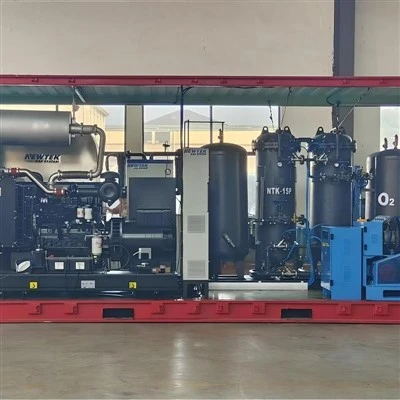
Containerized Pressure Swing Adsorption (PSA) oxygen systems offer a different approach. By integrating oxygen production equipment and associated components into a container-based structure, these systems can reduce the amount of on-site installation work and simplify project coordination. Depending on the configuration, a containerized PSA oxygen plant can incorporate the air compression system, air pretreatment equipment, PSA oxygen generation unit, oxygen storage, control system, and supporting utilities.
The main advantage is not merely that the equipment is placed inside a container. It is that the oxygen supply system can be designed, assembled, tested, transported, and installed as a more integrated package.
For industrial buyers, understanding the differences between containerized PSA oxygen and traditional equipment is important when evaluating capital investment, project implementation, operating expenses, and long-term production requirements.
What Is a Containerized PSA Oxygen System?
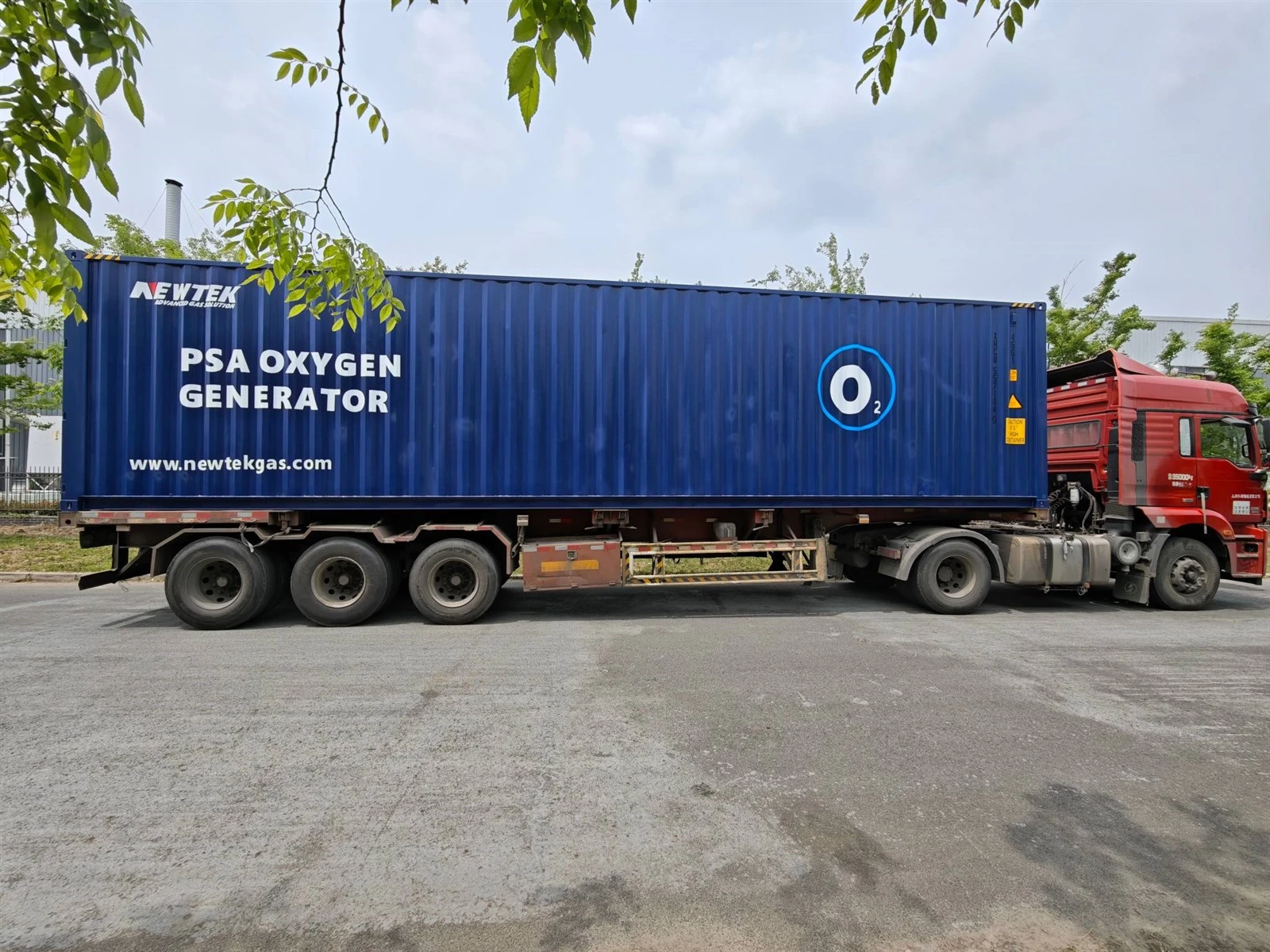
A containerized PSA oxygen system produces oxygen through Pressure Swing Adsorption technology. The process separates oxygen from compressed air using an adsorbent that preferentially retains nitrogen under specified operating conditions.
The system generally consists of several functional sections.
| System component | Main function | Why it matters to the buyer |
|---|---|---|
| Air compressor | Supplies compressed air for oxygen production | Determines whether the system receives sufficient air at the required pressure |
| Air pretreatment system | Removes moisture, oil aerosols, and other contaminants according to the system design | Helps protect downstream equipment and maintain process stability |
| PSA oxygen generation unit | Separates oxygen from nitrogen using an adsorption and regeneration cycle | Establishes the available oxygen output and product purity |
| Oxygen buffer tank | Stabilizes the oxygen supply and accommodates short-term variations in demand | Helps reduce pressure fluctuations during changes in consumption |
| Oxygen booster, if required | Raises oxygen pressure for applications requiring a higher delivery pressure | Supports processes with specific pressure requirements |
| Electrical control system | Coordinates operating sequences, alarms, and equipment monitoring | Reduces unnecessary manual intervention |
| Cooling and ventilation equipment | Manages heat and airflow according to the equipment configuration | Helps maintain suitable operating conditions |
| Container enclosure | Houses and protects the integrated equipment | Simplifies equipment arrangement, transportation, and site installation |
The exact configuration depends on the required oxygen capacity, purity, discharge pressure, ambient conditions, and application.
A containerized system should therefore be selected according to the customer's actual process requirements rather than container dimensions alone.
Traditional equipment, by comparison, may be supplied as separate machines that are installed in an existing building or a purpose-built equipment room. The equipment can still be highly automated and technically sophisticated, but the buyer may need to coordinate more site-specific construction and installation activities.
Shorter On-Site Installation and Commissioning
One of the most important differences between containerized PSA oxygen and traditional equipment is the amount of work required at the installation site.
More equipment integration before delivery
With a conventional installation, the buyer may need to arrange the equipment room, foundations, piping routes, electrical distribution, ventilation, and installation of individual machines. The responsibilities of the equipment manufacturer, civil contractor, electrical contractor, and local installation team must also be coordinated.
A containerized PSA oxygen system can bring many of these elements together before shipment. Major equipment is positioned within the container, and specified internal connections can be completed at the factory.
This allows the supplier to inspect equipment arrangement, check selected connections, verify control functions, and conduct applicable factory tests before delivery.
Less construction work at the customer's site
For projects in remote industrial areas, building a dedicated oxygen production room may create additional costs and delays. Civil works can be particularly challenging where construction materials, qualified labor, or local contractors are difficult to obtain.
A containerized design can reduce the need for a permanent equipment building, provided the installation location meets the system's structural, environmental, ventilation, and safety requirements.
The site preparation process may consequently focus on a suitable foundation, equipment positioning, external utility connections, and connection to the oxygen distribution network.
Better coordination between project stages
A traditional installation often requires several activities to be completed in sequence. For example, the equipment cannot be installed until the equipment room is ready, while electrical work may depend on the final equipment layout.
Factory integration allows some equipment preparation and site construction to proceed in parallel.
This can improve project scheduling, especially when the oxygen supply system is part of a larger industrial project.
However, containerization does not eliminate every installation task. The buyer must still account for transport access, lifting arrangements, external power, ventilation provisions, grounding, drainage where required, and commissioning under actual site conditions.
Reduced Dependence on Permanent Buildings
Not every oxygen-consuming facility has the space, budget, or operating conditions needed for a dedicated equipment building.
Mining operations, temporary construction sites, industrial demolition projects, marine salvage operations, and remote production facilities may operate in locations where conventional infrastructure is limited.
A more practical option for remote sites
A containerized PSA oxygen plant can provide an organized equipment installation without requiring the customer to construct a complete permanent building.
For example, a mining operator may need an oxygen supply close to a processing area. Transporting oxygen over long distances can increase logistics costs and introduce additional supply coordination requirements. A locally installed oxygen production system may reduce dependence on external oxygen deliveries when the site's demand and operating conditions justify on-site production.
Similarly, an industrial demolition contractor may require oxygen for metal cutting at a project location that will not remain in use permanently. A containerized system can be considered when the project duration, gas consumption, and relocation requirements make a dedicated installation economically attractive.
More flexibility in equipment placement
Traditional equipment rooms are usually designed around the building's available space, internal access routes, and existing utilities. These restrictions can complicate installation when a facility has limited room for additional machinery.
A containerized system provides a more defined equipment footprint. The buyer can evaluate its placement in relation to the production line, oxygen consumption points, maintenance access, and external utility connections.
Nevertheless, the container must not be treated as a structure that can be placed anywhere without preparation. Foundation capacity, local building requirements, environmental exposure, fire protection, and safe access must all be assessed before installation.
Easier Transportation and Potential Relocation
Industrial projects do not always remain in one location for their entire service life. Mining projects develop through different phases, contractors move between job sites, and temporary industrial facilities may eventually be dismantled.
A containerized PSA oxygen system can provide greater flexibility in these circumstances.
Transportation as an integrated package
When traditional oxygen equipment is supplied as separate machines, relocation may require dismantling individual components, disconnecting piping, labeling electrical connections, and organizing several shipments.
A containerized system consolidates a substantial portion of the equipment into one transportable structure. This can simplify logistics planning and reduce the number of separate equipment-handling operations.
The actual shipping arrangement depends on container dimensions, gross weight, lifting points, transport regulations, and the equipment installed inside the enclosure.
Reuse across multiple projects
For contractors whose operations move between locations, the possibility of relocating the oxygen plant can affect the total investment calculation.
Consider a company that performs industrial demolition and large-scale metal cutting at multiple sites. If oxygen consumption is sufficiently high and each project lasts long enough, purchasing a containerized oxygen system may provide an alternative to repeated oxygen deliveries.
After one project is completed, the system may be transported to another suitable location, subject to technical inspection, transport preparation, and recommissioning.
The economic benefit depends on how frequently the equipment can be reused, the cost of relocation, and the oxygen demand at each site.
Relocation is not automatically cost-free
A containerized system still requires safe isolation, transportation planning, utility disconnection, and reconnection. Some installations may require renewed inspection or adjustments to accommodate different ambient temperatures, electrical standards, or oxygen distribution arrangements.
Buyers should therefore compare the expected number of relocations and the associated costs rather than assuming that a containerized system is automatically mobile during operation.

More Predictable Project Costs
The purchase price of an oxygen plant is only one part of the total project investment.
A complete comparison should consider civil construction, equipment installation, electrical work, piping, commissioning, transportation, and the cost of coordinating different suppliers.
Understanding the total installed cost
For traditional equipment, the initial quotation may cover the main oxygen production machinery but exclude the building, foundations, external piping, and some installation services.
These additional items may be purchased from different contractors. As a result, the final installed cost can differ significantly from the initial equipment quotation.
A containerized PSA oxygen plant may incorporate more of the required equipment and installation work into a single supply package. This makes it easier to establish a preliminary project budget and define the manufacturer's scope of responsibility.
| Cost category | Traditional equipment installation | Containerized PSA oxygen system |
|---|---|---|
| Dedicated equipment building | May be required | May be reduced or avoided if site conditions permit |
| Internal equipment arrangement | Often completed on-site | Largely completed before delivery |
| Internal piping and wiring | May involve substantial site work | Can be integrated according to the approved scope |
| External connections | Required | Required |
| Civil works | Depends on the building and equipment layout | Foundation and site preparation are still required |
| Transport | Equipment and components may require separate handling | Integrated package transport may simplify handling |
| Commissioning | Coordinated across installation activities | Factory preparation can reduce some on-site work |
| Relocation | May involve dismantling and reinstallation | Can be simpler, but still requires proper preparation |
The table illustrates general tendencies rather than guaranteed savings. A traditional system installed in an existing industrial building may be less expensive than a containerized plant if the necessary infrastructure is already available.
Fewer interfaces between suppliers
A turnkey containerized package can reduce the number of separate parties responsible for internal equipment integration.
This is particularly useful when the customer has limited engineering resources or does not want to manage multiple contractors.
Before placing an order, the buyer should request a clear scope-of-supply list that identifies included equipment, excluded services, external connection requirements, commissioning responsibilities, and warranty coverage.
A lower number of supplier interfaces can simplify project management, but it does not remove the need to verify technical specifications and contractual responsibilities.
Integrated Automation and Centralized Monitoring
Automation is another important consideration when comparing containerized PSA oxygen with traditional installations.
The container itself does not make a system more intelligent. The benefits depend on the control architecture, instrumentation, and level of automation specified by the manufacturer.
Coordinated operation of major components
A properly integrated PSA oxygen system coordinates the operation of the air compressor, pretreatment equipment, adsorption cycle, oxygen monitoring instruments, and associated auxiliary equipment.
The control system may manage operating sequences, pressure conditions, valve switching, and alarms according to the approved design.
This reduces the need for operators to coordinate every operating step manually.
Clearer operating information
Depending on the configuration, the control panel may display:
Oxygen purity and relevant analyzer status.
Oxygen outlet pressure.
Air pressure and other monitored process conditions.
Operating status of major equipment.
Active alarms and equipment faults.
Operating hours and maintenance reminders.
These parameters help operators understand whether the system is operating within its intended conditions.
For oxygen-consuming processes, the information is especially important because an interruption or change in oxygen quality may affect production.
Remote monitoring options
Some containerized PSA oxygen plants can be equipped with remote monitoring functions. These may allow authorized personnel to review operating parameters and alarm information from another location.
Remote monitoring can be useful for mining sites, remote aquaculture facilities, and industrial plants with limited on-site technical staff.
However, remote monitoring and remote control are different capabilities. Buyers should confirm whether the offered system supports data transmission only, remote diagnostics, or authorized control functions.
The supplier should also explain communication requirements, network availability, cybersecurity measures, and the actions required when an alarm occurs.
A More Organized Maintenance Environment
Maintenance requirements are determined primarily by the equipment design, operating hours, component quality, and service conditions. Containerization does not eliminate routine maintenance, but it can make equipment arrangement more systematic.
Components arranged as a coordinated system
When equipment is integrated into a planned container layout, maintenance personnel can follow a defined arrangement of machines, valves, instruments, and electrical components.
A well-designed layout can simplify routine inspections and help operators identify the relevant component when a fault occurs.
The benefit depends on the internal arrangement. A container that is too crowded or lacks suitable access space can make maintenance more difficult rather than easier.
Maintenance access must be designed in advance
Buyers should check whether the container layout provides adequate clearance for filter replacement, valve servicing, instrument calibration, compressor maintenance, and the removal of components that may eventually require replacement.
The maintenance plan should also specify access doors, lifting arrangements, lighting, ventilation, and safe isolation procedures.
Standardized service procedures
A system supplied with a clear maintenance manual, component list, electrical drawings, piping diagrams, and troubleshooting instructions can be easier to maintain over its service life.
For customers operating in remote regions, the availability of spare parts and technical support may be as important as the physical enclosure.
Before purchasing, ask the manufacturer which maintenance tasks can be performed by trained local personnel and which require specialized technicians.
Greater Flexibility for Different Industrial Applications
The containerized format can be adapted to different oxygen consumption requirements and site conditions. However, the plant must be engineered for the intended application rather than selected solely because it fits inside a container.
Mining and mineral processing
Some mining and mineral-processing operations require a continuous or predictable oxygen supply for specific production processes.
A containerized PSA oxygen plant can be considered where transporting oxygen to the operating site is costly or where a dedicated oxygen supply improves production planning.
Important selection factors include required oxygen flow, purity, delivery pressure, operating hours, altitude, ambient temperature, and the availability of electricity.
Industrial demolition and metal cutting
Industrial demolition, factory decommissioning, shipbreaking, and heavy metal cutting can consume substantial quantities of oxygen.
For these operations, the buyer must determine whether oxygen demand is continuous or intermittent and whether consumption changes significantly across different work phases.
The oxygen system should be sized for the actual cutting process, with appropriate allowance for simultaneous users, peak demand, and the required distribution pressure.
A containerized installation may be especially attractive when a project has limited permanent infrastructure or when the equipment is expected to serve multiple sites over time.
Medical and industrial cylinder filling
Cylinder filling operations require careful attention to oxygen quality, pressure, filling capacity, and applicable regulatory requirements.
A containerized oxygen production plant may provide a compact equipment arrangement for a filling facility, but the oxygen production equipment alone does not constitute a complete cylinder filling station.
The project may also require oxygen compression, filling manifolds, cylinder inspection arrangements, appropriate gas analysis, safety systems, and other application-specific equipment.
Medical oxygen applications require particular attention to applicable medical gas standards, quality assurance, validation, and local regulatory approval. A buyer should not assume that industrial oxygen equipment is automatically suitable for medical use.
Wastewater treatment and ozone production
Some wastewater treatment processes use oxygen as part of biological treatment or as a feed gas for ozone generation.
The oxygen supply system must be matched to the treatment process, including flow demand, purity requirements, operating pressure, and downstream equipment specifications.
For ozone applications, the required oxygen quality and pressure should be confirmed with the ozone generator manufacturer. The oxygen production plant, buffer storage, and downstream gas treatment should be designed as a coordinated system.
Aquaculture and intensive fish farming
Intensive aquaculture operations may require a stable oxygen supply to maintain suitable dissolved oxygen conditions.
At remote fish farms, transporting oxygen cylinders can create recurring logistics costs and operational risks associated with delayed deliveries.
A containerized PSA oxygen plant can provide an alternative source of oxygen when the required capacity, purity, power availability, and environmental conditions are suitable.
The complete installation should also account for oxygen transfer equipment, distribution piping, water conditions, backup supply arrangements, and the consequences of a power or equipment failure.
Better Protection Through Purpose-Designed Enclosures
Industrial oxygen equipment may be exposed to dust, rain, sunlight, humidity, and changing ambient temperatures. These conditions can affect electrical components, instruments, filters, and other equipment.
A containerized system provides an enclosure that can be designed to reduce exposure to environmental conditions.
Protection against environmental exposure
Depending on the specified design, the container may include weather-resistant doors, protective coatings, suitable cable entries, and ventilation arrangements.
Additional insulation, heating, cooling, or dust-control measures may be required for particular climates.
A standard shipping container should not automatically be considered suitable for housing industrial oxygen equipment. The enclosure must be assessed for structural integrity, airflow, heat rejection, maintenance access, and the relevant local requirements.
Temperature management
Compressors, motors, electrical panels, and other equipment generate heat during operation. Excessive temperatures can affect equipment performance and service life.
The manufacturer should calculate the required ventilation or cooling capacity based on equipment heat loads, expected ambient temperatures, and operating conditions.
For hot regions, insufficient heat removal can become a significant operational problem. For cold regions, provisions may be needed to prevent unsuitable operating temperatures or moisture-related issues.
Safety remains a system-level responsibility
Oxygen supports combustion and can make fires develop more rapidly. Materials and equipment exposed to oxygen-enriched environments therefore require appropriate selection and handling.
The installation should address oxygen leakage, ventilation, ignition sources, electrical safety, pressure-system integrity, and emergency shutdown procedures as applicable.
The container enclosure is not a substitute for a proper safety design. It must be engineered to support safe operation of the equipment installed inside it.
Potentially Lower Long-Term Oxygen Supply Costs
For many buyers, the most important financial question is not whether containerized equipment has a lower purchase price. It is whether producing oxygen on-site can reduce the total cost of supplying oxygen over the project's operating life.
Compare oxygen production with delivered oxygen
Purchased oxygen may involve several cost components, including gas charges, cylinder rental, delivery fees, transportation, storage, and the labor required to manage cylinder inventories.
For a remote facility with high and predictable oxygen demand, these recurring costs can become substantial.
An on-site PSA oxygen plant changes the cost structure. Instead of relying entirely on delivered oxygen, the customer purchases equipment and pays for electricity, maintenance, consumables, labor, and other operating requirements.
Calculate the actual cost per unit of oxygen
A meaningful comparison should estimate the cost of producing a cubic meter of oxygen at the required purity and pressure.
The analysis should include:
Initial equipment investment and installation.
Electricity consumption under actual operating conditions.
Air compressor and auxiliary equipment requirements.
Routine maintenance and replacement parts.
Labor and technical support.
Equipment utilization and expected service life.
Financing costs, if applicable.
Backup oxygen arrangements and downtime risks.
The relevant cost unit should be clearly defined. Buyers should compare oxygen volumes at consistent reference conditions and account for differences in delivered pressure, purity, and usable output.
Utilization determines the economic outcome
An oxygen plant operating for many hours per day may distribute its fixed investment across a larger volume of produced oxygen.
A plant that operates only occasionally may have a higher capital cost per unit of oxygen, making delivered oxygen more competitive.
Therefore, a containerized PSA oxygen system is not automatically the cheapest option for every customer. Its economic value depends on demand, utilization, electricity costs, delivery distance, and the cost of alternative oxygen supplies.
Containerized PSA Oxygen vs. Traditional Equipment: Key Differences
The following table summarizes the main considerations for industrial buyers.
| Evaluation factor | Containerized PSA oxygen | Traditional equipment installation |
|---|---|---|
| Equipment arrangement | Major components integrated into a defined enclosure | Equipment may be distributed throughout a dedicated room or building |
| Site preparation | May require less building construction | May require an equipment room if suitable space is unavailable |
| Installation work | More integration can be completed before shipment | More assembly and coordination may occur on-site |
| Project coordination | Can be supplied as a more integrated package | May require coordination among multiple equipment and construction suppliers |
| Transportation | Integrated package may simplify handling | Separate equipment may require individual handling |
| Relocation | Can be more practical for suitable projects | Dismantling and reinstallation may be more extensive |
| Automation | Depends on the specified control system | Can offer equivalent automation when properly designed |
| Maintenance | Depends on internal access and layout quality | Depends on the equipment room layout and service provisions |
| Environmental protection | Enclosure can be designed for specified conditions | Depends on the building and installed environmental controls |
| Expansion or modification | Limited by container space and original system design | May offer more flexibility where building space is available |
| Initial investment | Includes container integration and associated design costs | May be more economical when infrastructure already exists |
| Long-term operating cost | Depends on equipment efficiency and operating conditions | Depends on equipment efficiency and operating conditions |
The comparison shows that containerization primarily changes how the equipment is packaged, installed, protected, and transported. It does not automatically make the underlying oxygen production process more efficient.
A well-designed traditional installation may outperform a poorly configured containerized system. Buyers should evaluate both options against the same operating requirements and financial assumptions.
How to Select the Right Containerized PSA Oxygen Plant
Before requesting a quotation, industrial buyers should prepare a clear set of technical and operational requirements.
Define oxygen demand
Identify the normal oxygen consumption, peak demand, number of operating hours, and whether multiple processes will consume oxygen simultaneously.
A system sized only for average demand may be insufficient during peak production.
Confirm oxygen purity
Different industrial processes require different oxygen purity levels. The buyer should specify the required purity at the point of use and clarify the conditions under which the manufacturer guarantees the stated output.
Oxygen flow and purity must be considered together because the available output may vary with operating conditions and the selected configuration.
Establish delivery pressure
Determine whether oxygen will be supplied directly to a process, distributed through a pipeline, or compressed for cylinder filling.
Applications requiring higher pressure may need additional oxygen compression equipment. This affects investment, energy consumption, layout, and maintenance.
Evaluate the installation environment
Provide the supplier with information about ambient temperature, humidity, altitude, dust levels, rainfall, available space, electrical supply, and site accessibility.
These details are essential for determining compressor performance, cooling requirements, enclosure design, and installation arrangements.
Define the required scope of supply
Confirm whether the quotation includes the compressor, air treatment, oxygen generation unit, storage tanks, booster, electrical control panel, ventilation, monitoring instruments, and installation accessories.
The supplier should clearly identify which items are optional and which must be provided by the customer.
Check operating and maintenance support
Ask about spare parts, recommended maintenance intervals, warranty coverage, technical documentation, remote diagnostics, and commissioning support.
For remote facilities, confirm how quickly critical parts and technical assistance can be provided.
Compare total cost of ownership
Evaluate the total installed investment and expected operating costs over a consistent period. Include energy consumption, maintenance, downtime, relocation where relevant, and the alternative cost of purchasing delivered oxygen.
This provides a more useful basis for comparing quotations than equipment price alone.
Common Mistakes When Purchasing Containerized Oxygen Equipment
Even when containerization appears attractive, several purchasing mistakes can reduce the expected benefits.
Choosing capacity based only on current consumption. Future production plans, simultaneous oxygen demand, and peak operating conditions should be considered before finalizing the plant capacity.
Ignoring the climate at the installation site. A container designed for mild conditions may require additional cooling, heating, filtration, or other modifications in an extreme environment.
Assuming the container includes every required component. Oxygen boosters, storage tanks, external piping, cylinder filling equipment, backup supplies, and installation services may not be included in the standard quotation.
Overlooking maintenance access. A compact layout is useful only if operators can safely inspect, service, and replace the equipment.
Comparing equipment prices without comparing performance guarantees. Oxygen purity, guaranteed flow, discharge pressure, power consumption, and operating conditions should be evaluated on a consistent basis.
Underestimating backup requirements. Where oxygen interruption could threaten production, product quality, animal welfare, or process safety, the project should include an appropriate contingency plan.
Assuming relocation is straightforward. Transport dimensions, lifting arrangements, local regulations, and recommissioning requirements should be reviewed before selecting a system for multi-site use.
Addressing these issues during the quotation stage can reduce the risk of unexpected costs and operational limitations after delivery.
Conclusion: When Is Containerized PSA Oxygen the Better Choice?
Containerized PSA oxygen systems offer several practical advantages over traditional equipment installations. These include reduced dependence on permanent buildings, more factory integration, potentially shorter installation schedules, simplified transportation, more centralized equipment management, and greater flexibility for selected remote or temporary projects.
Their value is particularly relevant to mining operations, industrial demolition and metal cutting, remote industrial facilities, aquaculture projects, wastewater treatment plants, and appropriately designed cylinder filling facilities.
However, containerization is not automatically the best option for every industrial oxygen project. A conventional installation may be more economical when the customer already has a suitable equipment room, established utility connections, and sufficient maintenance infrastructure.
The correct decision depends on the complete operating scenario: oxygen demand, required purity, discharge pressure, installation conditions, project duration, energy consumption, maintenance resources, and expected equipment utilization.
For buyers evaluating a containerized PSA oxygen plant, the most effective approach is to begin with the process requirements and then determine which system configuration provides the best balance of installation convenience, operational performance, safety, and total cost of ownership.
A properly engineered containerized oxygen solution should do more than place machinery inside an enclosure. It should provide an integrated oxygen supply system that fits the customer's production process, site conditions, and long-term operating objectives.