NEWTEK (Hangzhou) Energy Technology Co., Ltd.
NEWTEK (Hangzhou) Energy Technology Co., Ltd. has established itself as a global leader in Pressure Swing Adsorption (PSA) technology, specializing in the design and deployment of advanced on-site oxygen generation systems. Headquartered in Hangzhou, China, the company combines cutting-edge R&D with modular engineering to deliver scalable, energy-efficient PSA solutions tailored for extreme environments. With installations in over 100 countries, NEWTEK's PSA oxygen plants are renowned for their adaptability to temperature ranges from -20°C to +50°C, altitudes up to 4,000 meters, and harsh conditions.
Core Technological Advantages
Molecular Sieve Engineering: NEWTEK's proprietary zeolite formulations optimize PSA Oxygen Generators, achieving purity levels of 93%–99% while reducing energy consumption by up to 15% compared to traditional PSA models. These materials are moisture-resistant materials for Southeast Asia and altitude-adapted composites for alpine applications.
Adaptive Control Systems: PLC-based smart controls integrated with AI algorithms auto-adjust to fluctuating ambient conditions, ensuring stable oxygen supply in challenging terrains. NEWTEK's systems have been deployed in Saudi Arabian deserts and Syrian industrial zones, demonstrating resilience in extreme heat and dust.
Modular Design Philosophy: A standardized framework enables dust-resistant enclosures for mining operations, corrosion-proof coatings for coastal installations, and seismic-resistant structures for tectonically active regions. This modularity aligns with aerospace requirements for compact, scalable solutions.
Product Portfolio
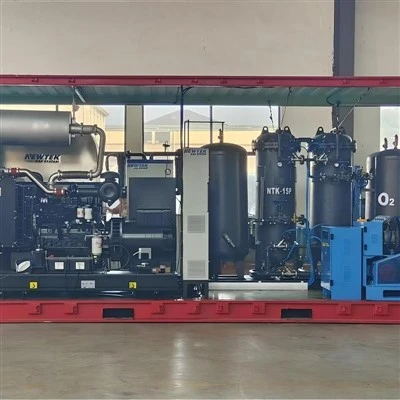
Skid-Mounted PSA Oxygen Generators: Compact, pre-assembled units ideal for remote sites, featuring quick-connect interfaces that reduce installation time by 40% compared to traditional systems.
Containerized PSA Systems: Fully integrated solutions housed in ISO containers, equipped with built-in cooling/heating units to operate in extreme climates, from the Arctic Circle to the Arabian Peninsula.
Modular PSA Plants: Scalable systems that allow incremental capacity expansion (up to 300 Nm³/hr), supported by remote monitoring capabilities for industrial automation environments.


Current Applications of PSA Technology in Aerospace
PSA technology plays a critical role in ensuring continuous oxygen supply for astronauts during space missions. Unlike cryogenic systems, which require large storage tanks and constant refrigeration, PSA systems generate oxygen on demand using ambient air, reducing payload weight and operational complexity. China's Tiangong Space Station employs a hybrid life support system that integrates PSA for oxygen generation and electrolysis for water recycling. NEWTEK's modular design could enhance systems by providing redundant oxygen production capabilities, particularly during emergencies.
In commercial and military aviation, PSA-based oxygen systems are increasingly adopted for cabin pressurization. These systems extract oxygen from ambient air at high altitudes, ensuring passenger and crew safety. The U.S. Air Force's F-22 Raptor, uses an advanced PSA-based oxygen generation system (OBOGS) to deliver high-purity oxygen to pilots during high-G maneuvers. NEWTEK's adaptive control systems, which auto-adjust to altitude and temperature variations, could further improve the reliability of applications.
PSA technology is gaining traction in rocket propellant production, particularly for in-situ resource utilization (ISRU) on the Moon and Mars. By extracting oxygen from regolith or atmospheric CO₂, PSA systems could reduce reliance on Earth-based resupply. NASA's Mars Oxygen ISRU Experiment (MOXIE) demonstrated the feasibility of producing oxygen from Martian CO₂ using solid oxide electrolysis, but PSA-based approaches offer advantages in energy efficiency and scalability. NEWTEK's collaboration with European research institutions on ion transport membranes (ITMs) could bridge this gap, combining PSA's adsorption efficiency with ITMs' high-temperature oxygen separation capabilities.
Advantages of PSA Technology Over Traditional Aerospace Oxygen Systems
PSA systems consume significantly less energy than cryogenic distillation or electrolysis. A typical PSA oxygen plant operates at 0.5–1.5 kWh/Nm³, compared to 4–6 kWh/Nm³ for electrolysis systems. This efficiency is critical for off-grid aerospace applications, where energy resources are limited.
PSA systems are compact and lightweight, making them ideal for space missions with strict payload constraints. NEWTEK's containerized PSA units, which integrate all components into a single ISO container, can be easily transported and deployed in microgravity environments. In contrast, cryogenic systems require bulky storage tanks and complex refrigeration units, increasing launch costs.
PSA technology's modular design allows for redundant oxygen production, ensuring continuous supply even if individual components fail. NEWTEK's skid-mounted systems can be configured with multiple adsorption columns, enabling seamless switching between units during maintenance. This reliability is particularly crucial for long-duration space missions, where system failure could be catastrophic.
Future Trends and Opportunities
Integration with Renewable Energy
As space missions prioritize sustainability, PSA systems are being integrated with solar and nuclear power. NEWTEK's solar-powered PSA plants, developed in collaboration with German green tech firms, store excess energy in lithium-ion batteries, ensuring continuous oxygen supply for off-grid lunar bases. This synergy aligns with NASA's Artemis program, which aims to establish a sustainable lunar presence by 2028, and similar initiatives focused on renewable energy integration in space infrastructure.
In-Situ Resource Utilization (ISRU)
PSA Oxygen Generators could revolutionize ISRU by extracting oxygen from extraterrestrial environments. On Mars, PSA systems could separate oxygen from CO₂-rich atmosphere, while on the Moon, they could extract oxygen from regolith through hydrogen reduction. NEWTEK's partnership with Japanese companies to recycle molecular sieves into construction materials further supports circular economy practices in space, reducing waste and enhancing self-sufficiency for long-term space habitats.
Hybrid Systems for Enhanced Efficiency
Hybrid PSA-electrolysis systems are emerging as a viable solution for aerospace applications. By using PSA for base-load oxygen supply and electrolysis for peak demand or hydrogen co-production, these systems optimize energy use and reduce water consumption. NEWTEK's pilot projects in sub-Saharan Africa demonstrate this hybrid approach, where solar-powered PSA systems provide oxygen for medical clinics while surplus energy powers electrolyzers for hydrogen storage-a model that can be adapted for space applications requiring dual gas production.
NEWTEK's Strategic Positioning in Aerospace
NEWTEK has formed strategic partnerships with aerospace research institutions(CAST, ESA), to develop space-qualified PSA systems. These collaborations focus on radiation-resistant materials, microgravity-compatible designs, and ISRU applications. Joint research with CAST has led to the development of zeolite composites that maintain adsorption efficiency under prolonged radiation exposure, critical for deep-space missions.
Lightweight PSA Modules: Reducing system weight by 30% through advanced composite materials, targeted for satellite and lunar rover applications. These modules use carbon fiber-reinforced polymers for enclosures, balancing strength with minimal mass.
Emergency Oxygen Systems: Compact, rapid-deployment units for spacecraft emergencies, capable of producing 100 Nm³/hr within 30 seconds. These systems feature redundant power supplies and simplified interfaces for quick activation in critical situations.
NEWTEK is targeting emerging aerospace markets. Its containerized PSA systems, which can be rapidly deployed at spaceports, are ideally suited for supporting Virgin Galactic and Blue Origin's operations. Additionally, the company's localized manufacturing hubs in Kenya and South Africa ensure cost-effective supply to the Nigerian National Space Research and Development Agency (NASRDA), aligning with the continent's growing space sector.
Advanced Materials Innovations for Aerospace PSA
NEWTEK's R&D efforts focus on zeolite formulations embedded with radiation-shielding nanoparticles. These composites maintain adsorption efficiency after prolonged exposure to cosmic radiation, a critical factor for deep-space missions. Testing at China's Manned Space Engineering Office has shown these materials retain 95% of their oxygen separation capacity after 1,000 hours of simulated space radiation.
To address temperature fluctuations in space (ranging from -150°C to +120°C), NEWTEK is developing superhydrophobic and thermal barrier coatings for PSA enclosures. These nanocoatings reduce thermal conductivity by 40% and prevent ice formation in cryogenic environments, ensuring consistent operation in lunar polar regions or Martian winters.
For ISRU applications, NEWTEK is researching plant-based polymers for seals and gaskets. These biodegradable materials decompose harmlessly in extraterrestrial environments, aligning with planetary protection protocols while maintaining chemical resistance to rocket propellants and space debris.
Policy and International Collaboration
NASA's Artemis Program: NEWTEK's solar-integrated PSA systems align with Artemis' goal of a sustainable lunar presence by 2028, supporting oxygen supply for lunar bases. The company is participating in NASA's Small Business Innovation Research (SBIR) program to develop compact PSA modules for rover applications.
China's Lunar Exploration Program: Collaborations with CAST enable NEWTEK to contribute to oxygen generation for Chang'e mission support infrastructure.
ESA's Space Resources Strategy: NEWTEK's ISRU-focused PSA technology supports ESA's plans for lunar resource utilization, particularly oxygen extraction from regolith. The company is part of a pan-European consortium studying PSA integration with lunar rover designs.
India's Gaganyaan Mission: Partnerships with Indian space entities aim to adapt PSA systems for manned spaceflight oxygen needs, addressing the country's requirement for indigenous life support technologies.
Environmental and Ethical Considerations
NEWTEK's focus on recyclable PSA components supports the UN Space Debris Mitigation Guidelines. The company's modular design allows for easy disassembly and material recovery, reducing the environmental impact of defunct space systems and contributing to sustainable space operations.
PSA systems for Martian missions are designed to meet NASA's Planetary Protection requirements, ensuring terrestrial organisms do not contaminate other celestial bodies. NEWTEK's sterilization protocols for PSA components have been validated by the Jet Propulsion Laboratory (JPL) for use in Mars-bound missions.
By reducing reliance on cryogenic oxygen transport, PSA technology contributes to lowering launch vehicle emissions. NEWTEK's lightweight PSA modules decrease payload mass, enabling more efficient rocket launches and aligning with global decarbonization goals in the space industry.
Future Projects and Technological Roadmap
NEWTEK is participating in a joint Chinese-European project to develop a compact PSA unit for lunar oxygen extraction. The pilot, scheduled for 2026, will test PSA technology using simulated lunar regolith at facilities in Beijing and Munich, demonstrating oxygen production efficiency under lunar atmospheric conditions.
Working with international consortia, NEWTEK is adapting its PSA systems to extract oxygen from Martian CO₂, integrating with rover designs for 2030 Mars sample return missions. The project involves testing PSA modules in Mars simulation chambers, validating performance under low-pressure, high-CO₂ environments.
PSA systems are being developed for high-altitude research stations. These installations will serve as testbeds for space-adjacent technologies.
PSA Technology's Transformative Role in Aerospace
PSA technology is poised to revolutionize oxygen supply in aerospace, offering energy-efficient, reliable, and scalable solutions for manned missions, aircraft cabins, and ISRU. NEWTEK's focus on modular design, extreme environment adaptability, and strategic partnerships positions it as a key player in this emerging market. Challenges and regulatory compliance persist, the industry's shift toward sustainability and decentralized oxygen production ensures PSA's continued growth.
By 2030, PSA technology is projected to capture 15–20% of the aerospace oxygen generation market, driven by advancements in lightweight materials, renewable energy integration, and hybrid system designs. NEWTEK's hybrid systems and ISRU innovations will be instrumental in realizing oxygen self-sufficiency for lunar bases and deep-space missions, cementing PSA's status as a cornerstone of future aerospace infrastructure.
For organizations seeking to leverage PSA technology in aerospace, NEWTEK's model of technological agility, regional responsiveness, and cross-border collaboration offers a blueprint for success. By integrating cutting-edge materials science, policy alignment, and educational initiatives, PSA technology is set to enable sustainable space exploration and aviation for decades to come.