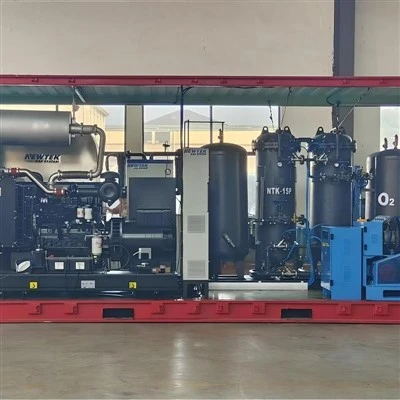
Glass manufacturing requires a stable and carefully controlled heat source to melt raw materials, maintain the required glass temperature, and support consistent production. Whether a factory manufactures container glass, flat glass, fiberglass, tableware, or specialty glass, furnace performance directly influences product quality, energy consumption, production capacity, and operating costs.
Traditional glass furnaces commonly use air-fuel combustion, in which fuel burns with atmospheric air. However, the nitrogen contained in combustion air does not contribute directly to combustion. It absorbs heat and leaves the furnace as part of the exhaust gas. Oxygen-enriched combustion can change this process by increasing the oxygen concentration available for fuel oxidation, reducing the amount of nitrogen introduced with the combustion air, and potentially improving heat transfer to the glass batch and melt.
For glass manufacturers considering oxygen supply options, an on-site Pressure Swing Adsorption (PSA) oxygen plant can provide an alternative to purchasing all oxygen from external suppliers. A properly designed system produces oxygen from compressed air and supplies it to compatible combustion equipment according to the furnace's operating requirements.
PSA oxygen plants can be attractive to certain glass factories because they offer on-site production, operational control, and a supply arrangement that can be matched to the plant's oxygen demand. However, suitability depends on the required oxygen flow, purity, pressure, furnace design, burner configuration, fuel type, and the economics of the complete combustion system.
This article explains why PSA oxygen plants may be suitable for glass furnaces, which production problems oxygen-assisted combustion can address, and what manufacturers should evaluate before implementing an on-site oxygen supply system.

Supporting More Efficient Fuel Combustion
The primary purpose of oxygen in a glass furnace is to support the combustion process. In a conventional air-fuel furnace, atmospheric air supplies the oxygen required for fuel oxidation, but it also introduces a large quantity of nitrogen.
Nitrogen does not participate significantly in the combustion reaction under normal furnace conditions. Instead, it absorbs heat and contributes to the volume of exhaust gas that must be managed by the furnace system.
Increasing the oxygen concentration supplied to suitable burners can reduce the amount of nitrogen introduced with the combustion stream. Depending on the burner design, oxygen concentration, fuel, furnace configuration, and operating conditions, this can improve combustion performance and change the distribution of heat within the furnace.
Potential benefits for glass production
More oxygen is available to support fuel combustion.
Less nitrogen enters the combustion process when oxygen-enriched or oxygen-based combustion replaces part of the combustion air.
The volume of combustion products may decrease, depending on the overall combustion arrangement.
Heat transfer to the glass melt may improve under suitable furnace conditions.
Furnace operators gain another variable for optimizing combustion performance.
These effects are not automatic. The actual improvement depends on how oxygen is introduced, how the burners are designed, and how the furnace is operated. Oxygen supply should therefore be integrated with a combustion engineering assessment rather than treated as an independent equipment upgrade.
Reducing the Volume of Nitrogen Entering the Furnace
Atmospheric air contains approximately 21% oxygen by volume, with most of the remainder consisting of nitrogen. In conventional air-fuel combustion, a substantial amount of nitrogen passes through the furnace without contributing directly to fuel oxidation.
When a glass furnace uses oxygen-enriched combustion, some of the nitrogen associated with combustion air can be displaced by a higher oxygen concentration. With appropriately designed oxygen-based combustion, the reduction can be more substantial.
This change affects the furnace's thermal and exhaust-gas characteristics.
Why nitrogen matters in a glass furnace
Nitrogen entering with combustion air must be heated as it passes through the furnace. The energy used to heat this gas is not directly available for melting the glass batch.
Nitrogen also contributes to exhaust-gas volume. Depending on furnace design and operating conditions, lower combustion-gas volumes can affect flue-gas handling, heat losses, and the operating conditions of downstream exhaust equipment.
For a glass manufacturer, reducing the unnecessary heating of combustion air can create an opportunity to improve thermal efficiency. However, the extent of the benefit depends on the baseline furnace, oxygen concentration, fuel consumption, excess oxygen, heat recovery, and other process variables.
A technical evaluation should compare actual fuel use and furnace performance before and after oxygen enrichment rather than assuming a fixed saving for every installation.
Helping Glass Furnaces Meet High and Stable Thermal Demands
Glass melting requires sustained high temperatures. Raw materials must be heated, undergo chemical reactions, and form a homogeneous melt before the glass can move through refining, conditioning, and forming operations.
A furnace must maintain appropriate thermal conditions while handling variations in batch composition, production rate, glass type, and operating schedule.
Oxygen-assisted combustion can provide additional flexibility for managing heat input. Depending on the combustion system, oxygen enrichment may help increase flame temperature, modify flame characteristics, and improve the distribution of heat within the furnace.
These changes may be useful when a manufacturer needs to increase melting capacity, address a thermal bottleneck, or optimize an existing furnace.
Applications where thermal control matters
Container glass: Bottle and jar production requires stable melting conditions to support consistent glass quality and continuous forming operations.
Flat glass: Float-glass production depends on maintaining the required thermal conditions and melt quality throughout the process.
Fiberglass: Glass composition and downstream fiber-forming requirements can place specific demands on furnace temperature and melt homogeneity.
Specialty glass: Certain formulations require careful control of melting and refining conditions to achieve the intended properties.
The benefits of oxygen enrichment vary across these applications. The furnace's refractory materials, burner arrangement, glass chemistry, and operating profile must all be considered when determining whether oxygen-assisted combustion is appropriate.
Providing an On-Site Oxygen Supply for Continuous Production
Glass furnaces often operate continuously for extended periods. An interruption in fuel combustion or oxygen supply can affect furnace stability, production scheduling, and the quality of the glass being manufactured.
Factories using purchased oxygen must coordinate deliveries, maintain appropriate storage, and ensure that supply availability matches the combustion system's demand. These arrangements can be effective, but they may introduce logistical dependencies.
An on-site PSA oxygen plant allows a glass factory to produce oxygen at the facility, provided the plant is sized and configured for the required operating conditions.
Operational advantages
Local production: Oxygen is generated at the factory rather than relying entirely on deliveries.
Supply planning: Production can be coordinated with the furnace's expected oxygen demand.
Reduced delivery frequency: Depending on the system capacity and supply strategy, routine dependence on external oxygen deliveries may decrease.
Greater operational visibility: Operators can monitor production output, pressure, purity, and equipment status.
More direct coordination: The oxygen supply arrangement can be integrated with the furnace's combustion controls and operating schedule.
On-site production does not guarantee uninterrupted oxygen availability. PSA equipment requires electrical power, suitable compressed air, maintenance, and appropriate operating conditions. A glass furnace must have a defined contingency strategy for equipment faults, power interruptions, or demand that exceeds the available supply.
For critical continuous processes, backup oxygen arrangements and an engineering assessment of supply reliability are particularly important.
Matching Oxygen Production to the Furnace's Operating Profile
A glass furnace does not necessarily consume the same amount of oxygen under every operating condition. Demand may change with production rate, burner settings, furnace temperature, glass composition, maintenance activities, and the extent of oxygen enrichment.
A PSA oxygen plant can be designed around a defined demand profile, allowing the factory to establish a suitable relationship between oxygen production and combustion requirements.
However, the design must account for both normal consumption and the operating conditions that determine peak demand.
Key capacity considerations
| Design parameter | Why it matters |
|---|---|
| Normal oxygen flow | Establishes the routine production requirement |
| Peak oxygen flow | Determines whether the supply can support the highest expected demand |
| Oxygen purity | Must match the combustion system's specified requirements |
| Delivery pressure | Must be compatible with burner and distribution requirements |
| Daily operating hours | Influences equipment utilization and operating cost |
| Furnace production rate | Helps determine oxygen demand under different production conditions |
| Future production changes | Supports realistic capacity planning |
| Reserve and backup requirements | Helps manage equipment outages and unexpected demand |
A common mistake is to select a system based only on average oxygen consumption. If the furnace requires a higher flow during certain operating conditions, the oxygen supply may become a production constraint.
The opposite mistake is excessive oversizing. A plant that is much larger than the actual requirement can increase capital costs and may operate inefficiently under some conditions.
The appropriate capacity should be determined from measured or calculated oxygen demand, burner requirements, expected operating conditions, and a realistic assessment of future production needs.
Potentially Reducing Fuel Consumption
Fuel consumption is a major operating expense in glass manufacturing. The energy required to melt glass depends on the furnace design, batch composition, production rate, heat recovery, combustion efficiency, operating temperature, and many other factors.
Oxygen enrichment can improve the thermal performance of some furnaces by reducing the nitrogen introduced with combustion air and changing heat-transfer conditions. Under suitable circumstances, this can reduce the amount of fuel required to produce a given quantity of glass.
For manufacturers evaluating PSA oxygen, however, the correct comparison is not simply fuel consumption before and after adding oxygen.
The oxygen plant itself consumes electricity. Its compressor, air treatment equipment, PSA unit, and auxiliary systems all contribute to operating expenses. Additional equipment may also be needed for oxygen storage, pressure regulation, and distribution.
Evaluating the net energy effect
A meaningful assessment should include:
Baseline fuel consumption per tonne of saleable glass.
Expected fuel consumption after oxygen enrichment.
Oxygen consumption under the proposed combustion arrangement.
Electricity consumption of the PSA oxygen plant.
Electricity required by associated compression and auxiliary equipment.
Changes in furnace exhaust conditions and heat recovery.
Effects on production rate, glass quality, and furnace operation.
Maintenance costs and any additional equipment requirements.
The economic result depends on the relationship between fuel savings, electricity consumption, oxygen production cost, and any improvement in furnace output.
A glass manufacturer should request performance estimates based on its actual furnace data and confirm the assumptions through commissioning measurements or a controlled trial where feasible.
Supporting Lower Exhaust-Gas Volumes Under Suitable Conditions
Exhaust-gas volume is an important consideration in furnace operation. The volume and composition of flue gas affect ducting, exhaust equipment, heat recovery, and the conditions under which emissions are monitored.
When oxygen enrichment reduces the quantity of nitrogen entering combustion, the volume of combustion products may decrease. The effect depends on the fuel, oxygen concentration, combustion arrangement, air infiltration, excess oxygen, and furnace operating conditions.
Potential consequences include changes to:
Flue-gas volume and flow characteristics.
Heat carried away through the exhaust.
The operating conditions of downstream heat-recovery equipment.
The thermal loading of certain exhaust-system components.
Furnace pressure and combustion-control requirements.
These effects require careful engineering evaluation. A lower flue-gas volume does not automatically mean that every exhaust component can be reduced in size or that the existing exhaust system will operate correctly without modification.
Glass furnaces also release process emissions associated with raw materials, including gases generated during batch reactions. Oxygen enrichment does not eliminate these sources. Emissions performance must be evaluated across the complete production process.

Creating Opportunities to Improve Furnace Productivity
For glass manufacturers, productivity is closely linked to the amount of saleable glass produced over a given period while maintaining the required quality.
Oxygen-assisted combustion may create opportunities to improve furnace productivity where combustion performance or thermal capacity limits production. Depending on furnace design, oxygen enrichment can support changes in heat input and flame characteristics that may help the furnace accommodate a higher melting rate.
However, additional oxygen alone cannot guarantee a higher production rate. Productivity depends on the combined performance of melting, refining, conditioning, forming, annealing, and downstream handling.
Increasing the melting rate without sufficient capacity elsewhere may simply move the bottleneck to another stage.
Before using oxygen enrichment to increase production, a factory should assess:
Maximum sustainable melting rate.
Glass residence time and refining requirements.
Temperature distribution across the furnace.
Burner and combustion-control capacity.
Refractory temperature and wear.
Forehearth and forming-line capacity.
Product quality at the intended production rate.
Effects on furnace operating life and maintenance intervals.
A controlled combustion optimization programme can help determine whether oxygen enrichment offers a practical productivity benefit without compromising glass quality or furnace integrity.
Improving Combustion Control and Operating Flexibility
Glass quality depends on maintaining a suitable balance between furnace temperature, heat distribution, glass chemistry, and production conditions.
Combustion control is therefore an important part of furnace management. Operators need to adjust fuel and oxidant supply according to process requirements while maintaining safe operating conditions.
An oxygen supply system can provide an additional variable for managing combustion. When integrated with suitable burners, flow controls, instrumentation, and furnace automation, it may help operators adjust oxygen delivery to meet the intended operating profile.
A PSA oxygen plant can also provide monitoring data on its own performance, including output flow, purity, pressure, and operating status, depending on the configuration.
Nevertheless, the oxygen plant and the furnace control system serve different functions. PSA equipment generates oxygen within its operating specifications; the furnace control system manages combustion according to the process requirements.
Effective integration requires clearly defined control responsibilities, appropriate instrumentation, and safeguards for abnormal operating conditions.
Understanding the Relationship Between Oxygen Purity and Furnace Performance
PSA oxygen plants separate oxygen from compressed air through an adsorption process. Their output purity and production capacity depend on the equipment design and operating conditions.
For glass furnace applications, the required oxygen purity should be determined by the burner manufacturer, combustion engineering team, and project performance requirements.
Higher oxygen concentration can change combustion characteristics, but it does not automatically guarantee a better furnace result. The appropriate oxygen specification depends on the combustion technology and the intended operating conditions.
When evaluating an on-site PSA plant, manufacturers should confirm:
Guaranteed oxygen purity at the required production rate.
Rated flow at the specified purity.
Delivery pressure and allowable pressure variation.
Feed-air quality and environmental requirements.
Energy consumption at representative operating conditions.
Start-up and operating characteristics.
Monitoring, alarms, and maintenance requirements.
A system's maximum advertised flow should not be treated as its guaranteed output under every purity and pressure condition. Capacity, purity, and power consumption should be reviewed together using the supplier's specified operating data.
Managing Oxygen Supply Reliability in a Continuous Furnace
A glass furnace may operate continuously for long periods, making oxygen supply reliability a major engineering concern when oxygen is used as part of its combustion process.
An on-site PSA system can reduce exposure to some delivery-related risks, but the factory must also manage risks associated with the production equipment and supporting utilities.
A complete reliability strategy may include:
Preventive maintenance: Scheduled inspection and servicing of compressors, filters, valves, instruments, and other components help maintain performance.
Continuous monitoring: Suitable instruments can identify abnormal oxygen purity, pressure, flow, or equipment status.
Buffer storage: Appropriately designed storage can help manage short-term differences between oxygen production and furnace demand.
Backup supply: A reserve source can provide oxygen when the primary system is unavailable or unable to meet demand.
Power planning: The electrical supply and any necessary backup arrangements should be evaluated according to the required continuity level.
Contingency procedures: Operators should know how to respond to equipment alarms, supply pressure changes, power interruptions, and other abnormal conditions.
The backup arrangement must be designed around the furnace's actual oxygen demand and the time required to restore the primary supply. A small reserve may be sufficient for one application but inadequate for another.
Considering Oxygen Supply Costs in Glass Manufacturing
The suitability of a PSA oxygen plant depends on both technical performance and economic feasibility.
A glass factory should compare the total cost of producing oxygen on-site with the cost of alternative oxygen supply arrangements. The comparison should reflect the actual purity, flow, pressure, availability, and delivery conditions required by the furnace.
Main cost components
| Cost category | Evaluation focus |
|---|---|
| Capital investment | PSA equipment, compressors, air treatment, storage, controls, installation, and commissioning |
| Electricity | Energy used by the complete oxygen production system |
| Maintenance | Routine service, component replacement, and repair |
| Oxygen distribution | Piping, pressure regulation, instrumentation, and connection to the combustion system |
| Backup supply | Reserve oxygen arrangements and related costs |
| Furnace modifications | Burner upgrades, control-system changes, and any required engineering work |
| Production performance | Changes in fuel use, output, quality, and maintenance requirements |
For factories currently purchasing oxygen, the delivered oxygen price provides an important starting point. However, the analysis should also account for transport costs, storage arrangements, delivery reliability, and supply-contract conditions.
For factories considering oxygen enrichment for the first time, the evaluation must include the combustion-system investment and the expected operational effect on the furnace.
A complete cost model should compare the cost per tonne of saleable glass before and after the proposed change, rather than considering the oxygen production cost in isolation.
Environmental Considerations: Potential Benefits and Limitations
Glass manufacturers increasingly evaluate energy consumption and emissions as part of their operating strategy. Oxygen-assisted combustion may influence both, but the outcome depends on the furnace configuration and the overall energy balance.
Reducing nitrogen entering the combustion process can reduce certain combustion-gas volumes. Improved thermal performance may also reduce fuel consumption under suitable conditions.
However, environmental benefits should not be assumed without measurement. The PSA plant consumes electricity, and the environmental impact of that electricity depends on how it is generated. Furnace emissions also depend on fuel type, combustion temperature, raw material chemistry, production rate, and emissions-control equipment.
For example, thermal NOx formation may be affected by changes in flame temperature and combustion conditions. The final result depends on the specific burner technology and operating strategy; oxygen enrichment should not automatically be described as eliminating nitrogen oxides.
A comprehensive environmental assessment should consider direct fuel use, electricity consumption, relevant greenhouse-gas emissions, NOx, particulate matter, process emissions, and the performance of existing exhaust-treatment systems.
The most useful comparison is based on verified emissions and energy data per tonne of saleable glass.
Installation and Safety Considerations
Oxygen supports combustion and can cause materials to ignite more readily or burn more intensely under oxygen-enriched conditions. Therefore, oxygen production and distribution equipment must be designed and operated with appropriate safety measures.
Glass manufacturers should assess the full installation, including the PSA plant, compressors, storage vessels, oxygen piping, valves, pressure regulation, burner connections, and control systems.
Important considerations include:
Appropriate materials for oxygen service.
Oxygen-compatible valves, seals, and fittings.
Cleanliness of oxygen piping and components.
Prevention of oil and grease contamination in oxygen-service equipment.
Suitable pressure protection and isolation arrangements.
Adequate ventilation and equipment access.
Clearly defined operating and emergency procedures.
Training for operators and maintenance personnel.
Compliance with applicable pressure-system, electrical, fire-safety, and oxygen-handling requirements.
The oxygen system should also be integrated with the furnace's combustion safeguards. Start-up, shutdown, low-flow conditions, and abnormal combustion events require procedures consistent with the burner and furnace design.
Before commissioning, the project team should verify the required output performance, gas quality, pressure, controls, alarms, and the safe operation of the complete system.
How to Determine Whether a PSA Oxygen Plant Is Suitable for a Glass Furnace
Not every glass furnace has the same oxygen demand or economic requirements. A factory should establish the technical basis for the project before choosing equipment.
Identify the combustion objective
Determine whether the goal is to reduce fuel consumption, increase melting capacity, improve thermal control, reduce dependence on purchased oxygen, or address another defined operating problem.
Collect furnace operating data
Review fuel consumption, glass production rate, furnace temperature profile, burner configuration, operating hours, and current exhaust conditions.
Calculate oxygen demand
Establish the required oxygen flow under normal and peak operating conditions. Include the intended oxygen concentration and the requirements of the proposed burners.
Confirm the oxygen specification
Define purity, pressure, flow, and availability requirements. Ensure that the proposed PSA system can meet these requirements simultaneously under the specified operating conditions.
Assess system integration
Review oxygen piping, controls, storage, burner compatibility, safety interlocks, and any furnace modifications required.
Calculate the full economic impact
Include PSA equipment costs, electricity, maintenance, fuel savings, potential productivity changes, backup supply, and any required burner or control-system upgrades.
Establish performance verification
Define how the factory will measure oxygen output, purity, fuel consumption, furnace productivity, glass quality, and relevant emissions before and after implementation.
This approach helps manufacturers distinguish between theoretical benefits and measurable improvements under actual production conditions.
Conclusion
PSA oxygen plants can be suitable for glass furnaces that need a dependable on-site oxygen source and have combustion requirements compatible with the technology. They can support oxygen-assisted combustion, reduce dependence on external oxygen deliveries, improve supply planning, and provide opportunities to optimize fuel consumption and furnace productivity.
The potential thermal benefits arise from changes in the oxygen concentration supplied to combustion, including reduced nitrogen introduction under appropriate operating conditions. However, the actual effects depend on furnace design, burner technology, fuel type, operating temperature, oxygen purity, and the overall combustion strategy.
An on-site PSA oxygen plant should therefore be selected as part of an integrated furnace engineering project. The factory must evaluate the required flow and pressure, oxygen purity, energy consumption, system reliability, backup supply, safety requirements, and total cost per tonne of saleable glass.
When the equipment is correctly sized and integrated with suitable combustion controls, an on-site oxygen supply can become a useful part of a glass manufacturer's strategy for improving operational control and managing long-term production costs.
FAQ
Why can oxygen-assisted combustion benefit glass furnaces?
Increasing the oxygen concentration supplied to compatible burners can reduce the amount of nitrogen entering the combustion process and change flame characteristics and heat transfer. Depending on the furnace design, these changes may support improved thermal efficiency or productivity.
Can a PSA oxygen plant supply oxygen continuously to a glass furnace?
It can supply oxygen continuously within its rated operating range when supported by suitable utilities, maintenance, and operating conditions. Because glass furnaces may require continuous operation, the factory should also evaluate backup oxygen, storage, and contingency procedures.
How should a glass factory determine the required PSA oxygen capacity?
Capacity should be based on the furnace's oxygen demand under normal and peak operating conditions, required purity, delivery pressure, burner specifications, and expected production changes. Average demand alone may not be sufficient.
Does installing a PSA oxygen plant automatically reduce fuel consumption?
No. Oxygen-assisted combustion may reduce fuel consumption under suitable conditions, but the net result depends on the furnace, burner configuration, operating strategy, and energy used to produce oxygen. Performance should be evaluated using actual furnace and energy data.
Is PSA oxygen suitable for every type of glass furnace?
Suitability depends on the glassmaking process, burner design, required oxygen flow and purity, operating conditions, and project economics. A combustion engineering assessment is necessary before selecting an oxygen supply system.
What should a glass manufacturer compare when evaluating on-site oxygen production?
The manufacturer should compare equipment investment, electricity consumption, maintenance, oxygen purity and pressure, backup supply, furnace modification costs, expected fuel savings, productivity effects, and changes in emissions. The evaluation should focus on the complete production process rather than oxygen cost alone.
What safety measures are important for oxygen supply in glass manufacturing?
The installation requires oxygen-compatible materials, clean oxygen-service components, suitable pressure protection, appropriate isolation and control arrangements, trained personnel, and documented emergency procedures. The oxygen supply must also be integrated with the furnace's combustion safeguards and applicable industrial safety requirements.