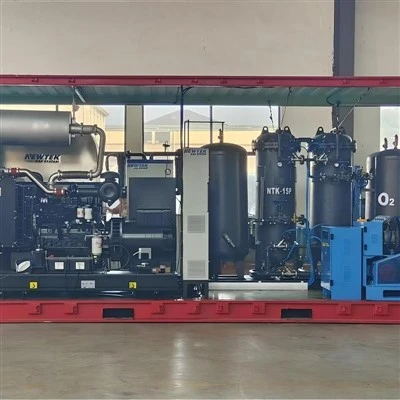
In recent years, with the development of development and process technology and the continuous expansion of gas application fields, especially the continuous improvement of the quality and quantity requirements for oxygen, nitrogen and nitrogen, many companies have increased their investment in technology research and application, greatly increasing the proportion of gas production in the gas market, and becoming another powerful air separation technology after cryogenic air separation. Although oxygen production technology has a history of many years, it still needs to be further developed because it has opened up a new path in the field of oxygen production and is unique. Taking advantage of the new achievements of contemporary cutting-edge science, exploring the mechanism of adsorption separation process, and carefully designing and optimizing parameters will be the direction and focus of the development of this technology.
Concept of adsorption separation
The adsorption separation process consists of two steps: adsorption and desorption of fluid. As early as 1990, … put forward the concept of "adsorption", and pressure swing adsorption belongs to physical adsorption. Physical adsorption is a surface phenomenon. In the two-phase region, the fluid and the porous solid are combined with each other. There is an intermolecular force between the two phases, which causes the fluid molecules to accumulate and concentrate on the surface of the porous solid. For multi-component fluids, there are differences in the forces between each component and the porous solid, so selective adsorption occurs. Under certain conditions, the components adsorbed on the solid phase surface leave the interface and return to the fluid phase. This process is the reverse process of adsorption, called desorption or desorption.
Through adsorption and desorption, component separation and solid phase regeneration are achieved, thereby realizing the separation and purification of mixed fluids. The solid phase porous material is called the adsorbent, and the adsorbed fluid is called the adsorbent. When the fluid is adsorbed, the distance between molecules is reduced, the molecular kinetic energy is reduced, and heat is released. On the contrary, during desorption, the molecular kinetic energy increases, and heat absorption is required to remove the adsorbed molecules adsorbed on the surface.
Principle of oxygen production by pressure swing adsorption
The adsorption separation of the mixed gas is completed by pressurization, and the adsorbed gas components are desorbed under reduced pressure conditions to achieve separation between the components of the mixed gas and the regeneration of the adsorbent. Fluid component adsorption equilibrium isotherm, when the temperature is constant, the adsorption amount of the mixed gas on the adsorbent increases with the increase of the partial pressure of the component;
Assuming that the temperature in the adsorption container remains constant during adsorption and desorption, by changing the partial pressure of the fluid component, the adsorption amount of the fluid on the solid phase adsorbent will change along the adsorption isotherm, the working point is between the points, and the difference between the adsorption amounts of the two points is the component separation amount of the isothermal pressure-swinging adsorption cycle. However, in the actual pressure swing adsorption separation process, the adsorption process releases heat, and the desorption process absorbs heat. The temperature of the adsorption bed will change, affecting the occurrence of the adsorption process. As the adsorption proceeds, the actual pressure swing adsorption process will proceed between the two points and the actual pressure swing adsorption component separation amount.
Increasing the difference in the adsorption amount of the gas components on the adsorbent during the adsorption and desorption processes will help improve the separation effect. In addition to having a large difference in selectivity for each component, the selected adsorbent should also have a significant change in the slope of the adsorption isotherm, and the pressure change should be increased as much as possible to increase the change value of the component adsorption amount. Oxygen production uses air as the raw gas and zeolite molecular sieves as solid phase adsorbents. The separation mechanism belongs to the equilibrium separation type, that is, the difference in the intermolecular force between nitrogen and oxygen molecules in the air in the molecular sieve pores is fully utilized to achieve air separation oxygen production.
The dipole moment of nitrogen molecule is , the dipole moment of oxygen molecule is , and the polarizability of nitrogen is larger, so the interaction between nitrogen and cations and polar surfaces in zeolite is stronger than that between nitrogen and oxygen. Therefore, zeolite molecular sieves can selectively adsorb nitrogen. By utilizing the property of zeolite molecular sieves to preferentially adsorb nitrogen at medium and low pressures, the purpose of separating nitrogen and oxygen in the air is achieved through pressure increase treatment, and then the pressure is reduced to desorb the nitrogen adsorbed in the solid phase molecular sieves, so that the solid phase molecular sieves can be recycled.