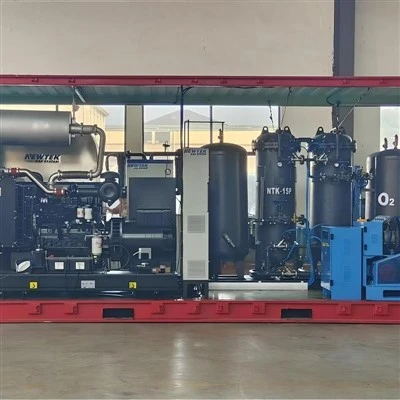
The process of oxygen production by pressure swing adsorption air separation involves mass transfer, heat transfer and momentum transfer. The pressure, concentration and temperature changes in the system are complex and difficult to measure. Relying on simple experimental research has great limitations and it is difficult to obtain the internal mechanism of the adsorption separation process. Therefore, compared with the rapid promotion of industrial applications, there are many research works that need to be strengthened.
The computational fluid dynamics (CFD) software FLUENT is used for numerical simulation of oxygen production by pressure swing adsorption. The gas-phase single-phase porous medium model cannot express the mass transfer and heat transfer between gas and solid adsorption particles. The gas-solid two-phase mass transfer and heat transfer in the pressure swing adsorption separation process are expressed through custom programming. The single-phase model is improved into a gas-solid two-phase flow pressure swing adsorption model, the interaction between the gas-solid two-phase in the pressure swing adsorption cycle process is analyzed, and the internal mechanism of pressure swing adsorption is explored. The CFD method was used to study the effects of particle diameter and backflush rate on the performance of PSA oxygen production, in order to better guide the experiment and analyze the flow distribution law in the adsorption packed bed. The main contents are:
Based on the basic principle of PSA air separation oxygen production, its mass transfer rate model and two-phase equilibrium model were determined. The user-defined function (UDF) function of FLUENT was used to couple the mass transfer model and equilibrium model with the porous medium model to reflect the gas-solid two-phase mass transfer effect. Through the user-defined scalar (UDS) function, the solid phase energy equation was introduced to integrate the porous medium single-phase model into a more complete gas-solid two-phase flow PSA oxygen production fixed packed bed model. The reliability of the gas-solid two-phase flow PSA model was verified from the aspects of the simulation and experimental comparison of the Langmuir isotherm curve of the components, the grid independence test, the comparison of the use of the viscosity model, and the simulation and experimental comparison of the average oxygen mole fraction at the outlet.
Based on the established reliable two-phase flow PSA model, the commonly used two-bed four-step PSA oxygen production cycle was simulated and analyzed, and the gas phase oxygen mole fraction distribution in the adsorption bed at the end of the four steps in different cycles, the adsorption concentration of the components in the solid phase and the change of the two-phase temperature were obtained. The results show that the maximum oxygen mole fraction at the end of the first cycle can reach 72.0%, the recovery rate is about 31.4%, and the gas-solid two-phase temperature fluctuates around 10K. During the non-steady-state cycle, the oxygen mole fraction and recovery rate both increase with the increase in the number of cycles, but the rate of increase gradually decreases, and a steady state is reached in the sixth cycle. After the cycle stabilizes, the maximum oxygen mole fraction can reach 99.9%, and the oxygen recovery rate is about 39.5%. The adsorption concentration of the component in the solid phase depends only on the mole concentration of the component in the gas phase, and has no necessary relationship with the mole fraction of the gas phase component.
The gas-solid temperature change in the two-phase region of porous media is mainly due to nitrogen adsorption and desorption. The two-phase flow pressure swing adsorption model was used to study the effects of particle diameter and backwash rate on the concentration and recovery value of oxygen in the pressure swing adsorption oxygen production product. When the backwash rate was 0.6, simulation comparisons using particle diameters of 0.4mm, 0.8mm, 1.6mm, 3.2mm, and 6.4mm showed that there was an optimal particle size of 1.6mm that allowed the average molar fraction of oxygen in the gas production and the oxygen recovery rate to reach the maximum values, which were 99.7% and 39.5%, respectively. When the particle diameter was 1.6mm, the simulation results of backwash rates of 0.4, 0.5, 0.6, 0.7, and 0.8 were compared, and it was found that the oxygen recovery rate reached its maximum value when the backwash rate was 0.6.