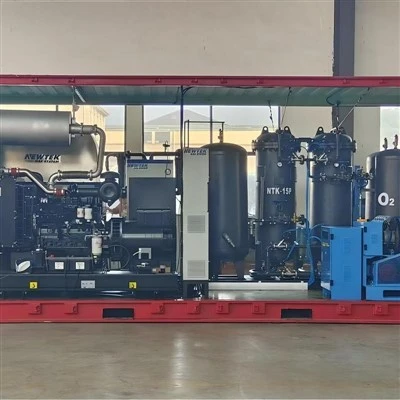
Oxygen generator for industrial useThe commonly used adsorption regeneration process is pressure swing adsorption (PSA). The PSA process generally changes the pressure during the adsorption process to achieve adsorption and desorption. The basic PSA process is adsorption under pressure and desorption under low pressure or atmospheric pressure. Vacuum pressure swing adsorption (VPSA) is a pressure swing adsorption process that adsorbs under pressure and desorbs under low pressure (vacuum). It is also a type of PSA process and is currently widely used in oxygen production in the field of gas separation.
Process principle of oxygen production by pressure swing adsorption
According to the separation mechanism of gas components by pressure swing adsorption, adsorbents can be divided into kinetic selective adsorbents and equilibrium selective adsorbents. The former is separated based on the difference in the diffusion rate of adsorbate molecules in the micropores of the adsorbent, while the latter is separated based on the size of the force of the adsorbate molecules in the pores of the adsorbent. The adsorbent for oxygen production by pressure swing adsorption is zeolite molecular sieve. The zeolite molecular sieve used for oxygen production mainly includes X-type zeolite (such as LiX, NaX, CaX) molecular sieve and A-type zeolite (such as CaA) molecular sieve.
Zeolite molecular sieve is a porous silicate crystal with a pore size of the order of magnitude of the molecular size. It is polar and belongs to a balanced selective adsorbent. It is mainly composed of ion holes and charged silicon-aluminum skeletons. The main role of cations in zeolite molecular sieves is to supplement the lack of positive charge of aluminum oxide tetrahedrons that constitute the molecular sieve skeleton. The cation is shared by another aluminum oxide or silicon oxide tetrahedron, extending the three-dimensional space of the lattice to form a three-dimensional cage structure. The cations in the lattice have the effect of local strong positive lattice points, which electrostatically attract polar molecules. Non-polar oxygen and nitrogen molecules produce dipole moments under polarization, and the induced dipoles produced have adsorption effects with the inherent dipoles of the adsorbent. Under isothermal conditions, the induction force of nitrogen is greater than that of oxygen. The adsorption capacity of nitrogen by zeolite molecular sieve is greater than that of oxygen. When oxygen and nitrogen pass through the zeolite molecular sieve bed at the same time, nitrogen molecules are mainly adsorbed, and oxygen molecules are less adsorbed. Thus, oxygen and nitrogen are separated, and the unadsorbed oxygen is enriched and output as oxygen product.
X-type zeolite molecular sieve belongs to the isometric crystal system and has a cubic octahedral zeolite structure (FAU). Its silicon-oxygen skeleton and aluminum-oxygen skeleton structure are the same as those of natural faujasite zeolite[28]. The FAU skeleton structure of X-type zeolite molecular sieve contains two three-dimensional cavity structures. The large cavity structure is supercages with a pore diameter of about 13Å, and the small cavity structure is β cages (sodalite or β cages) with a pore diameter of about 8Å.
Generally, synthetic molecular sieves with faujasite structure (FAU) are divided into Y-type molecular sieves (n(SiO2)/n(Al2O3)>3.0) and X-type molecular sieves (2.0≤n(SiO2)/n(Al2O3) ≤3.0) according to the different framework silicon-aluminum molar ratios [n(SiO2)/n(Al2O3)]. The framework silicon-aluminum molar ratio of low silicon-aluminum ratio X (LSX) type molecular sieves is between 2.0-2.2. Because of its low framework silicon-aluminum ratio, it has more negative charges, so its cation exchange capacity is large, the charge density is high and the adsorption capacity is strong; at the same time, it has a FAU topological structure, and has the large pore volume and pore size of X-type zeolite molecular sieve itself, and has a large adsorption capacity. Therefore, LSX type molecular sieves have excellent adsorption performance [30]. Lithium ion (Li+) is the metal ion with the smallest radius, has a very high charge density, and has a high polarizability.
After the 13X (NaX) molecular sieve is modified by Li+ exchange to become a high-exchange Li-LSX molecular sieve, the nitrogen-oxygen separation coefficient and nitrogen adsorption capacity are improved, and the selective adsorption performance is better. Therefore, Li-LSX molecular sieve has become the best adsorbent currently recognized in pressure swing adsorption oxygen production, and is also the most widely used adsorbent in actual industrial production.
Hot Tags: oxygen generator for industrial use, China oxygen generator for industrial use manufacturers, suppliers, Oxygen Generator Industrial, oxygen generators industrial, industrial psa oxygen generator, industrial oxygen making machine, industrial psa oxygen generator plant, Industrial Oxygen Gas Plant