When Does On-Site Oxygen Generation Make More Sense?
Not every business has the same oxygen procurement requirements. An on-site generation system becomes worth considering when existing supply arrangements create operational limitations.
Frequent Oxygen Deliveries
Facilities consuming large quantities of oxygen may need frequent cylinder or liquid oxygen deliveries. On-site generation reduces the need to coordinate every replenishment cycle.
Unpredictable Oxygen Consumption
Production demand can change between shifts, processes and operating periods. A properly configured generation system allows oxygen production to be matched with actual consumption patterns.
Remote Installation Locations
Factories located far from industrial gas suppliers may experience higher transportation costs and longer delivery lead times. Local oxygen generation reduces dependence on external logistics.
Long-Term Supply Expenses
For businesses with sustained oxygen consumption, recurring gas purchases, transportation and handling expenses should be evaluated together when comparing supply methods.
From Oxygen Production to Actual Factory Operations
An oxygen generation system should not be treated as an isolated machine. Its value depends on how effectively it connects with the customer's existing production infrastructure.
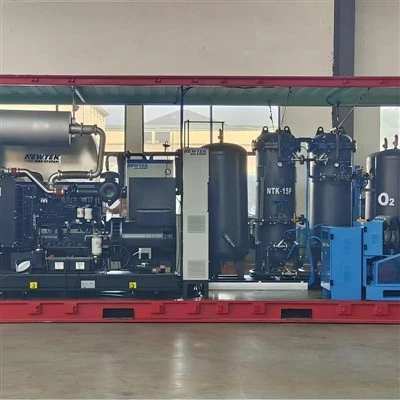
An Atmos Oxygen Plant can be incorporated into a complete oxygen supply arrangement covering:
Air Supply: Compressed air preparation provides the operating conditions required for oxygen separation.
Oxygen Generation: The PSA system produces oxygen according to the required production schedule.
Gas Buffering: Oxygen storage helps accommodate fluctuations between generation and consumption.
Pressure Management: Additional equipment can be configured when downstream processes require higher oxygen pressure.
Distribution Network: Pipeline connections deliver oxygen to designated production areas.
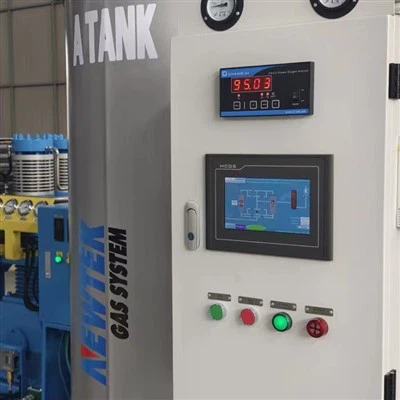
Monitoring and Control: Operating conditions and oxygen concentration can be monitored through the control system.
The final arrangement depends on the distance between the generation station and consumption points, operating pressure requirements and the customer's production layout.
Matching Oxygen Supply to Different Production Environments
The same oxygen generation technology can serve different industries, but the equipment configuration and downstream integration requirements are not necessarily identical.
|
Industry |
Oxygen Supply Requirements |
System Considerations |
|---|---|---|
|
Metal Fabrication |
Oxygen for cutting and heating processes |
Pressure stability and downstream consumption |
|
Aquaculture |
Continuous oxygen supply for aquatic environments |
Dissolved oxygen management and distribution |
|
Wastewater Treatment |
Oxygen for biological treatment and oxidation |
Continuous operation and pipeline distribution |
|
Glass Manufacturing |
Oxygen for industrial combustion |
Process integration and operating continuity |
|
Chemical Production |
Oxygen for oxidation and related reactions |
Process pressure and oxygen consumption |
|
Industrial Gas Supply |
Oxygen for subsequent compression and filling |
Booster compression and cylinder filling integration |
The system should be designed around the actual oxygen consumption point rather than simply selecting equipment based on industry classification.
What Makes a Practical Oxygen Supply System?
A successful installation involves more than selecting an oxygen generator. Buyers should evaluate the entire supply arrangement before confirming equipment specifications.
Production Continuity
The system should accommodate the facility's operating schedule and expected oxygen demand. Storage capacity and backup arrangements should also be considered where uninterrupted supply is essential.
Air Treatment Quality
Compressed air pretreatment is important for protecting molecular sieve materials and maintaining stable adsorption performance. Filtration, moisture removal and oil control must be addressed during system design.
Downstream Compatibility
The oxygen generation system must match the pressure, flow and connection requirements of the customer's existing equipment. Additional boosters or storage vessels may be required.
Maintenance Accessibility
Routine inspection of filters, valves, compressors and adsorption equipment should be considered when planning the installation layout.
Operating Environment
Ambient temperature, ventilation, installation space and local electrical conditions all influence equipment configuration and long-term operation.
Integrating Oxygen Generation with Existing Facilities
For factories that already have an established production line, replacing the entire gas supply arrangement may not be necessary.
An Atmos Oxygen Plant can be planned as an additional oxygen source and connected to existing pipelines or designated consumption areas.
Depending on the project, the system may include:
Independent oxygen generation equipment.
Oxygen buffer and storage arrangements.
Pipeline connection to existing production equipment.
Oxygen pressure boosting equipment.
Cylinder filling equipment for gas distribution businesses.
Centralized control and monitoring.
For new projects, the oxygen generation station can also be incorporated into the overall factory utility layout from the beginning, reducing the need for major modifications after production starts.
Choosing Between Different Oxygen Supply Arrangements
Before investing in an oxygen generation system, buyers should understand how it compares with conventional supply methods.
|
Supply Method |
Main Characteristics |
Suitable Operating Conditions |
|---|---|---|
|
Oxygen Cylinders |
Flexible delivery and relatively simple installation |
Small or intermittent oxygen consumption |
|
Liquid Oxygen Supply |
Bulk storage and vaporization for gas distribution |
Large oxygen demand with established delivery access |
|
On-Site PSA Generation |
Produces oxygen at the consumption location |
Regular industrial oxygen demand and local supply requirements |
The most suitable option depends on oxygen consumption, purity requirements, supply pressure, energy costs, transportation expenses and local gas availability.
For some facilities, a combination of on-site generation and backup oxygen storage may provide a more appropriate supply arrangement.
Project Information Required Before Equipment Selection
To avoid unnecessary equipment costs or insufficient oxygen supply, buyers should clarify several project details before requesting a quotation.
Consumption Profile: Is oxygen required continuously, intermittently or during specific production shifts?
Supply Requirements: What oxygen purity, flow rate and pressure are required at the point of use?
Production Environment: Will the system operate indoors, outdoors or in a containerized installation?
Existing Infrastructure: Are compressed air equipment, storage vessels and oxygen pipelines already available?
Future Operating Plans: Will the facility add production lines or increase oxygen consumption?
Local Conditions: What electrical supply, ambient temperature and installation restrictions apply?
Providing this information allows NEWTEK to evaluate the complete oxygen supply arrangement rather than recommending equipment based on capacity alone.
FAQ
Is an Atmos Oxygen Plant suitable for factories with continuous oxygen consumption?
Yes. A properly configured PSA oxygen generation system can support continuous industrial oxygen supply through alternating adsorption and regeneration cycles. The overall system should be designed according to actual consumption and operating conditions.
Can an on-site oxygen plant replace delivered oxygen cylinders?
For facilities with regular oxygen demand, on-site generation can reduce dependence on delivered cylinders. However, backup storage or an alternative supply arrangement may still be necessary for critical production processes.
Does the oxygen plant require a separate air compressor?
The system requires a compressed air source. Depending on the selected configuration, the air compressor can be supplied as part of the complete oxygen generation package or arranged separately.
Can the system supply oxygen to multiple production areas?
Yes. Oxygen distribution pipelines can connect the generation station with multiple consumption points. Pipeline sizing and pressure management should be determined according to the total demand and facility layout.
Can the system be customized for remote industrial facilities?
Yes. The installation can be planned around available space, local power conditions, operating environment and oxygen distribution requirements. Containerized configurations can also be considered where appropriate.
What should buyers prepare before requesting a quotation?
Buyers should provide their intended application, oxygen consumption, required purity, operating pressure, daily operating schedule and installation conditions. Existing equipment information is also useful for evaluating system integration.
Hot Tags: atmos oxygen plant, China atmos oxygen plant manufacturers, suppliers, Oxygen Gas Plant, oxygen generat machin, Oxygen Generating Plants, oxygen generator o2, oxygen generator psa, psa generator oxygen