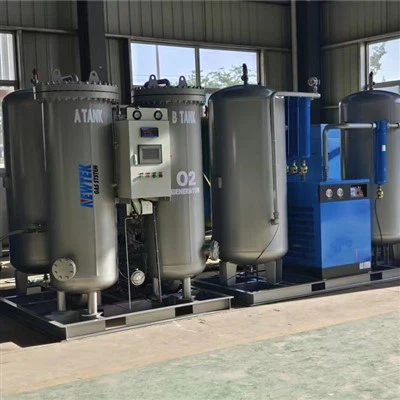
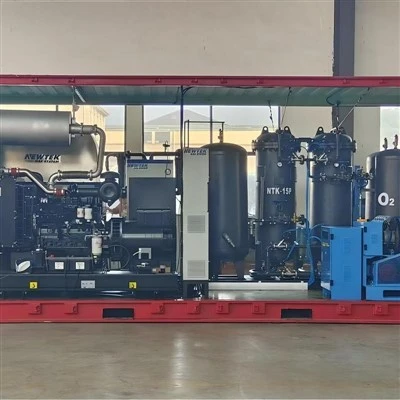
Molecular sieve pressure swing adsorption (PSA) gas separation and purification technology is a technology that has developed rapidly since the 1960s with the requirements of environmental protection and pollution control. Oxygen gas plants have been widely used in many industries such as steel production, gas industry, electronics industry, petrochemical industry, and medical and health care.
Working principle of PSA oxygen production technology
The basic principle of PSA is to use the difference in adsorption performance of nitrogen and oxygen in the air on zeolite molecular sieve (ZMS) due to different pressures. The adsorption capacity changes with the pressure. Under equilibrium conditions, the molecular sieve preferentially adsorbs nitrogen components. Under increased pressure conditions, the adsorption of nitrogen is higher than the adsorption capacity at low pressure. The desorption and regeneration of the molecular sieve is achieved by changing the operating pressure, that is, pressurized adsorption and depressurized desorption, thereby achieving oxygen and nitrogen separation.
The term "adsorption" was first proposed by Kayser in 1881, meaning the condensation of gas on a free surface. Adsorption is now strictly defined internationally as: the enrichment or loss of one or more components at the interface [8]. Pressure swing adsorption refers to the process in which a porous solid material contacts a fluid, a certain component or multiple components in the fluid accumulate on the solid surface, and the quantity and concentration of the fluid change through pressure change. The removal of components adsorbed on the surface of porous solids is called desorption or desorption process, which is the reverse process of adsorption. Through adsorption and desorption, the purpose of separating or purifying different components in the fluid can be achieved.
The core component of the oxygen production system is molecular sieve. At present, the commonly used adsorbent for small and medium-sized medical molecular sieve oxygen production equipment is ZMS. ZMS is a white particle made of zeolite as the main raw material and processed by special processing. It is a semi-permanent adsorbent. Pay attention to waterproofing during use, otherwise it will lose its adsorption effect. The commonly used adsorbent for PSA oxygen production is synthetic ZMS, among which the commonly used is zeolite molecules with a pore size of 5A, which is a polar adsorbent composed of cations and negatively charged silicon aluminum oxide skeletons.
Although oxygen and nitrogen are non-polar substances, they will produce induced dipoles under the influence of zeolite molecular sieves. There is an attraction (inductive force) between the induced dipole and the inherent dipole of polar molecules. Because the inductive force of nitrogen is greater than that of oxygen, the molecular sieve adsorbs much more nitrogen than oxygen. When air passes through the zeolite molecular sieve, nitrogen is preferentially adsorbed by the molecular sieve and enriched in its micropores, while only a small amount of oxygen is adsorbed, and most of it passes through the molecular sieve to become product gas. The oxygen is then filtered through the dust filter and the sterilization filter to obtain qualified medical oxygen. In order to obtain continuous and stable medical oxygen, the pressure swing adsorption oxygen production equipment is equipped with two adsorption towers to produce oxygen alternately. When one absorbs and produces oxygen, the other adsorber is in a regeneration state. The other component gases discharged by the regeneration are silenced and discharged to the outside through the muffler.
Hot Tags: oxygen gas plant, China oxygen gas plant manufacturers, suppliers, oxygen generat machin, oxygen gas manufacturing plant, oxygen gas generation plant, Oxygen Gas Plant, oxygen generator, o2 manufacturing plant