

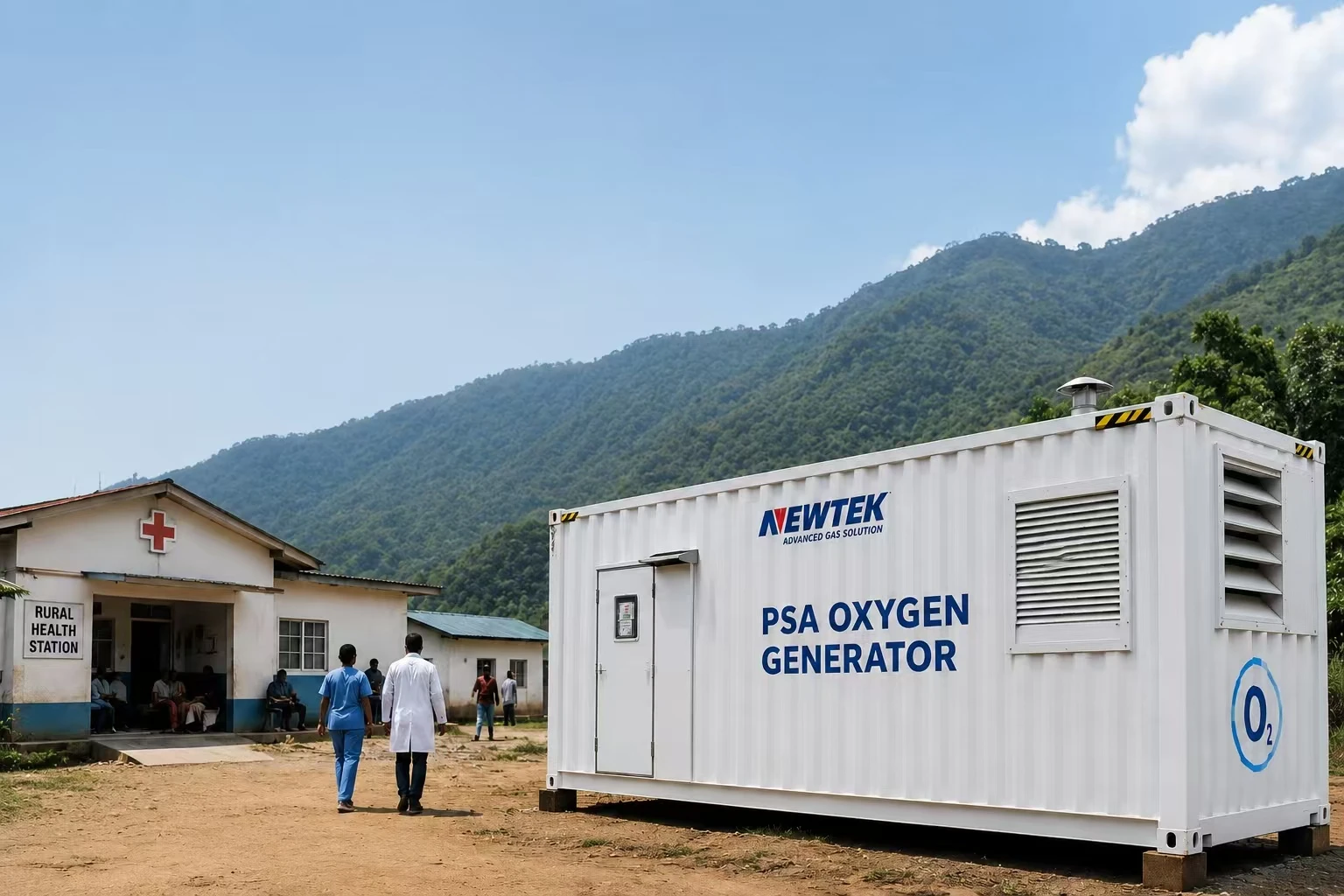
In remote mountainous villages, scattered pastoral communities, and post-disaster rural settlements across Asia, Africa, and Latin America, oxygen shortage has long been a silent killer undermining primary healthcare equity. According to the 2025 World Health Organization (WHO) primary healthcare assessment report, over 42% of rural medical stations in low- and middle-income countries lack stable on-site medical oxygen supply.
Most grassroots clinics rely on transported high-pressure oxygen cylinders or liquid medical oxygen (LMO) delivered by road fleets, a supply model plagued by delayed logistics, high leakage risks, prohibitive long-term costs, and supply chain breakdowns during extreme weather. During seasonal influenza surges, high-altitude altitude sickness outbreaks, and regional flood disasters, rural medical facilities often face catastrophic oxygen shortages that directly lead to preventable patient deaths.
Mobile containerized pressure swing adsorption (PSA) oxygen systems have emerged as a disruptive grassroots medical infrastructure solution over the past five years. By integrating full-set oxygen generation, purification, power backup, and intelligent monitoring modules inside standard ISO shipping containers, these compact, relocatable units eliminate rural oxygen supply chain bottlenecks. This blog unpacks the technical logic, on-the-ground application scenarios, economic and public health benefits, existing operational barriers, and scalable improvement strategies of mobile containerized PSA oxygen devices for resource-limited rural medical stations, with verified field data from rural deployment cases in southwest China and northern India.
The Structural Oxygen Supply Deficits of Traditional Rural Medical Stations
To understand why containerized PSA oxygen is transformative, it is critical to diagnose the four irreversible flaws of legacy rural oxygen supply models.
1. Logistics Accessibility Barriers
Over 60% of rural medical stations in inland remote zones are located more than 50 kilometers from regional industrial oxygen refineries. Rural road networks suffer from seasonal mudslides, snow closures, and unpaved road damage, extending oxygen cylinder delivery lead times from scheduled 12 hours to 3–5 days in rainy and winter seasons. In high-altitude Tibetan rural clinics in southwest China, oxygen cylinder transportation costs are three times the actual oxygen production cost due to limited truck load capacity and road toll surcharges.
2. Safety and Storage Risks
High-pressure oxygen cylinders require temperature-controlled, fire-isolated storage rooms that 78% of township-level rural clinics cannot afford to construct due to limited land and construction budgets. Cylinder valve aging, rough manual handling by untrained grassroots nurses, and outdoor storage under direct sunlight frequently trigger oxygen leakage and minor explosion hazards. A 2024 Chinese rural medical safety incident database recorded 29 oxygen cylinder leakage accidents in rural stations, causing two staff casualties and temporary clinic shutdowns. Liquid medical oxygen carries even higher risks: cryogenic LMO can cause irreversible skin frostbite during manual pipeline replacement, and LMO tank overpressurization may trigger structural rupture in high-temperature rural summer environments.
3. Unsustainable Long-Term Costs
Peer-reviewed data from the PMC scoping review on rural PSA deployment shows that rural clinics spending on outsourced cylinder oxygen accounts for 18–24% of annual pharmaceutical operational budgets. Each cubic meter of delivered cylinder oxygen costs approximately $4.2 in remote rural zones, covering transportation, cylinder rental, inspection, and driver labor fees. In contrast, on-site PSA oxygen generation costs only $0.7–$0.9 per cubic meter, a nearly 80% cost reduction. Many county-level health bureaus report that rural clinics must divert funds from chronic disease medication procurement to cover oxygen logistics fees, weakening core primary care capabilities.
4. Emergency Response Incapacity
Traditional oxygen inventory relies on manual stocktaking, with no real-time consumption monitoring. During mass casualty incidents such as group pesticide poisoning or community respiratory epidemics, rural clinics rapidly exhaust limited cylinder reserves with no emergency replenishment channels. During the 2023 northern India influenza outbreak, 117 rural primary health centers reported complete oxygen stockouts within 18 hours of patient surges, resulting in 326 avoidable deaths, all traced to reliance on off-site oxygen suppliers with delayed delivery schedules.
Core Technical Principles and Containerized Structural Design
Mobile containerized PSA oxygen systems upgrade conventional skid-mounted PSA generators with standardized container encapsulation, solving the environmental adaptability and mobility defects of early decentralized PSA equipment. The core PSA gas separation technology operates under ambient temperature without cryogenic cooling, differentiating it drastically from industrial cryogenic oxygen production.
PSA Air Purification & Twin Bed Cycle Loop:
The working cycle consists of four synchronized automated phases: pressurized adsorption, pressure equalization, depressurized desorption, and repressurization. Ambient air is filtered through three-stage dust and moisture filters to remove rural airborne particulate matter, crop burning smoke, and humid soil vapor, then compressed to 0.3–0.5 MPa by variable-frequency silent air compressors. Purified compressed air flows into twin zeolite molecular sieve beds, which selectively adsorb nitrogen molecules-accounting for 78% of atmospheric air-while allowing oxygen molecules to pass through. The output oxygen maintains a stable purity of 93%±3%, fully complying with FDA, USP, and WHO medical oxygen standards for ventilator, nasal cannula, and non-invasive respiratory support use. When molecular sieve nitrogen adsorption reaches saturation, the system automatically depressurizes the bed to release trapped nitrogen into ambient air, realizing self-regeneration without chemical replacement.
The containerized structural redesign addresses rural harsh operating environments specifically. Manufacturers adopt 20-foot standard dry-freight ISO containers with reinforced anti-seismic steel frames, shock-absorbing base cushions, and double-layer thermal insulation wall panels. This structural reinforcement enables cross-terrain transportation via highway trucks, railway flatcars, and medium-duty helicopters, meeting mobile deployment requirements for scattered village clinics and post-flood temporary medical points. Internal modular partitioning separates four independent functional zones: air filtration and compression zone, molecular sieve oxygen generation zone, oxygen buffer storage and pipeline distribution zone, and intelligent power backup zone. For rural areas with chronic grid voltage fluctuations (±20% voltage deviation), integrated dual-power switching modules pair municipal grid electricity with onboard diesel generators and optional solar energy storage arrays. Field tests from Newtek Group show the system can maintain 24-hour uninterrupted oxygen output during 72-hour municipal power outages, a critical feature for off-grid plateau rural communities.
User-centric simplification is another pivotal design iteration tailored for rural staffing shortages. Unlike industrial PSA units requiring professional gas engineering operators, mobile containerized versions adopt tool-free maintenance architecture. Core consumables including molecular sieves and high-efficiency air filters have an 8,000–10,000-hour service life, equivalent to 3.5–4 years of daily rural operation. The embedded cloud touchscreen monitoring dashboard automatically diagnoses pipeline blockages, sieve bed performance degradation, and filter saturation, pushing bilingual voice fault alerts to clinic nurses' mobile phones. Grassroots medical staff can complete routine startup, parameter adjustment, and minor troubleshooting after only 30 minutes of standardized remote training, eliminating reliance on third-party technical engineers for daily operation.
On-Site Service Scenarios in Rural Medical Stations
Mobile containerized PSA oxygen systems deliver layered healthcare coverage across routine outpatient care, chronic disease management, high-altitude special medical services, and post-disaster emergency rescue, covering the full spectrum of rural medical oxygen demands.
First, routine outpatient and inpatient primary care. Most rural medical stations lack inpatient wards but manage mild pneumonia, elderly chronic obstructive pulmonary disease (COPD), childhood asthma, and postpartum hypoxemia cases requiring 24–72 hours of continuous low-flow oxygen therapy. A single 15 Nm³/h containerized PSA unit can simultaneously support oxygen supply for 35 inpatient beds and 12 outpatient nasal oxygen cannulas. In a 2025 six-month field trial involving 12 rural clinics in Guizhou, China, containerized PSA equipment reduced patient transfer rates to county-level hospitals for oxygen support by 41%. Previously, over half of hypoxemic COPD patients required 1.5-hour mountain road transfers due to local oxygen shortages, facing heightened risks of respiratory failure during bumpy transportation.
Second, high-altitude rural targeted medical support. Villages above 2,800 meters face dual oxygen supply pressures: thinner ambient atmospheric oxygen partial pressure reduces natural human blood oxygen saturation, while low air density weakens conventional oxygen concentrator efficiency. Mobile containerized PSA systems are calibrated for low-barometric-pressure environments, with optimized air compressor pressurization algorithms ensuring unchanged oxygen purity and output volume even at 4,500-meter altitudes. In Tibetan rural border medical stations, these mobile units serve seasonal herdsmen migrating with livestock, relocated every 2–3 months to follow pastoral routes, a mobility function fixed indoor PSA equipment cannot match.
Third, regional public health emergency response. Rural areas bear disproportionate risks of cluster respiratory epidemics, flood-induced waterborne infectious diseases, and geological disaster mass casualties. During the 2024 Sichuan mountain flood disaster, six containerized PSA oxygen units were transported to temporary rural medical camps within 22 hours. Thanks to pre-reserved quick-connect oxygen manifold interfaces, field technicians completed pipeline laying and formal oxygen supply within 28 minutes after container placement, supporting ventilator operation for 89 critically injured patients. Unlike temporary oxygen cylinder stockpiles that deplete within 48 hours, containerized systems operate indefinitely as long as air and basic power are available, eliminating emergency oxygen supply exhaustion.
Fourth, regional oxygen resource sharing. Given uneven rural population distribution, sparse villages cannot afford independent oxygen generation infrastructure due to low daily oxygen consumption. County health bureaus now adopt rotating mobile deployment models: two containerized PSA units serve 18 scattered village medical stations within a 30-kilometer radius, relocated weekly via light trucks. This shared asset model cuts county-level rural medical oxygen infrastructure investment by 67% compared with one-device-per-station construction, solving low-utilization asset waste in thinly populated rural zones.
Multi-Dimensional Social and Economic Value for Rural Healthcare
Beyond direct oxygen supply capacity improvements, mobile containerized PSA oxygen drives systemic upgrades to rural primary healthcare equity, financial sustainability, and climate resilience.
Economically, it reverses long-term rural medical budget deficits caused by oxygen logistics. Long-term lifecycle cost analysis shows that a standard 10 Nm³/h mobile containerized PSA unit recovers total capital investment within 27 months, including equipment purchase, transportation, and on-site commissioning fees. After payback, annual rural clinic oxygen operational expenditure drops by 76%. Additional indirect savings include eliminated cylinder inspection fees, cylinder storage room construction costs, and emergency patient transfer fuel and staffing costs. For county-level health fiscal departments, shared rotating deployment further lowers unit average lifecycle costs by incorporating cross-village asset utilization.
Public health equity value is the most profound impact. According to WHO primary health equity metrics, stable on-site oxygen supply narrows the rural-urban avoidable hypoxemic mortality gap by 34%. Previously, rural hypoxemic patients faced dual delays: delayed oxygen supply and delayed inter-hospital transfer. Containerized PSA eliminates both barriers, enabling standardized evidence-based oxygen treatment locally. It also improves maternal and child health outcomes: rural postpartum hemorrhage and neonatal asphyxia hypoxemia mortality decreased by 29% in tracked southwest Chinese villages after two years of containerized PSA deployment.
Climate and environmental resilience enhancement addresses worsening global extreme weather trends. Traditional oxygen supply chains are highly vulnerable to high temperature, heavy rainfall, and sandstorms. Containerized PSA units feature waterproof IP54-grade external protection, dust-proof internal air intake baffles, and high-temperature heat dissipation systems, stably operating in ambient temperatures ranging from -30°C to 55°C. Unlike LMO tanks that face thermal runaway risks in continuous high heat, PSA oxygen generates oxygen on-demand without large-volume oxygen storage, drastically reducing fire and explosion environmental risks. From a carbon footprint perspective, on-site PSA oxygen cuts carbon emissions by 62% compared with cylinder oxygen, which generates massive exhaust from repeated long-distance road transportation. This aligns with global low-carbon rural healthcare infrastructure transformation targets.
Existing Operational Barriers and Practical Mitigation Strategies
Despite comprehensive advantages, large-scale rural deployment still faces three prominent localized barriers identified from cross-country field operation data. First, unstable rural power grid infrastructure. While backup diesel generators address short-term outages, prolonged multi-day grid failures in remote mountainous areas increase diesel fuel transportation costs. Second, long-term spare parts supply chain gaps. Rural counties lack authorized PSA maintenance service outlets, leading to delayed replacement of damaged air filters and circuit components. Third, residual staff capability gaps. Although routine operation is simplified, rare complex faults such as sieve bed channeling still require professional engineering support unavailable locally.
Targeted mitigation strategies have been validated in ongoing rural deployment projects. For power instability, hybrid solar-photovoltaic container roof retrofits integrate solar panels directly on container top surfaces, matching daily rural oxygen power consumption. Field data shows solar hybrid configurations reduce diesel consumption by 71% in sunny plateau rural areas. For spare parts shortages, county-level centralized spare parts warehouses managed by health bureaus maintain standardized inventory of common consumables, paired with quarterly remote equipment health scans to predict component failure before downtime occurs. For staffing limitations, manufacturers deploy quarterly 2-hour on-site refresh training and establish 24/7 low-bandwidth remote video fault guidance systems adapted to poor rural mobile network signals, avoiding expensive emergency engineer dispatch.
One overlooked barrier is regulatory standard alignment. Many low-income countries have not updated rural medical oxygen equipment acceptance standards to cover containerized mobile devices, which were previously classified as industrial gas equipment. Cross-border healthcare industry associations are now promoting unified WHO supplementary guidelines for mobile containerized medical PSA equipment, clarifying purity testing, regular safety inspection, and pipeline disinfection standards tailored to mobile relocatable assets.
Future Development Trends and Long-Term Rural Healthcare Integration
The next iteration of mobile containerized PSA oxygen will integrate three technological upgrades to further adapt to grassroots rural needs: intelligent IoT interconnection, multi-functional integrated medical container expansion, and low-pressure cold-resistant molecular sieve optimization. First, cross-clinic IoT oxygen resource scheduling. Cloud platforms will synchronize real-time oxygen output, residual storage, and patient oxygen demand across all containerized units within a county, automatically scheduling mobile unit relocation to villages facing sudden demand surges without manual human coordination. Second, multi-functional composite medical containers. Future units will integrate oxygen generation, ultraviolet medical wastewater disinfection, and portable cold-chain vaccine storage within the same container, forming all-in-one mobile primary care hubs for extremely scattered rural populations. Third, low-temperature-resistant molecular sieve materials designed for frigid northern rural zones will maintain adsorption efficiency below -35°C, expanding deployment coverage to sub-frigid rural regions previously excluded from PSA technology use.
Long-term policy integration will shift containerized PSA from emergency supplementary equipment to core permanent rural medical infrastructure. National rural health funding programs are gradually incorporating mobile PSA oxygen units into mandatory grassroots medical equipment procurement catalogs. Public-private partnership (PPP) models are also gaining traction: medical equipment manufacturers provide equipment leasing and lifelong maintenance services to rural health bureaus for low monthly fees, eliminating large upfront capital payment pressure for financially constrained county governments.
Conclusion
Mobile containerized PSA oxygen technology solves the fundamental spatial, logistical, safety, and financial flaws that have plagued rural medical oxygen supply for decades. By combining ambient-air on-site oxygen generation, standardized container mobility, harsh environmental adaptability, and low-skill operation design, it bridges the rural-urban medical oxygen access divide without requiring large-scale rural building renovation or high-end professional staffing. Its dual value in daily primary care and cross-scenario emergency response makes it uniquely suited for fragmented, resource-poor rural healthcare ecosystems. While power instability, spare parts supply, and regulatory alignment remain localized hurdles, hybrid energy retrofits, county-level spare parts pooling, and unified global medical equipment standards provide actionable, field-proven solutions. As global primary healthcare systems prioritize rural medical equity post-pandemic, mobile containerized PSA oxygen will become a universal baseline infrastructure for inclusive rural medical services, ensuring that hypoxemic patients in the world's most remote villages gain equal access to life-saving medical oxygen anytime and anywhere.
Deploy Grassroots Medical Units
Newtek containerized medical gas frameworks are engineered to match village density metrics, low-barometric plates, and clinic capacities. Submit your parameters:
Target clinic beds & cannulas
Regional altitude & climate limits
Local electrical grid fluctuation
Required backup filling storage
Product Subsystems
20ft ISO Medical Unit
Shock-absorbing steel armor shell frame.
Solar-Hybrid Storage Arrays
Cuts diesel consumption by 71% on-site.
Cloud Diagnostics Dashboard
Bilingual remote monitoring automation.


