Introduction
Many gold, copper, lead-zinc, lithium, and rare earth mining projects operate far from industrial gas production centers. In these locations, oxygen is often required for metallurgical processes, cyanide leaching circuits, wastewater treatment systems, smelting support operations, and emergency response facilities.
Unlike mines located near industrial zones, remote mining sites face additional challenges when sourcing oxygen. Long transportation routes, limited infrastructure, seasonal road access, and high logistics costs can significantly affect oxygen supply reliability and operating expenses.
For this reason, many mining operators are replacing delivered oxygen with on-site oxygen generation systems based on Pressure Swing Adsorption (PSA) technology.
However, selecting a PSA oxygen plant for a remote mine requires more than choosing a production capacity. Engineers must evaluate process demand, site conditions, power availability, environmental exposure, expansion requirements, maintenance capability, and deployment method before selecting equipment.
This article explains the key engineering factors involved in selecting a PSA oxygen system for remote mining projects.
1. Define the Actual Oxygen Consumption Requirement
Start with Process Oxygen Demand
The first step is calculating oxygen consumption at the process level.
Mining applications requiring oxygen may include:
· CIL gold recovery
· CIP gold recovery
· Oxidation reactors
· Ozone generation feed systems
· Wastewater treatment
· Smelting support operations
· Underground emergency systems
Each process consumes oxygen differently.
For example, a gold processing plant may inject oxygen into:
· Pre-leach tanks
· Leaching tanks
· Slurry pipelines
The required oxygen flow depends on:
· Ore throughput
· Slurry density
· Cyanide concentration
· Target dissolved oxygen level
Selecting equipment without determining actual process demand often results in oversizing or undersizing.
Calculate Peak Demand Instead of Average Demand
Mining operations rarely consume oxygen at a constant rate. Engineers should evaluate:
· Average oxygen demand
· Maximum oxygen demand
· Future expansion demand
For example: A mine consuming 300 Nm³/h average oxygen may experience peak consumption exceeding 450 Nm³/h during throughput increases or production optimization campaigns. System sizing should accommodate operational peaks rather than average conditions alone.
2. Determine Required Oxygen Purity
Different Mining Processes Have Different Purity Requirements
Not every mining application requires identical oxygen purity. Typical PSA oxygen systems produce 90%, 93%, or 95% oxygen purity.
For many gold leaching operations, oxygen concentration within this range is sufficient to increase dissolved oxygen levels in slurry. The selected purity should be based on:
· Process design
· Metallurgical testing
· Oxygen transfer efficiency
· Recovery targets
Higher purity generally requires lower production capacity from the same PSA system. Engineers must evaluate both purity and flow requirements simultaneously.
3. Evaluate Site Location and Logistics Conditions
Transportation Routes Influence System Selection
Remote mines frequently experience logistics constraints. Examples include: desert mining camps, mountain operations, arctic exploration projects, and island mining facilities. Transportation conditions influence equipment dimensions, delivery methods, and installation strategy. Before selecting a PSA plant, project teams should evaluate road width restrictions, bridge load limits, port facilities, and crane availability. These factors affect equipment configuration and shipment planning.
Assess Seasonal Accessibility
Some mines lose road access during snow seasons, monsoon periods, or flood conditions. If maintenance access becomes difficult during part of the year, system redundancy may become more important than minimum capital cost. In these situations, engineers often specify backup compressors, additional storage capacity, spare valve kits, and redundant instrumentation to reduce operational risk.
4. Consider Containerized Deployment
Why Containerized Systems Are Common in Remote Mines
Remote sites often lack infrastructure during early project stages. Constructing a conventional oxygen generation building may require concrete foundations, structural steel, roofing systems, and electrical rooms. These requirements increase construction complexity.
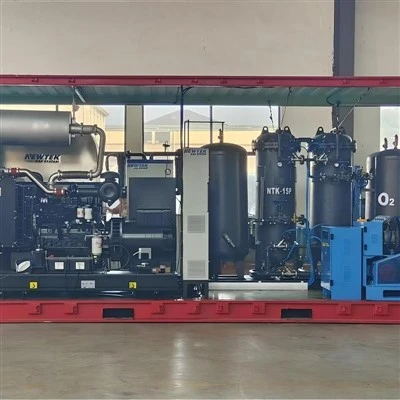
A NEWTEK Containerized Gas Solution integrates oxygen generation equipment inside an ISO container before shipment. The equipment typically includes: air compressor, air receiver, air dryer, filtration package, PSA oxygen generator, and PLC control system. The container acts as the equipment enclosure, transport frame, and weather protection structure.
Installation Requirements: Most containerized systems require: 1. Concrete foundation, 2. Power connection, 3. Oxygen pipeline connection, and 4. Commissioning. Compared with traditional plant construction, fewer field assembly activities are required. This can be particularly important in remote mining environments where construction resources are limited.
5. Evaluate Environmental Conditions
High Temperature Mining Regions: Mining projects in desert environments often experience ambient temperatures above 40°C, dust accumulation, and solar heat exposure. High temperatures affect compressor cooling, dryer efficiency, and electrical component life. Equipment should be selected with suitable cooling capacity and ventilation design.
Cold Climate Mining Operations: Mining projects in northern regions may experience sub-zero temperatures, snow accumulation, and frozen condensate risks. Air treatment systems must protect drain valves, instrument tubing, and compressor cooling circuits from freezing conditions.
Coastal Mining Sites: Mining facilities near ports may experience salt spray, humidity, and corrosive atmospheres. These conditions may require stainless steel tubing, corrosion-resistant coatings, and marine-grade fasteners to reduce long-term equipment degradation.
6. Evaluate Power Infrastructure & Maintenance
Electrical Availability Directly Impacts System Design
PSA oxygen plants rely primarily on air compressors, control systems, and air treatment equipment. Power requirements increase with oxygen production capacity. Engineers should evaluate utility power availability, generator capacity, voltage stability, and harmonic conditions before selecting equipment.
Generator-Powered Mining Camps: Many exploration projects rely on diesel generators. In these cases, oxygen plant design should consider generator loading, startup current, and fuel consumption to ensure compatibility with available power infrastructure.
7. Assess Maintenance Capability & Critical Components
Remote Mines Often Have Limited Technical Support. Maintenance teams at remote sites may not include PSA specialists. Equipment selection should therefore consider spare part availability, diagnostic accessibility, and instrument standardization. Systems using common industrial components can simplify maintenance planning. Critical components requiring routine inspection include:
| Component Group | Routine Monitoring & Inspection Parameters |
|---|---|
| Air Compressors | Monitor: oil condition, cooling systems, and air-end performance. |
| Filters | Inspect: pressure differential, condensate removal, and filter element condition. |
| PSA Valves | Check: actuator operation, seal integrity, and switching performance. |
| Oxygen Analyzers | Verify: calibration accuracy and sensor response. Routine maintenance prevents performance degradation. |
8. Plan for Future Expansion & NEWTEK Advantages
Mining Throughput Often Changes: Mining projects frequently increase processing capacity after commissioning. Examples include: mill expansions, additional leaching tanks, and increased ore throughput. If oxygen demand is expected to grow, engineers should evaluate expansion options during the initial design stage.
Modular PSA Designs Simplify Expansion: Many NEWTEK PSA Oxygen Plants use modular architecture. Expansion may involve: additional adsorption towers, larger storage vessels, and additional compressor capacity. This approach can increase oxygen production without replacing the entire system.
Why Many Remote Mines Select NEWTEK Containerized Oxygen Plants: A NEWTEK GROUP Containerized Oxygen Plant combines oxygen generation equipment, air treatment systems, storage vessels, and automated controls within a transportable enclosure. For remote mining projects, this configuration offers several practical advantages:
· Reduced field assembly requirements
· Simplified transportation planning
· Protection against dust and weather exposure
· Modular capacity expansion options
· Integration with CIL and CIP oxygen injection systems
Because oxygen is generated directly from ambient air, mines can reduce dependence on recurring cylinder deliveries and liquid oxygen transportation.
FAQ
What oxygen purity is typically required for gold leaching?
Most mining PSA systems operate between 90% and 95% oxygen purity, depending on process requirements and plant design.
Can PSA oxygen replace liquid oxygen at a mine?
Many mining operations use PSA oxygen as their primary oxygen source when production capacity is properly matched to process demand.
Is a containerized oxygen plant suitable for remote locations?
Yes. Containerized systems simplify transportation and reduce construction requirements at isolated mining sites.
How should oxygen capacity be sized?
Capacity should be based on peak process demand, future expansion plans, oxygen purity requirements, and operating reserve margins rather than average consumption alone.
Conclusion
Selecting a PSA oxygen system for a remote mining site requires a detailed evaluation of process oxygen demand, environmental conditions, power availability, logistics constraints, maintenance capability, and future expansion requirements. A properly sized NEWTEK PSA Oxygen Plant can provide continuous oxygen generation for CIL, CIP, oxidation, and other mining processes while reducing dependence on external oxygen deliveries. For projects located in deserts, mountains, islands, or other remote environments, NEWTEK Containerized Gas Solutions offer a deployment method that combines oxygen generation equipment and protective infrastructure within a single transportable package, simplifying installation and long-term operation.
Submit Project Parameters
If you are evaluating oxygen generation capacity for a remote mining project, provide the following configuration metrics:
Fish species / target ore type
Stocking density / milling throughput
Daily biomass / slurry processing scale
Water volume / retention loop timelines
Oxygen consumption target specifications
Available electrical power source data
Installation location environmental profiles
Mining Oxygen Infrastructure
Modular PSA Generators
Scalable dual-tower gas plant platforms.
Containerized Gas Solution
All-in-one pre-piped transportable enclosures.
Defensive Filter Upgrades
Protects internal sieves from aggressive dust loading.