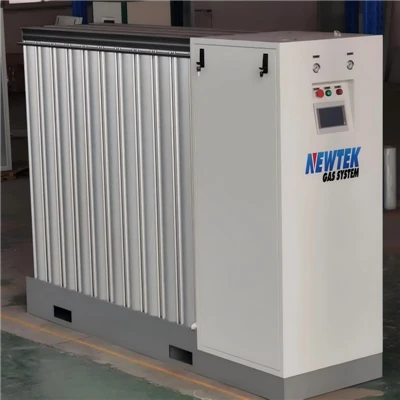
Delivered oxygen, supplied as liquid oxygen (LOX) or compressed gas, offers a relatively simple supply arrangement. It avoids the need to operate an oxygen generation plant and allows farms to obtain high-purity oxygen when required. However, recurring purchases, transportation charges, storage requirements, and delivery schedules can increase operating expenses, particularly for remote facilities with substantial oxygen demand. On-site oxygen generation provides another approach. Using Pressure Swing Adsorption (PSA) technology, a farm can produce oxygen from ambient air through an automated separation process. This reduces dependence on external gas deliveries but introduces equipment investment, electricity consumption, maintenance, and backup power requirements.
Neither option is automatically more economical for every fish farm. The financial outcome depends on oxygen demand, electricity tariffs, delivered oxygen prices, equipment utilization, transportation distance, and the expected operating life of the facility. A meaningful comparison must therefore consider total ownership costs rather than the purchase price of oxygen alone.
Oxygen Demand Determines the Economics of Fish Farming
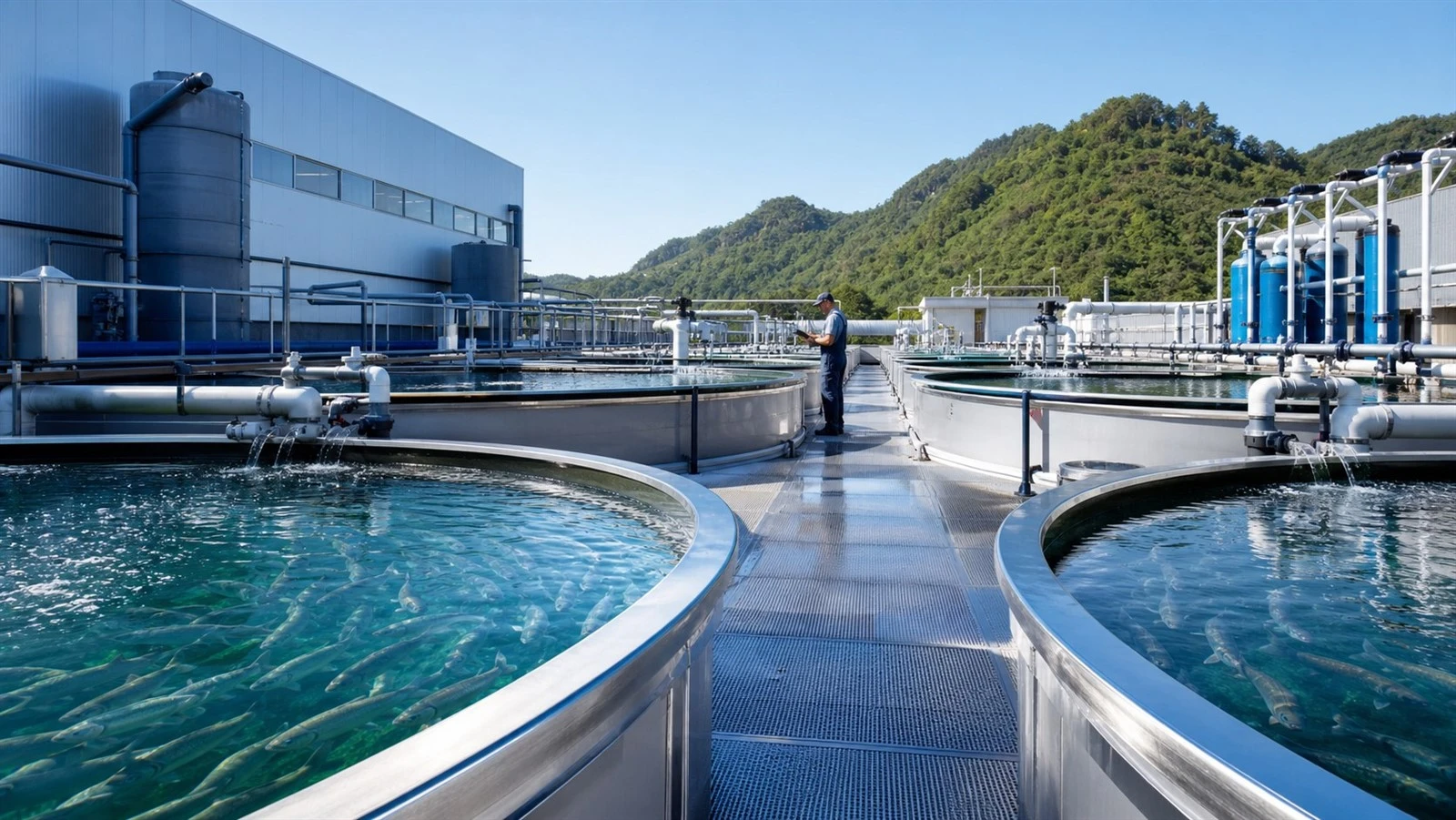
Before comparing supply methods, farm operators need to understand how much oxygen their production systems actually consume. Oxygen demand is not determined by pond area or tank volume alone. It changes with fish species, biomass, feeding intensity, water temperature, stocking density, and the efficiency of oxygen transfer into the water. In intensive aquaculture, fish consume oxygen continuously, while biological filtration systems in RAS facilities also require oxygen to support nitrifying bacteria that convert ammonia into nitrite and subsequently nitrate. Mechanical circulation, water treatment, and degassing processes can further influence the overall oxygen balance.
Several operating conditions can cause oxygen demand to increase:
- Higher stocking density: More fish within the same water volume increase total respiratory demand and reduce the available oxygen margin during supply interruptions.
- Intensive feeding: Fish metabolic activity increases after feeding, while biological treatment systems must process additional waste.
- Higher water temperature: Warm water holds less dissolved oxygen, while the oxygen requirements of some fish species increase with temperature and activity.
- Larger standing biomass: As fish grow, total oxygen consumption generally increases, requiring adjustments to supply capacity.
- Water treatment requirements: Biofilters and other biological processes consume oxygen independently of fish respiration.
Seasonal variation is particularly important. A farm may operate at relatively low oxygen demand during cooler months but require substantially more oxygen during warmer periods. Some aquaculture operations experience oxygen consumption levels during late summer that exceed twice their winter requirements. This variation affects equipment selection and procurement planning. A generator sized only for average demand may be insufficient during peak production periods, while sizing the entire plant for a short annual peak can leave expensive equipment underutilized for much of the year.
Farm operators should therefore establish three separate demand figures:
- Average oxygen demand: The normal daily requirement across the production cycle.
- Peak oxygen demand: The maximum requirement during high biomass, intensive feeding, and unfavorable water conditions.
- Emergency oxygen demand: The supply capacity required to protect fish during equipment failure, power interruptions, or unexpected changes in water quality.
These figures provide the foundation for comparing delivered oxygen with on-site production and selecting an appropriate supply capacity.
Delivered Oxygen: Lower Equipment Investment but Recurring Supply Costs
Delivered oxygen is commonly used by fish farms that require a dependable supply without investing in their own generation equipment. Larger facilities often receive oxygen as cryogenic liquid stored in insulated bulk tanks, while smaller operations may use compressed oxygen cylinders or other packaged gas arrangements. The main financial advantage is the relatively low initial investment in production infrastructure. Instead of financing air compressors, adsorption equipment, controls, and supporting treatment components, the farm purchases oxygen as needed.
However, the total cost of delivered oxygen includes several expenses beyond the quoted gas price.
- Oxygen purchase and transportation: The supplier determines the purchase price, while transportation costs depend on delivery distance, shipment volume, road access, and regional distribution infrastructure. Farms located far from industrial gas production facilities may face higher delivered costs. When oxygen demand is continuous, the farm must maintain an adequate delivery schedule and sufficient storage capacity. Delayed deliveries can create operational risks if available inventory is insufficient.
- Storage and handling: Bulk liquid oxygen requires specialized storage equipment, vaporizers, pressure regulation, and appropriate safety arrangements. Depending on the supply contract, storage tanks may be rented, leased, or purchased. Liquid oxygen also requires proper storage management because heat entering the vessel can cause some of the liquid to evaporate. Actual losses depend on tank design, insulation, operating conditions, and oxygen withdrawal patterns.
- Supply dependence: External delivery creates a relationship between farm operations and supplier logistics. The farm must coordinate orders, inventory levels, and delivery schedules. Weather disruptions, transportation problems, supplier capacity limitations, and regional shortages can affect continuity. Delivered oxygen also has an important technical advantage: liquid oxygen can provide very high-purity oxygen without requiring the farm to operate a separation system. It does not depend on the farm's electrical supply for the basic oxygen source, although downstream equipment used to distribute and inject oxygen may still require electricity.
For these reasons, delivered oxygen can be economically appropriate for farms with low or irregular consumption, limited technical personnel, or access to competitively priced local suppliers. Its main limitation is that oxygen remains a recurring operating expense. As production expands, the farm must purchase more oxygen, arrange more frequent deliveries, and potentially increase storage capacity. These expenses can become a substantial part of long-term production costs.
On-Site Oxygen Generation: Higher Initial Investment but Greater Cost Control
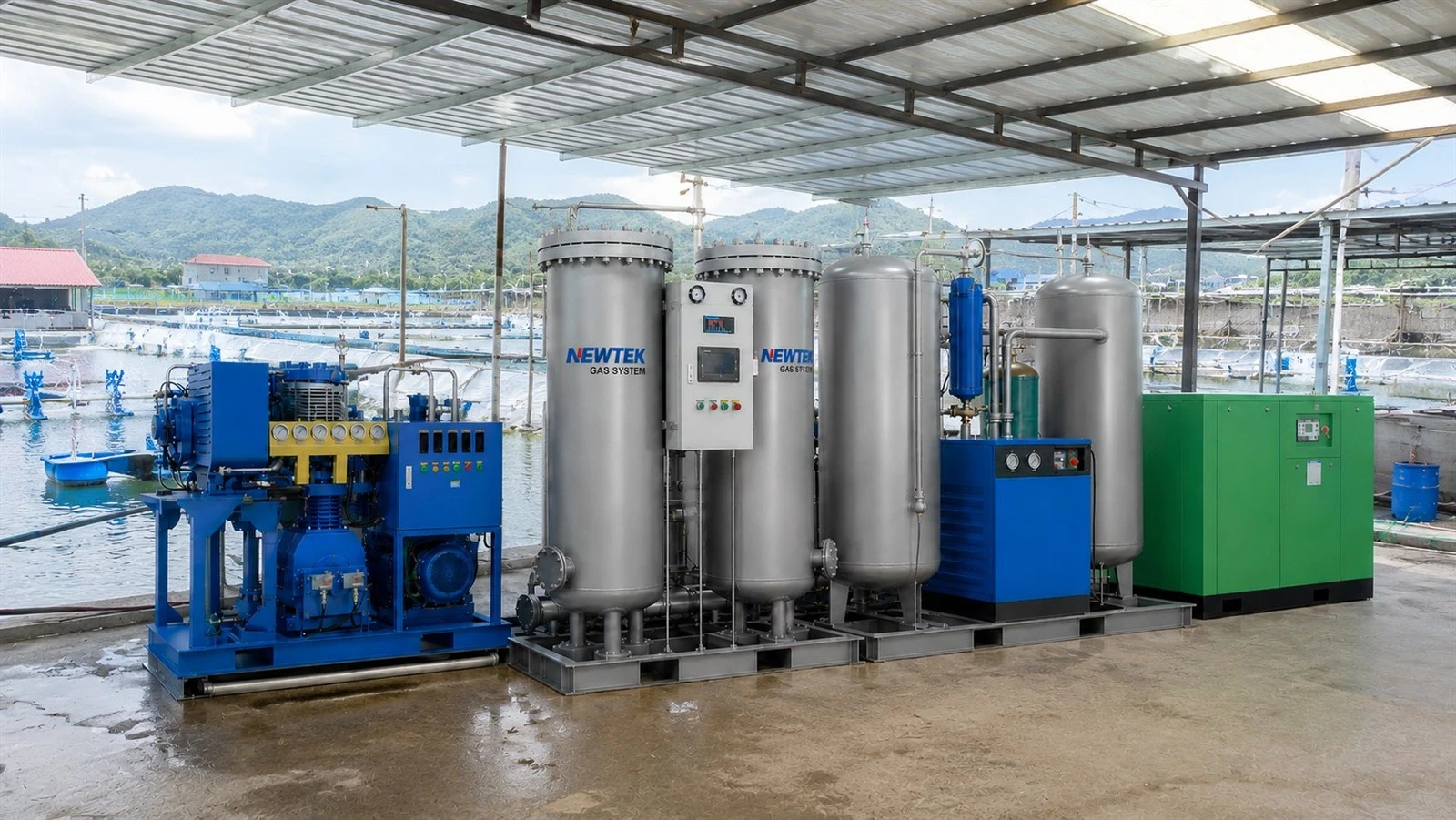
On-site oxygen generation changes the cost structure by replacing repeated oxygen purchases with an investment in production equipment and its supporting infrastructure. PSA technology is widely used for this purpose. The process separates oxygen from compressed ambient air through molecular sieve adsorption. The system generally uses two adsorption vessels operating alternately: one vessel removes nitrogen from the incoming air while the other undergoes regeneration. This continuous switching process produces an oxygen-enriched gas stream.
A typical PSA installation includes several interconnected components:
- Air compressor: Supplies compressed air at the pressure required by the adsorption process.
- Air treatment equipment: Removes moisture, oil, and particulate contaminants before the air reaches the molecular sieve.
- Adsorption vessels: Contain molecular sieve material that selectively adsorbs nitrogen.
- Oxygen buffer tank: Stores generated oxygen and helps stabilize downstream supply pressure and flow.
- Control system: Manages operating cycles, monitors pressure and operating conditions, and provides alarms.
- Distribution equipment: Transfers oxygen to fish tanks, oxygen cones, contactors, or other injection points.
The main economic benefit is that the farm produces oxygen from ambient air instead of purchasing every unit from an external supplier. Once the equipment is installed, the principal production expenses become electricity, maintenance, consumable components, and periodic replacement of relevant parts.
Electricity becomes the primary variable operating expense. PSA oxygen production requires electrical energy to operate compressors, valves, controls, and associated equipment. Electricity consumption depends on system capacity, operating pressure, oxygen purity, compressor efficiency, and actual operating conditions. For this reason, two generation systems with similar rated oxygen output may have different production costs. A farm located in a region with relatively inexpensive electricity may achieve a lower oxygen production cost than a facility operating under high industrial electricity tariffs. Compressor selection and air treatment efficiency also influence the total energy requirement.
Maintenance and component replacement must also be included in the financial assessment. Air filters, compressor components, valves, control instruments, and molecular sieve materials require appropriate inspection and servicing. Moisture contamination is particularly important because it can affect molecular sieve performance. Effective air drying, filtration, and operating condition monitoring help maintain stable oxygen output and reduce the risk of premature component deterioration.
Greater control over production schedules is another operational advantage. An on-site system allows oxygen production to follow the farm's operating requirements. Output can be planned around normal consumption, with buffer storage helping accommodate short-term differences between production and demand. This can reduce dependence on delivery schedules and improve supply planning. However, the system still requires reliable electricity, trained maintenance personnel, and an appropriate emergency supply arrangement.
Comparing the Total Cost of Ownership
The most useful way to compare the two oxygen supply methods is through Total Cost of Ownership (TCO). This approach considers the expenses incurred throughout the operating life of the system rather than comparing only the initial equipment investment or the price shown on an oxygen delivery invoice.
|
Cost factor |
Delivered oxygen |
On-site PSA generation |
|---|---|---|
|
Initial investment |
Generally lower |
Higher |
|
Oxygen purchase |
Recurring expense |
Not required for normal production |
|
Electricity |
Mainly for storage and distribution equipment |
Required for oxygen generation |
|
Transportation |
Recurring delivery costs |
Generally not required for normal production |
|
Storage |
Bulk tank or cylinder arrangements |
Oxygen buffer tank |
|
Maintenance |
Primarily storage and distribution equipment |
Compressor, filters, valves, controls, and adsorption components |
|
Supply dependence |
External supplier and delivery schedule |
Electricity and equipment availability |
|
Production flexibility |
Depends on purchased inventory |
Adjustable within system capacity |
|
Emergency planning |
Maintain sufficient stored oxygen |
Requires backup oxygen and power arrangements |
A complete financial assessment should include all expenses associated with each arrangement. For delivered oxygen, these include oxygen purchases, transportation, storage rental, handling, and delivery-related charges. For on-site generation, the calculation should include electricity consumption, routine maintenance, component replacement, equipment depreciation or financing, installation, and backup supply expenses. Comparing only the oxygen purchase price against the electricity cost of PSA production would underestimate the actual cost of both options.
An Illustrative Cost Comparison
Consider a hypothetical intensive fish farm that requires 500 kg of oxygen per day. Its annual oxygen requirement reaches 182,500 kg, based on continuous operation throughout the year.
Assume the farm evaluates two supply arrangements:
Delivered oxygen at an illustrative total cost of $0.30/kg, including relevant delivery charges.
On-site generation with an illustrative electricity requirement of 0.6 kWh/kg and an electricity tariff of $0.10/kWh.
The resulting annual costs are:
|
Cost item |
Delivered oxygen |
On-site generation |
|---|---|---|
|
Annual oxygen requirement |
182,500 kg |
182,500 kg |
|
Oxygen purchase cost |
$54,750 |
$0 |
|
Electricity cost |
Not included in oxygen purchase |
$10,950 |
|
Maintenance expenses |
Not included |
Not included |
|
Annualized equipment investment |
Not included |
Not included |
Illustrative assumptions only. These figures are not supplier quotations or guaranteed equipment performance. The delivered oxygen price includes assumed delivery charges. The on-site example excludes maintenance, backup arrangements, and annualized capital investment.
The initial calculation shows a difference of $43,800 per year before accounting for the additional expenses associated with on-site production. However, this is not the final financial saving. The generator must also be purchased, installed, maintained, and supported by an emergency oxygen arrangement.
The example demonstrates why electricity cost alone cannot determine the economic outcome. The investment becomes attractive when the accumulated difference between purchased oxygen expenses and on-site production expenses is sufficient to recover the initial capital expenditure.
Understanding the Break-Even Point
The break-even point is the level of oxygen consumption at which the financial benefits of on-site production offset its additional investment and operating expenses. Farm operators should compare the annual cost of delivered oxygen with the combined annual costs of electricity, maintenance, equipment investment, and backup supply.
Several factors influence how quickly a farm reaches this point:
- Annual oxygen consumption: Higher and more consistent demand generally allows the equipment investment to be distributed across a larger volume of generated oxygen.
- Delivered oxygen prices: Higher purchase and transportation costs improve the relative economics of on-site production.
- Electricity tariffs: Higher electricity prices increase the operating cost of PSA generation and can extend the investment recovery period.
- Equipment utilization: Systems operating near their practical designed capacity generally distribute fixed investment costs more efficiently than oversized systems with low utilization.
- Equipment service life: A longer useful operating period provides more time to recover the initial investment, provided maintenance and replacement costs remain manageable.
The financial comparison should also account for differences in oxygen purity, pressure, transfer efficiency, and actual oxygen utilization. Comparing one kilogram of purchased liquid oxygen directly with one kilogram of PSA-produced oxygen without considering these differences can produce misleading results.
Which Oxygen Supply Method Is More Suitable for Different Fish Farms?
The economic suitability of each supply method depends on the farm's production scale, operating schedule, location, and technical infrastructure. Rather than applying one solution to every facility, operators should match the oxygen supply arrangement to their actual consumption patterns.
Small fish farms with low oxygen demand
For small farms, delivered oxygen may be more economical because the initial investment in a complete generation system can be difficult to recover. If oxygen consumption is relatively low or intermittent, purchasing oxygen as needed avoids the fixed costs associated with maintaining generation equipment. This arrangement can also be suitable for farms without dedicated technical personnel to maintain compressors, air treatment equipment, and automated controls. However, operators should evaluate cylinder replacement frequency, delivery charges, and the availability of local oxygen suppliers before making a decision.
Medium-sized farms with regular oxygen consumption
Medium-sized farms often face a more balanced decision. If oxygen demand remains relatively stable throughout the production cycle, on-site PSA generation may reduce recurring procurement expenses. The economic advantage becomes more significant when delivered oxygen prices are high or transportation distances are substantial. However, farms with considerable seasonal fluctuations should avoid selecting equipment solely according to maximum theoretical demand. A practical approach is to size the generation system around the normal operating load and use buffer storage or supplementary oxygen to accommodate temporary increases.
Large intensive fish farms and RAS facilities
Large farms generally have greater opportunities to benefit from on-site production because their continuous oxygen requirements can support higher equipment utilization. In RAS facilities, oxygen is required not only for fish respiration but also for biological filtration and other water treatment processes. These ongoing requirements can create a relatively stable demand profile. When annual oxygen consumption is high, reducing the recurring cost of delivered oxygen can offset the capital investment in generation equipment. Large farms should also evaluate multiple generation units rather than relying entirely on one large machine. A modular configuration can provide operational flexibility, facilitate maintenance, and allow production capacity to follow changes in demand.
Remote fish farms with limited delivery access
Geographical location can substantially change the economics. A farm located near an industrial gas distribution network may obtain competitive oxygen prices and frequent deliveries. A remote farm may face higher transportation expenses, longer delivery intervals, and greater inventory requirements. In these circumstances, on-site generation can become economically attractive even when the farm's oxygen demand is not particularly high. Nevertheless, remote operations must also consider electricity reliability, spare parts availability, technical support, and emergency oxygen storage. Reducing dependence on oxygen deliveries does not eliminate the need for contingency planning.
Why a Hybrid Oxygen Supply Strategy Can Be More Economical
For many intensive fish farms, the decision does not need to be limited to choosing either delivered oxygen or on-site generation. A hybrid arrangement combines on-site oxygen production with an external oxygen supply for backup and additional demand. Under this configuration, the generation system handles the normal operating load, while stored liquid oxygen provides supplementary capacity during maintenance, equipment failure, power interruptions, or seasonal production peaks.
This arrangement offers several economic and operational advantages:
- Reducing dependence on purchased oxygen: When on-site production supplies the majority of daily demand, the farm purchases less oxygen from external suppliers. This can reduce transportation expenses, inventory turnover, and exposure to changes in delivered oxygen prices.
- Avoiding oversized generation equipment: Installing a generator large enough to handle every short-duration peak can increase capital expenditure. A supplementary oxygen source allows operators to size the generation system closer to normal operating requirements, improving equipment utilization and reducing unnecessary investment.
- Maintaining supply during equipment maintenance: PSA systems contain mechanical and electrical components that require periodic servicing. During maintenance, an external oxygen source can maintain supply without requiring the farm to suspend normal operations.
- Improving emergency preparedness: Oxygen is a critical input in intensive aquaculture. A power failure or interruption in oxygen production can quickly create dangerous water conditions, particularly in high-density tanks. A hybrid system can provide an additional protection layer, provided that the backup supply has sufficient capacity, automatic changeover arrangements, and enough stored oxygen to cover the expected emergency period.
The hybrid approach is particularly relevant to farms where oxygen demand fluctuates significantly or where uninterrupted supply is essential to protect valuable fish stocks. Rather than investing in generation capacity that remains underutilized during normal operations, farm operators can combine a suitably sized PSA system with supplementary oxygen storage.
Key Factors to Evaluate Before Investing in On-Site Oxygen Generation
A favorable operating-cost comparison does not automatically mean that a generation system is suitable for a particular farm. Several technical and financial conditions must be evaluated before equipment selection.
Actual oxygen demand and production schedule
Historical oxygen consumption records provide a more reliable basis for equipment sizing than estimates based solely on tank volume or planned production capacity. Operators should analyze daily consumption, seasonal variations, biomass growth, feeding schedules, and expected expansion. The selected system must accommodate normal operating requirements without creating excessive unused capacity.
Electricity tariffs and power reliability
Electricity is a major variable expense in PSA oxygen production. Farms should calculate generation costs using their actual industrial electricity tariffs, including demand charges where applicable. Power reliability is equally important. A facility with frequent outages may need standby generators, uninterruptible power supplies for control equipment, and automatic backup oxygen arrangements. These additional investments should be included in the economic assessment.
Oxygen purity, pressure, and flow requirements
Different aquaculture systems have different oxygen delivery requirements. An oxygen supply arrangement must provide the required flow and pressure at the actual injection point. The oxygen purity must also be compatible with the farm's oxygen transfer equipment and operating conditions. For example, oxygen cones, fine-bubble diffusers, and low-head oxygenation devices do not necessarily operate under identical pressure and flow conditions. Equipment selection should therefore consider the complete oxygen delivery process rather than the generator's rated output alone.
Oxygen transfer efficiency
Producing oxygen is only one part of the process. The oxygen must also transfer efficiently into the culture water. Poorly designed injection arrangements can increase gas losses and require additional oxygen production to maintain the same dissolved oxygen level. Farm operators should evaluate contact time, water flow, operating pressure, diffuser design, and gas utilization efficiency. Improving oxygen transfer can reduce the amount of oxygen that must be purchased or generated.
Maintenance and technical support
A PSA installation requires appropriate air treatment, compressor servicing, filtration, and inspection of the adsorption system. Before purchasing equipment, operators should identify the availability of replacement parts, local maintenance capabilities, service intervals, and expected component replacement costs. These factors are particularly important for remote farms where equipment downtime can create immediate production risks.
Future expansion requirements
A fish farm may increase production capacity through higher stocking density, additional tanks, or expanded water treatment facilities. The oxygen supply system should accommodate realistic expansion plans. Modular generation arrangements can provide additional capacity without requiring a complete replacement of the original installation. However, expansion should be based on projected oxygen demand rather than simply increasing the rated capacity of the generation equipment.
Conclusion
On-site oxygen generation and delivered oxygen serve different economic and operational requirements in fish farming. Delivered oxygen offers lower initial investment, high purity, and relatively simple operation. It can be suitable for small farms, facilities with irregular consumption, and operations with convenient access to competitive oxygen suppliers. On-site PSA generation requires greater capital investment and ongoing electricity consumption, but it can reduce recurring oxygen procurement expenses for farms with continuous demand, particularly when delivery costs are high or supply logistics are difficult.
For large intensive farms and RAS facilities, a hybrid arrangement can offer another practical approach by using on-site production for normal consumption and delivered oxygen for emergency backup and peak demand. The final decision should be based on annual oxygen consumption, delivered oxygen prices, electricity tariffs, equipment utilization, maintenance expenses, and backup requirements. By evaluating these factors together, fish farm operators can identify the supply arrangement that provides an appropriate balance between production cost, operational reliability, and long-term investment.