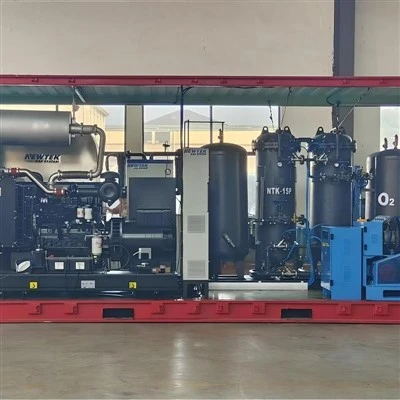
Modular PSA medical oxygen production equipment eliminates the economic pressure caused by the need to order oxygen cylinders and the uncertainty caused by the transportation of oxygen cylinders, and realizes efficient on-site oxygen production and modular detachable design to adapt to multiple medical scenarios such as medical rescue, wild area hospitals, and large medical rescue institutions.

Technical Principles and Core Processes
PSA (pressure swing adsorption) oxygen production technology is based on the highly selective adsorption characteristics of molecular sieves for nitrogen. It separates oxygen and nitrogen in the air through a pressurized adsorption-decompression desorption cycle, and produces medical oxygen with a purity of 93%±3%. As the core material, the pore structure and adsorption performance of molecular sieves directly affect the separation efficiency. Currently, lithium-based molecular sieves are used as the mainstream, and the nitrogen-oxygen separation ratio can reach more than 200:1. The modular design divides the system into independent units such as compressed air pretreatment, adsorption separation, and intelligent control, with the following advantages:
Rapid deployment and elastic expansion: supports single-unit to multi-unit parallel connection, adapting to different oxygen supply needs from grassroots clinics to tertiary hospitals. When expanding capacity, only modules need to be added instead of reconstructing the system.
Fault isolation and operation and maintenance cost reduction: The modules operate independently, the faulty modules can be replaced online, and the downtime is reduced by more than 60%; the standardized interface design reduces the complexity of spare parts management.
Energy efficiency optimization: Compared with the cryogenic method, energy consumption is reduced by 30%-50%, and there is no risk of high-pressure container storage, which meets the green and low-carbon transformation needs of medical institutions.
Application in medical scenarios and clinical adaptability
Intensive care and emergency treatment: Provide 24-hour stable oxygen source for ICU and emergency department, support treatment of critical illnesses such as respiratory failure and cardiogenic shock, and built-in oxygen concentration sensor to monitor purity deviation (±2%) in real time.
Integrated oxygen supply in operating room: Seamless connection with anesthesia machine and ventilator through multi-level pressure regulation module to ensure continuous oxygen supply for long-term surgery and avoid the risk of supply interruption of liquid oxygen storage tank.
Hyperbaric oxygen therapy synergy: The output pressure can be adjusted in the range of 0.2-0.6MPa, and it can be linked with hyperbaric oxygen chamber to treat carbon monoxide poisoning, trauma repair and other diseases, and increase blood oxygen partial pressure to more than 3 times the physiological threshold.
Special environment adaptation: In view of the problem of insufficient oxygen partial pressure in plateau areas (altitude > 3000 meters), the adsorption cycle algorithm is optimized to ensure the stability of oxygen concentration; the seismic design meets the needs of scenarios such as mobile medical vehicles and field hospitals.
Industry ecology and key technology evolution
Market size and regional growth: The global medical PSA oxygen concentrator market has an annual compound growth rate of 8.2%. The Chinese market has benefited from the upgrade of primary medical equipment and the new infrastructure policy, with a growth rate of 12.5%, and the scale will exceed 4.5 billion yuan in 2024.
Intelligent control: Integrated IoT remote monitoring system, real-time analysis of parameters such as molecular sieve adsorption efficiency and humidity changes, AI algorithm dynamically optimizes the adsorption cycle, and oxygen production efficiency is increased by 15%.
Material innovation: Hydrophobic molecular sieve coating technology reduces humidity sensitivity, and the three-stage filtration system (oil removal, dust removal, cold drying) extends the life of the molecular sieve to more than 8 years.
Standards and compliance: It must comply with YY 0732-2018 "Safety Requirements for Medical Oxygen Concentrators" and ISO 13485 quality management system. Export products must pass FDA 510(k) certification to ensure clinical safety and international mutual recognition.
Industry Challenges and Breakthrough Paths
Technical bottlenecks: Molecular sieve performance attenuation (annual average efficiency decreases by 1.5%-2%) and decreased adsorption capacity in high humidity environments (efficiency decreases by 20% when >60%RH) restrict equipment reliability, and composite adsorbent materials need to be developed.
Cost game: The initial investment of modular equipment is 30% higher than that of traditional models, but the operation and maintenance cost of the entire life cycle is 25%-30% lower. It is necessary to reduce manufacturing costs through supply chain localization (such as domestic molecular sieves replacing imports).
Clinical customization needs: Develop special models for neonatal department (flow accuracy ±0.1L/min) and respiratory chronic disease management (dynamic adjustment of oxygen concentration) to improve clinical adaptability.
Future development trends
Multimodal oxygen supply system: Linked with electronic medical records and intelligent ventilators, a closed loop of "oxygen production-oxygen delivery-blood oxygen monitoring" is constructed to achieve personalized oxygen therapy solutions.
Emergency medical penetration: Mobile modular equipment equipped with energy storage batteries and photovoltaic power supply will increase to 35% in disaster relief and medical points in remote areas.
Carbon neutrality path: Excess pressure recovery power generation technology, green electricity driven compressor and other solutions can help medical institutions reduce their carbon footprint by more than 40%.
I need to buy
Want to know more about the parameters, specifications and advantages of medical oxygen generators? Click the module below to get FREE knowledge.
To purchase, please click ►I need a free quote.